A new development in Washington, D.C. features the largest "shared space" in the United States.


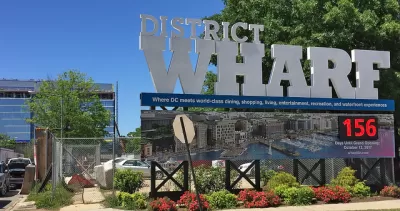
The Wharf, a new mixed-use development in southwest Washington, D.C., features a "shared street." At 60 feet wide and several blocks long, the right-of-way is carefully designed to allow vehicular traffic while favoring pedestrians. Although the development has only been open for a short time, the street is performing as expected.
Designed by Stan Eckstut of Ehrenkrantz Eckstut & Kuhn, the street is carefully calibrated to be pedestrian-friendly first and foremost. Vehicles are somewhat restricted thought not forbidden. A benefit of little traffic on Wharf Street is it allows for truck deliveries,
Wharf Street includes an array of street furniture, granite bollards, stripes of pavement and other design features visibly make the pedestrian at home and discourage vehicle speed. The street is even served by a cycletrack.
Even alleys that branch off Wharf Street are pedestrian-friendly. Blair Alley runs between an apartment building and an office building and provides truck docks for both buildings. Nearby Water Street acts as an alley, even hosting a scattering of shops. And like Blair Alley, Water Street provides a meaningful pedestrian connection to the waterfront.
Read the full story: A Radical Mixing of Cars and People Works as Planned


Designing for Dementia
Subtle design interventions can facilitate safe navigation in urban environments for people with cognitive abilities effected by dementia.
Has Washington, D.C. Finally Figured Out the Waterfront?
Looking back to evaluate the potential of the present.
D.C.'s Wharf Makes the City's Housing Problems Worse
Did The Wharf, a new mixed use mega project in Washington, D.C., deliver enough public benefit to warrant its large public subsidy?

Planetizen Federal Action Tracker
A weekly monitor of how Trump’s orders and actions are impacting planners and planning in America.

Colorado’s Largest Data Center Could Rise Next to Homes — Without a Public Hearing
The proposed campus would consume 11 times the power of Denver International Airport; as it has across the country, opposition mounts.

US to reduce Colorado River water deliveries to Mexico
A new Colorado Treaty amendment reduces Mexico’s Colorado River water allocation by 250,000 acre feet.

'This is going to be painful:’ Virginia stares down $1.7 billion funding gap for highway maintenance
The state may address the deficit by shifting $290 million from its construction budget to maintenance projects.

Judges permit Denver to divert 77,000 acre feet from the Colorado River for reservoir expansion
Overuse and climate change have caused the Colorado River’s water levels to plummet.

Amtrak, CN end decades-long dispute with eight-year agreement
The new operating agreement establishes an updated framework for the companies to work together, including processes to resolve disputes.

FREE Course: Walkable City 1: Why Walkability?
After describing his path towards focusing on walkability as the essence of good planning, Jeff Speck marches through his five principal reasons for making more walkable places.
Reinventing Malls: Planning Alchemy—Turning Gray Fields Into Gold
The course focuses on the opportunities and imperatives that shape reinvention of mall sites.

KFH Group Inc.
Greater Baltimore Committee
Eagle County Government
The Architects Foundation
University of Cincinnati Online
The Pocatello Development Authority
The Urban Renewal Agency of the City of Pocatello