Artists made San Francisco what it was. They might just be the key to its future.


Throughout the 20th century, brand-new forms of art emerged from San Francisco nearly every decade. As the century began, Honkytonk jazz entertained sailors — and pirates — on the Barbary Coast. Dashiell Hammet launched a new age of mystery fiction in the Tenderloin in the 1930s, and in the 40s, the Fillmore became Harlem of the West. Then Diebenkorn and others brought us the Bay Area Figurative Painters, and the Beat poets of North Beach stunned world literature. The Grateful Dead, Jefferson Airplane, and others made the Haight the global epicenter of rock, while Latin rock bands like Santana emerged in the Mission. Punk exploded in the ‘70s. Soon thereafter, the abandoned industrial sites South of Market birthed machine art, like Survival Research Laboratories’ Robot Wars, and performance art of all kinds.
Rent was cheap and the environment incomparably inspiring. The city vibrated with creative energy.
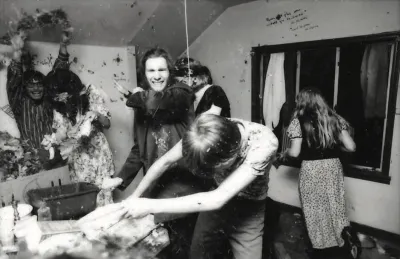
The last new global art movement to come from San Francisco was Burning Man at the Black Rock Desert. For a decade it was planned in my huge, semi-derelict Edwardian flat in the inner city.
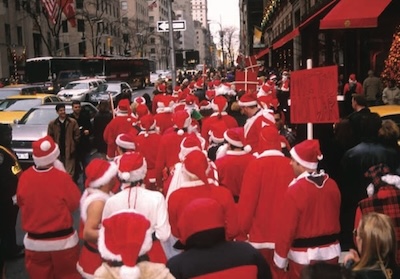
In that flat full of artists, tech found talent for the creation of computer graphics. The Cacophony Society launched globally favored events like SantaCon. And my own Cacophony event, The Marcel Proust Support Group, produced the first serial publication on the Web — “Proust Said That” — credited with launching the international Proust revival.
The unleashed creative energy in the city was palpable in those years and profoundly attractive. It was only a matter of time before others would want to be here, where that creative stimulation was, and rents soon began the rapid climb to unaffordability.
San Francisco’s “doom loop”
San Francisco is the poster child of rapid gentrification and the chaotic crisis of affordability that devastated the city’s arts community. As Silicon Valley moved north to the city, the cost of living skyrocketed to match tech industry salaries. Very soon, working artists were priced out. Their departure went unnoticed by politicians and policy makers; there was still plenty of art in galleries, touring musicians and theater companies, books published, and films made. No one seemed to notice that the local creators were mostly gone.
In 2017, the Arts Commission surveyed 600 San Francisco artists and found that nearly three quarters of them had already left or were planning to leave soon. Many had left long before 2010. When the pandemic shut the city down, almost all the sources of artists’ income stopped abruptly, further increasing the diaspora. Landlord policies now prohibit their return — many demand paystubs that people in the gig economy don’t have.
The media has dubbed San Francisco’s situation a “doom loop”: thousands of empty residential units, struggling commercial corridors, a dead downtown, and a glut of soulless high-rises, many of which are empty. Pundits point fingers at why the city is losing population dramatically, citing homelessness as a central issue. But we’ve had plenty of unhoused people here since the ‘70s, when globalization shut down thriving industrial facilities South of Market, leaving the paycheck-to paycheck workforce without jobs, homes, or funds for relocation. Just like today, the population experiencing homelessness was locals.
We still have a significant homeless population. The two things we don’t have any longer are genuinely affordable housing and the huge community of artists that made the city so charming in the 20th century.
The artist as asset
It’s no secret to urban planners that an uninteresting neighborhood becomes far more appealing when there are murals, art installations, or other colorful additions. Every planner from San Francisco to Berlin has watched as each run-down neighborhood where artists lived and worked became fashionable and gentrified — the former residents replaced with murals or other visual stimulation. However, a colorful mural soon fades into the landscape. Artists, on the other hand, are a constant source of something new to pique the imagination. In a society where novelty is of paramount importance, creators make ideal neighbors.
What seems to escape notice, however, are the invaluable benefits that artists themselves, not just their products, bring to the social fabric.
For decades, psychologists have studied the correlation between the arts and mental health — beyond just the passive enjoyment of visiting a museum or going to a concert. Classes, art therapy, open studios, jam sessions, and authors’ events give people access. Thousands of people in the Burning Man community volunteer every year to help build enormous sculptures or art cars, which creates feelings of agency, as part of making something amazing. The NIH’s medical library contains 900 publications that report on how art experiences heal, breaking findings down into diverse categories: fostering pro-social behaviors, reducing loneliness and isolation, facilitating mother-child relationships and educational development, encouraging healthier habits, and improving well-being, to name just a few.
An English study followed a huge sample for more than a decade and found that people who are regularly exposed to art, simply as observers or participants, live longer than people who aren’t. In times when our collective mental health is seriously challenged, the presence of people whose creativity heals seems more essential than ever.
Besides contributing to the city’s beauty, mental health, and cultural stimulation, artists are an asset to the business community. Since artists provide constant stimulation, people are drawn to wherever they have a public face, bringing foot traffic that supports small businesses around them. It also encourages opening of new businesses that attract a similar clientele. The transitory years of innovative rock music on Haight Street ended, but the businesses that opened to celebrate those years are still open, decades after the musicians were gone.
Tourism benefits from fandom travelers, but no tourist demographic is more lucrative than art tourism, whose patrons support the grand hotels and restaurants of cities like San Francisco. That kind of tourism is significantly diminished here, along with the legions of creators that once made San Francisco an international center of artistic innovation.
But consider the artist’s life in America. They live to produce things that people love, a process that can take years to fully develop, without the stipends and housing options they’d have in any European country. They deal with real life — housing, jobs, laundry, relationships — while most of their attention goes into creating what pleases and heals. To thank them, San Francisco landlords turn them away, and the city offers few options. Tiny stipends have recently been made available, but only if applicants live in certain zip codes. Artists clinging to long held, rent controlled housing in “nice” neighborhoods don’t qualify.
So here’s my pitch for San Francisco, and every other city and city planner out there facing a doom loop of their own: Stop just installing art — and start installing artists.
Artists in the planner’s toolkit
For planners working to revitalize a neighborhood or commercial corridor, providing artists with housing and venues there offers an immediate draw for visitors and other businesses. Where artists go, people want to go. Installing artists activates spontaneous growth around them, simplifying the challenge for planners.
When creating space for people in the arts, big budgets for new buildings aren’t necessary: creators like sculptors, painters, or artists who work with machine tools prefer existing older spaces where damage is less problematic than in pristine new construction. Cities can do this cheaply, using eminent domain to acquire abandoned buildings and engaging artists to renovate their own housing. The landlord is the city, rents bolster city coffers, and an unused property becomes a cultural hotspot. Win-win.
Kultur Räume Berlin offers publicly funded artist space in older buildings throughout the city
Planners considering how to revitalize empty financial districts as workers increasingly opt to work from home can collaborate with building owners and musicians to turn empty ground floor commercial spaces into concert venues or clubs. Upper floors can become musicians’ housing. Since these districts are mostly empty at night and have few residents, noise is not an issue and parking spaces are plentiful. Also, most cities with sizable financial districts have considerable public transportation routed to them. The former director of San Francisco’s Office of Economic and Workforce Development called this idea “awesome.”
Planners working in cities with intentional entertainment districts may find that concentrating entertainment in one place can be problematic for traffic and parking. Creating artists’ venues elsewhere in the city for performances or events diffuses the crowding of a centralized location.
If a city has an area where there’s social unrest, bringing artists into the community distracts in a psychologically healing way. While it may not solve the problems behind the unrest, enjoyment of the creative experience facilitates lowering stress and finding solutions, building what psychologists call “social cohesion.”
The same imagination that makes art can also drive urban planning. Planners and artists should, in fact, make inspired collaborators. Wherever a planner might want to direct public attention, the placement of artists attracts it. The practical can become whimsical. An empty lot can become a sculpture garden, a thing of beauty. The possibilities are endless.
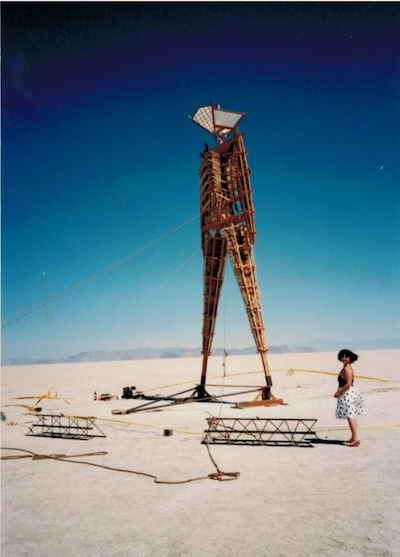
My artist friends and I had the extraordinary pleasure of building the kind of city we wanted to live in, in the most inhospitable empty space in North America: Nevada’s Black Rock Desert, where we took the Burning Man every year. It was a joyous exercise in serious play that grew exponentially, with continually more fantastic art installations. Black Rock City is now, a few weeks around Labor Day, the third largest city in Nevada. The only city built by artists for themselves is art therapy on steroids, replicated annually in 100 countries worldwide. If artists can do this in the middle of nowhere, starting with no capital, imagine what they could do in a city with plumbing. My nonprofit, ArtHouse, wants to provide co-op housing and venues for artists of all kinds, everywhere in San Francisco, to do just that. The question is, who wants to join us?

How a San Francisco Land Trust is Preserving Affordable Housing for Artists
The Artist Space Trust has received $10 million in properties bequeathed by artists that will become permanently affordable housing.
NYC has Lost 4% of its Resident Artists Since 2019
Advocates argue the city should build more affordable housing reserved for artists, who are being increasingly priced out.
San Francisco's School District Spent $105M To Build Affordable Housing for Teachers — And That's Just the Beginning
SFUSD joins a growing list of school districts using their land holdings to address housing affordability challenges faced by their own employees.

The state-sanctioned urbicide of Austin
People don’t kill cities. Freeways do.

US to reduce Colorado River water deliveries to Mexico
A new Colorado Treaty amendment reduces Mexico’s Colorado River water allocation by 250,000 acre feet.

New Jersey’s second-largest city bans standalone data centers
Jersey City will continue to allow co-location facilities, such as those meant for research institutions that store their own data.

Amtrak not solely to blame for New Jersey commuter rail's unreliability, report finds
A new study from the Garden State Initiative found that NJ Transit’s budget grew 20% across a 4 year period, but reliability declined significantly over the same period.

EPA erases limits on planet-warming pollution from power plants
Under Monday’s plan, power plants would still have some limits on how much mercury, arsenic and other contaminants they can emit.

Phoenix announces new on-demand transit service, more frequent RAPID buses
Both new services will launch in October, and are part of Phoenix's Project Effective Access Solutions for Easing Congestion.

FREE Course: Walkable City 1: Why Walkability?
After describing his path towards focusing on walkability as the essence of good planning, Jeff Speck marches through his five principal reasons for making more walkable places.
Reinventing Malls: Planning Alchemy—Turning Gray Fields Into Gold
The course focuses on the opportunities and imperatives that shape reinvention of mall sites.

Eagle County Government
Harvard University Graduate School of Design
Nashville Planning Department
The Architects Foundation
University of Cincinnati Online
The Pocatello Development Authority
The Urban Renewal Agency of the City of Pocatello
Journal of the American Planning Association


