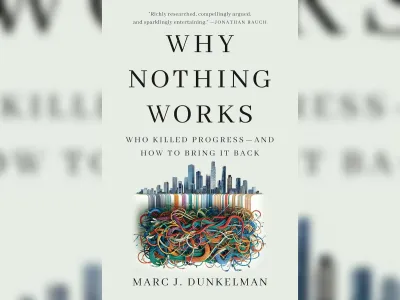
In “Why Nothing Works,” Marc Dunkelman argues that America’s political gridlock stems from an internal progressive conflict between Hamiltonian centralized efficiency and Jeffersonian individualized safeguards.



This review is part of a special collaboration between Planetizen and Booked on Planning, a biweekly podcast where AICP planners Stephanie Rouse and Jennifer Hiatt chat with authors of the latest books shaping urban planning today. Listen to the episode with today’s author in the player below.
In today’s political climate, it often feels like we can’t accomplish anything, despite a history of accomplishing massive feats like building the interstate highway system or creating the Tennessee Valley Authority. Marc Dunkelman argues in his book “Why Nothing Works: Who Killed Progress — And How to Bring it Back” that America’s stifled progress can’t wholly be blamed on conservatives, but that progressivism’s own fear of “The Establishment” is to blame.
This book will take you back to the founding of our democracy and the initial battle for control between Jeffersonian and Hamiltonian approaches to governing and the lasting legacy of the pendulum swing between each. As Dunkelman’s book shows, the desire to get things done is hampered by a desire to limit government. This tension has led the general public to lose faith in public institutions and stifle progressivism’s ability to deliver on its promises.
Dunkelman argues three main points in his book: 1) progressivism is defined by two diverging impulses (Hamiltonian vs Jeffersonian) 2) these two impulses have waxed and waned through time shifting the movement’s underlying zeitgeist, and 3) the balance that’s emerged excessively towards Jeffersonianism is a liability for the movement.
While this isn’t your standard urban design or planning book, it illuminates why the work we are trying to achieve — building more affordable housing, reducing climate impacts, replacing failing public infrastructure — is hamstrung by our own good intentions to “insert so many checks into the System that government has been rendered incompetent.” Look no further than the environmental review process. “Environmental impact statements, initially imagined at NEPA’s birth to be 150 page documents, eventually came to be volumes long, the length born of a bureaucratic desire to insulate any given decision from criticism that a concern had not been sufficiently considered.”
This added bureaucracy, meant to help protect the public, can largely be seen during the period of rampant road building following the passage of the Interstate Highway Act of 1956. These added checks and balances stopped power hungry builders like Robert Moses, but Dunkelman asks “how can we clear a path for progress without beckoning another Robert Moses?” While he does not lay out a clear path in his book to answer this question, he does note that reformers need to find a balance between centralized power and individualized safeguards. He is realistic in asserting that not everyone will agree, hence why we have had such a push and pull in tendencies over the centuries of government, but “in the end, someone needs to be empowered to choose.”
If we want to green the grid, build more affordable housing, create more inclusive, and welcoming cities, we must resolve the issues within the progressive movement that are hamstringing progress. “Why Nothing Works” doesn’t provide a clear path to the solution, but the narrative read will give you the understanding of how we arrived at the current gridlocked system and offers a direction for moving forward.


Are cities at risk of losing squirrels?
Book review: A common backyard forager could be in decline, but without the proper data we may not know until it’s too late. Nancy Castaldo’s "Squirrel" urges us to find out.
Review: "An Even Better Way to Zone"
Don Elliot’s sophisticated and much-anticipated follow up to "A Better Way to Zone" tackles equity, affordability and provides a better blueprint from theory to application.
The Bittersweet Path to the Housing Crisis — and how to Find our way Home
Book Review: In “Bittersweet Lane: Creating Home(s) in the American Affordable Housing Crisis,” affordable housing developer Jamie Madden blends memoir with a manifesto for a new era of affordable housing in America.

The state-sanctioned urbicide of Austin
People don’t kill cities. Freeways do.

US to reduce Colorado River water deliveries to Mexico
A new Colorado Treaty amendment reduces Mexico’s Colorado River water allocation by 250,000 acre feet.

New Jersey’s second-largest city bans standalone data centers
Jersey City will continue to allow co-location facilities, such as those meant for research institutions that store their own data.

Amtrak not solely to blame for New Jersey commuter rail's unreliability, report finds
A new study from the Garden State Initiative found that NJ Transit’s budget grew 20% across a 4 year period, but reliability declined significantly over the same period.

EPA erases limits on planet-warming pollution from power plants
Under Monday’s plan, power plants would still have some limits on how much mercury, arsenic and other contaminants they can emit.

Phoenix announces new on-demand transit service, more frequent RAPID buses
Both new services will launch in October, and are part of Phoenix's Project Effective Access Solutions for Easing Congestion.

FREE Course: Walkable City 1: Why Walkability?
After describing his path towards focusing on walkability as the essence of good planning, Jeff Speck marches through his five principal reasons for making more walkable places.
Reinventing Malls: Planning Alchemy—Turning Gray Fields Into Gold
The course focuses on the opportunities and imperatives that shape reinvention of mall sites.

Eagle County Government
Harvard University Graduate School of Design
Nashville Planning Department
The Architects Foundation
University of Cincinnati Online
The Pocatello Development Authority
The Urban Renewal Agency of the City of Pocatello
Journal of the American Planning Association

