Like urban violent crime, urban property crime is often a political football. Republicans claim that crime in Democrat-run cities is proof that Democrats are incapable of maintaining public order. Do they have a point?



Almost three years ago, I posted here about homicide rates in different types of cities: cities with progressive reputations, cities run by Republicans, and in-between cities that are run by Democrats but nevertheless are more suburban and more socially moderate than the most left-wing cities. I concluded that in the early 2020s, the most progressive cities had the highest increases in homicide (though often from a very low base) but that the differences between Republican-run cities and more moderate blue cities were fairly modest.
One reason I focused on homicide rates was that homicides are more likely to be reported to the police than less important crimes. But recently I read something that made me want to follow up on this topic — in particular, suggestions that because people tend to report stolen cars to their insurance company, car thefts are also more likely to be reported than other crimes, which means that car theft statistics are more reliable than robbery or burglary statistics. And even though car thefts did not rise as rapidly as homicide, they did rise in the past few years while starting to come down in the last year or two. So naturally I wondered: among the group of cities I mentioned in my 2023 post, did car thefts rise more in red cities or in blue cities? And if so, was there an obvious difference between different types of cities?
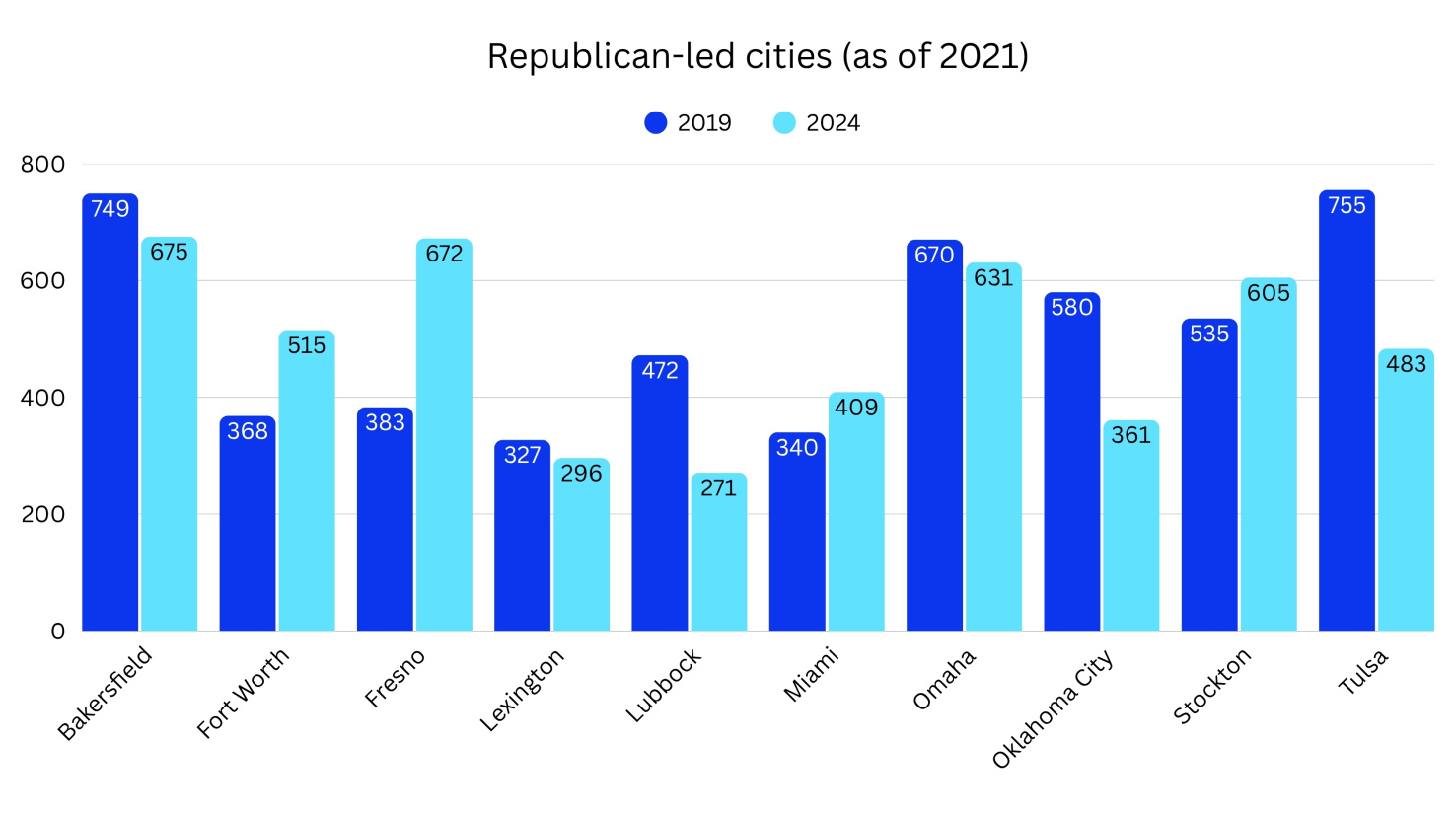
The Republican-run cities presented a mixed but positive picture: in six of the ten cities I had data for (Tulsa, Oklahoma City, Lexington, Lubbock, Omaha, and Bakersfield) car thefts actually declined in the 2020s. The other four "red cities," however, had a fairly mixed record: car thefts rose modestly (by 13 and 20 percent respectively) in Stockton and Miami, but rose by 40 percent in Fort Worth and 75 percent in Fresno.*
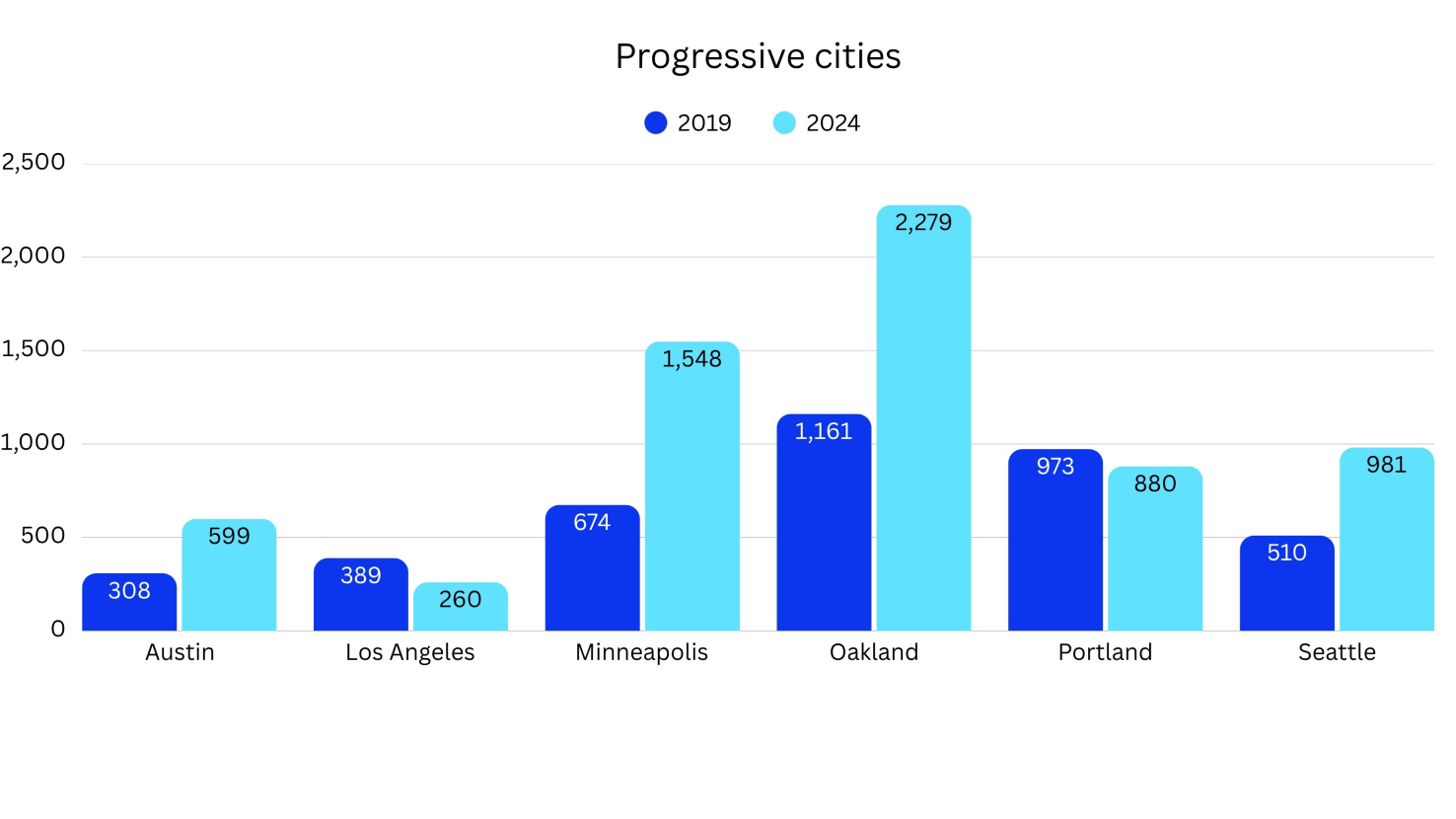
Another category I looked at were the six cities that have a reputation as especially progressive (Seattle, Portland, Austin, Minneapolis, Oakland and Los Angeles). In my earlier article, I suggested that these groups had the highest increase in homicide rates among any type of city I looked at. In two of these cities (Portland and Los Angeles) car theft rose in the early 2020s but declined to pre-2019 levels in 2024. On the other hand, car theft rates in Minneapolis are still more than double the 2019 rate, and rates in Seattle, Austin and Oakland are all a little over 90 percent higher than in 2019. In other words, four of the cities in this category had 2019-24 car theft increases that were higher than those of the worst-off Republican-run city (Fresno).
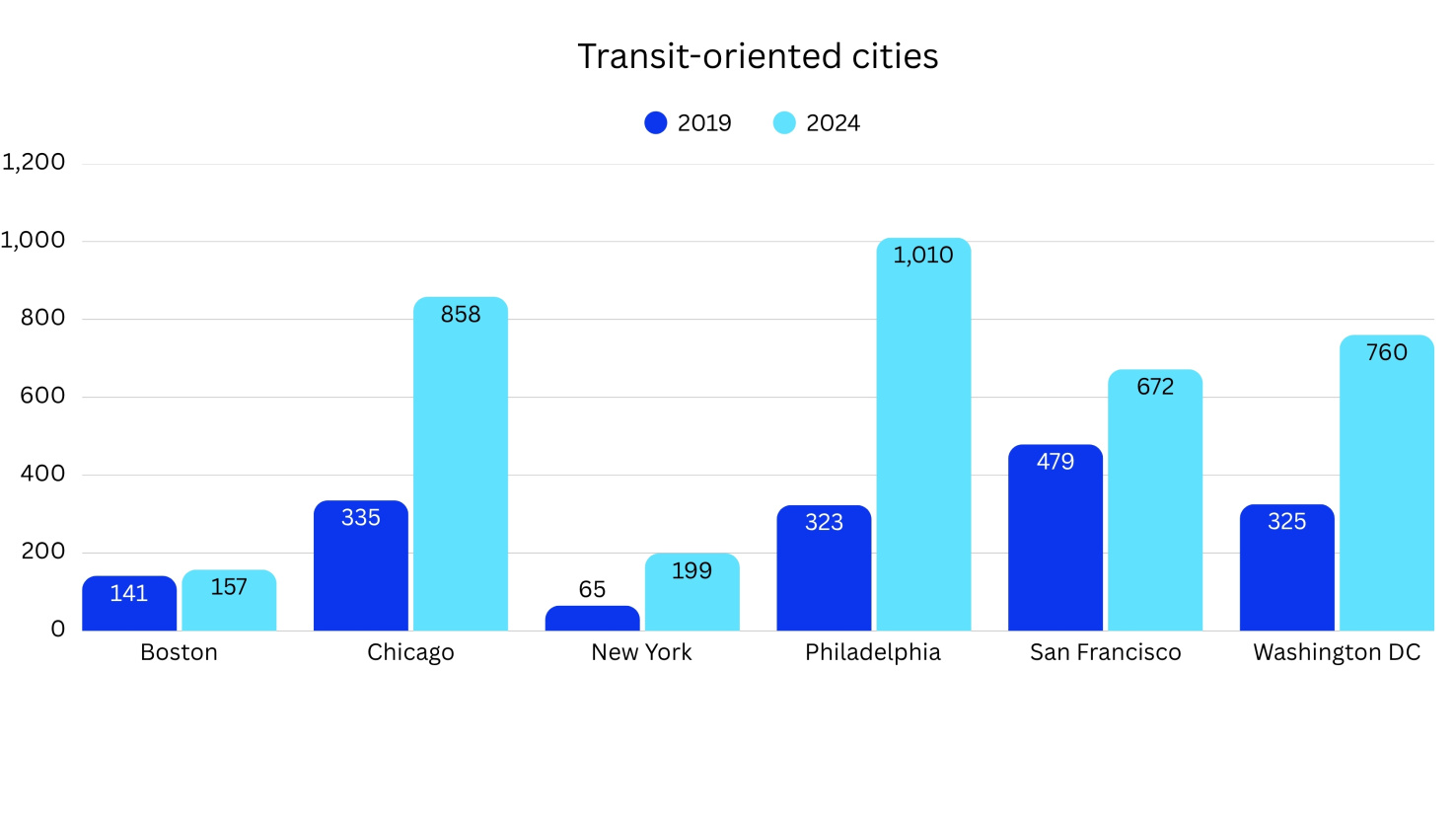
Similarly, the six most transit-oriented cities (Boston, Washington, Philadelphia, Chicago, San Francisco and New York) also struggled with car theft: Boston’s car theft rate in 2024 was only 16 percent higher than its 2019 rate, but San Francisco’s theft rate was 41 percent higher, and car theft increased by over 100 percent in Washington, Philadelphia, Chicago and San Francisco.
When I wrote about the Black-dominated Democrat-run cities two years ago (Atlanta, Memphis, Detroit, Cleveland, Baton Rouge, Baltimore) I mentioned that homicide rates had no clear pattern during the early 2020s. Car theft rates also varied widely, from a slight decline in Baton Rouge to a over-100-percent increase in Memphis. Although car thefts in Detroit rose by only 19 percent, car theft in the other three cities rose by 50-60 percent. To put it another way, the median car theft increase was just over 90 percent among the progressive cities and just over 50 percent among the most Black cities. So, on balance, it seems like the most Black-dominated cities outperformed more progressive cities — but were in turn outperformed by Republican-run cities.
What about the not-so-progressive cities with Democratic mayors? Were they more like the Republican-run cities (where car theft has generally gone down to 2019 levels or lower) or like the more left-leaning Democratic cities?
This group of (mostly) sprawling, car-oriented cities yielded mixed results. At the one extreme, car thefts doubled or more in six cities (El Paso, Charlotte, Raleigh, Durham, Kansas City, and Lincoln) and increased by 98 percent in Long Beach. At the other extreme, car theft rates went down in Sacramento and St. Petersburg, and increased by 10 percent or less in Phoenix, Tampa, Albuquerque, and San Jose. The median cities (that is, ranking 9th and 10th worst) were Greensboro (75 percent increase) and Denver (68 percent). So the median car theft increase in centrist Democratic cities was actually pretty close to that of other categories of Democrat-run cities — a result I would not have expected from looking at murder rates, which increased quite modestly in this group of cities during the early 2020s.
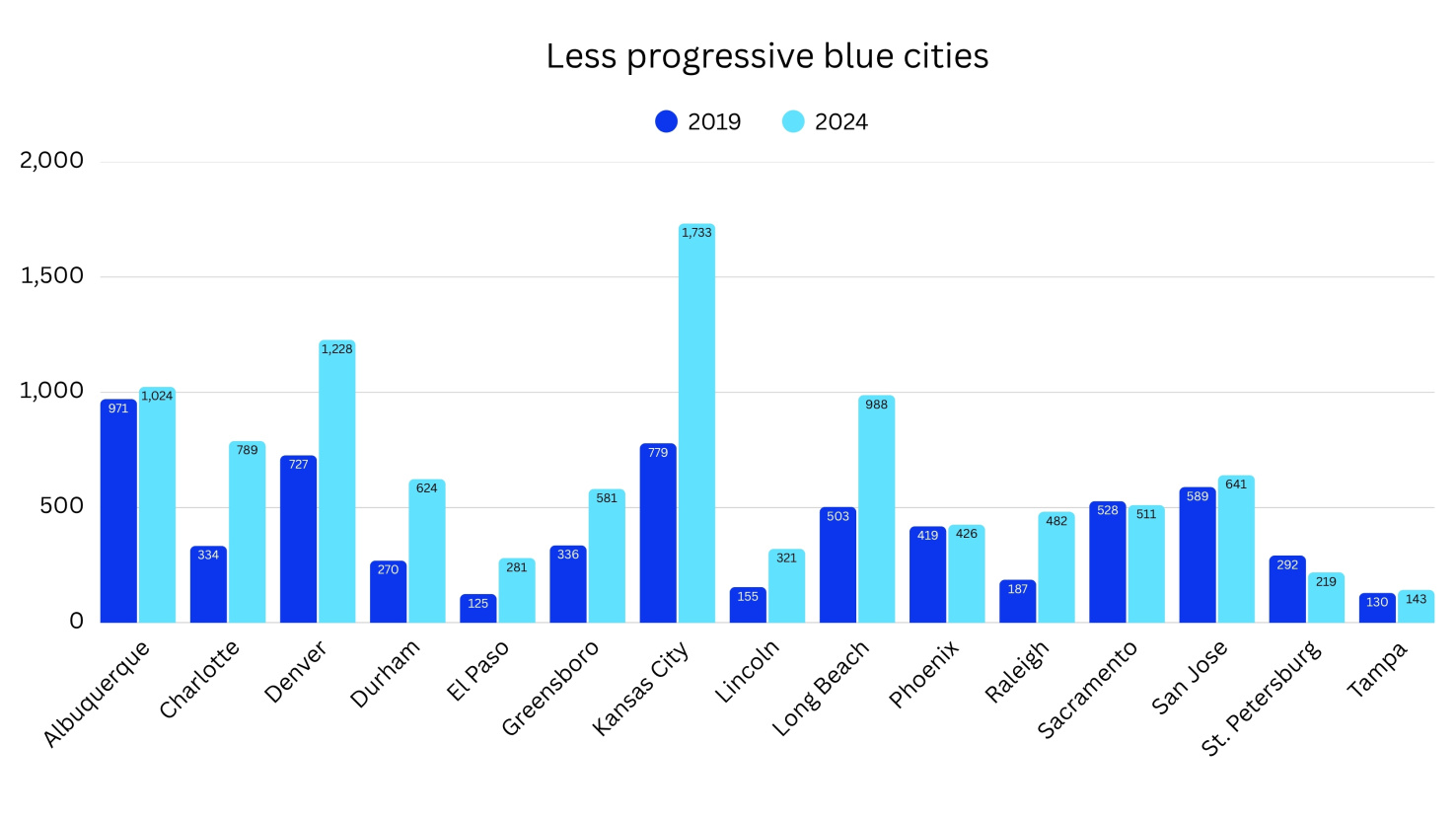
In sum, the stereotype of Democratic cities (especially those with progressive reputations) floundering while Republican cities successfully controlled crime seems to have been more accurate in the early 2020s for car theft than it was for homicide. On the other hand, my sample of cities was not large, and there are exceptions to this rule in every category: that is, car theft rose substantially in a couple of Republican-run cities, and declined in several Democrat-run cities. (Readers may wonder why this is so, but I leave this question for other scholars).
At this point readers might wonder: “so far we know where car theft went up and down, but how do overall theft rates compare among cities? Which cities have high rates and which have low rates?” The cities with under 200 car thefts per 100,000 residents include Tampa (143), Boston (157), New York (199).** Honorable mention goes to Los Angeles, El Paso, Fort Wayne, Lubbock and Lexington, which were in the 200-300 range.
At the other extreme, cities with over 1000 car thefts per 100,000 residents include Oakland (2279), Kansas City (1733), Memphis (1584), Minneapolis (1548), Detroit (1259), Denver (1228), Cleveland (1150), Baltimore (1058), Philadelphia (1010). Here, there is not such a sharp red/blue gap; dense, progressive Boston and New York had lower car theft rates in 2024 than every Republican-run city, although the worst-off cities tend to be a more Democratic group. Similarly, there doesn't seem to be a strong correlation between density/walkability and car theft: New York and Boston are two of the most walkable and transit-oriented American cities, but so is less-safe Philadelphia.
*Most of my data comes from city-data.com. Where data from this webpage was unavailable, I looked at local police statistics.
**One possible explanation of the low theft rates for New York and Boston is that lower rates of car ownership may lead to lower rates of car theft. However, the strong downtown job markets of these cities may mean that the lower number of resident-owned cars on the streets is at least partially balanced out by the higher number of commercial vehicles and/or suburban commuter-owned cars in the center city.

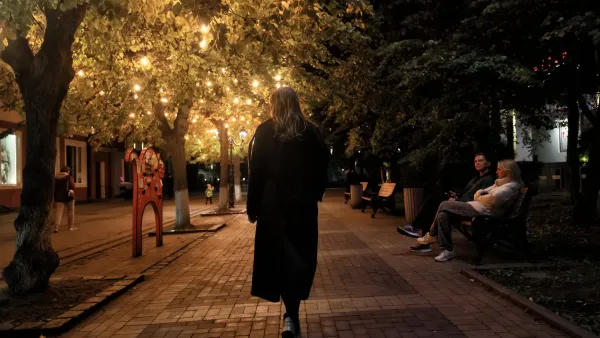
How urban design can deter crime
Well-designed public spaces and good lighting can prevent crime and make residents feel safer.
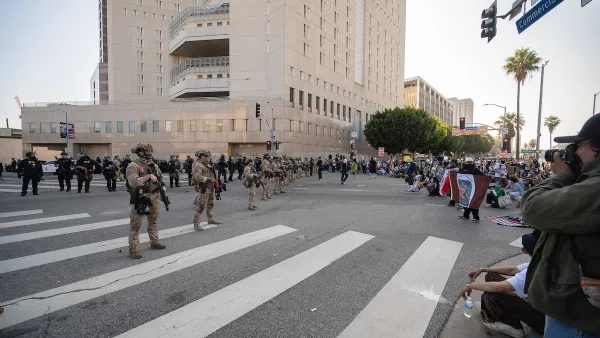
Opinion: Far From Cauldrons of Violence, Cities are Anti-Crime Innovators
Rather than funding the performative militarization of law enforcement, the federal government could instead support programs that prevent poverty and crime before it happens.
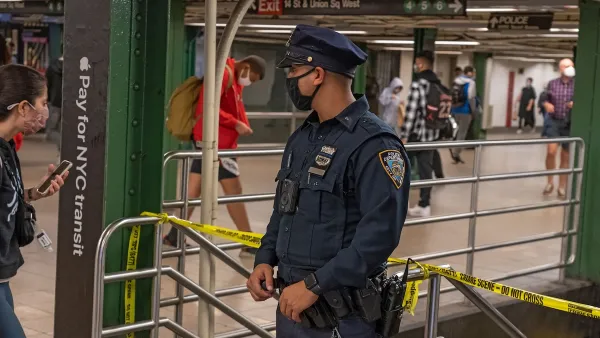
NYC Subway Has Safest Month Ever
The city’s subway system is seeing increased ridership and a sharp drop in crime a year after the MTA implemented new security measures.

Planetizen Federal Action Tracker
A weekly monitor of how Trump’s orders and actions are impacting planners and planning in America.

‘Going backwards:’ Baltimore mayor, students rally against state's transit funding plan
Maryland's proposed six-year plan provides no funding for Baltimore’s BMORE bus program and reduces its road maintenance funding.

Detroit to transform waterfront with $2.2 billion investment
Developers will convert about 18 acres of unused parking lot space into civic spaces.

HUD, USDA agree on framework to simplify housing environmental review standards
Their agreement is a requirement of the 21st Century ROAD to Housing Act.

Cost of water rising at a faster pace than inflation, median household income
California and Maryland residents have seen their water bills grow especially high.

NYC building owners overwhelmingly comply with new emissions limits
The New York City Department of Buildings is fining owners who did not file emissions reports.

FREE Course: Walkable City 1: Why Walkability?
After describing his path towards focusing on walkability as the essence of good planning, Jeff Speck marches through his five principal reasons for making more walkable places.
Reinventing Malls: Planning Alchemy—Turning Gray Fields Into Gold
The course focuses on the opportunities and imperatives that shape reinvention of mall sites.

planning NEXT
City of Thousand Oaks
City of Wisconsin Rapids
The Architects Foundation
University of Cincinnati Online
Northern Illinois Transit Authority (NITA)
The Pocatello Development Authority
The Urban Renewal Agency of the City of Pocatello

