History has taught us the risks of undervaluing the power of planning decisions. Overvaluing them might be just as dangerous.




Recently, the Santa Fe City Council held a public hearing on “Phase I” of the first major Land Use Code update since 1987, as covered by Carina Julig of the New Mexican, here.
Having opined on process stalls in a September New Mexican op-ed, I attended the meeting to listen to and observe the craft of planning and land use staff members and their consultant unfold in the City Different. After weeks of review by other city commissions and Council committees, the Governing Body’s deliberation revealed something rare: an honest debate about changes to fee-in-lieu provisions, on-site affordability exemptions, and the degree to which municipal policy, plans, and regulations can realistically influence housing outcomes.
Several councilors restated in their own words something that is actually a classic planner’s burden, not often stated as directly as it should be in times of change: Market forces have their own gravitational pull. Regulation might influence approach, cost, and developer behavior, but regulation alone is not the sole engine driving affordability outcomes.
That animated deliberation reminded me of a piece I wrote in April 2011 for my legacy blog, myurbanist, and later republished in the Huffington Post: “Urbanism Chasing Utopia.”
Different time, different context, yet the same foundational tensions between aspiration and implementation.
No one captured this better than Catherine Bauer Wurster, the pioneering housing advocate whose work has received renewed attention during today’s affordability crisis. In 1952, she offered a prescient reflection on the effectiveness of planning tools:
What we failed to see was that the powerful tools employed for civic development and home production also predetermine social structure to such an extent that there is little room left for free personal choice or flexible adjustment. The big social decisions are all made in advance, inherent in the planning and building process. And if these decisions are not made responsibly and democratically, then they are made irresponsibly by the accidents of technology, the myths of property interest, or the blindness and prejudice of a reactionary minority.
Catherine Bauer, Social Questions in Housing and Town Planning (London: University of London Press, 1952), p. 25
I heard her words in that November hearing: policy, planning, and regulation can encourage affordability, but they cannot guarantee it.
The Council debate and public testimony raised my themes from 2011. We should not oversell cure-all buzzwords or champion ideals that ignore pro formas, land values, and construction economics. Changes in architectural form do not always guarantee social cohesion. Most importantly, utopian clarity quickly blurs in the face of real markets, everyday constraints, and human behavior.
Santa Fe in 2025 is wrestling with the same questions that have challenged planners for a century. What can planning accomplish? How central are market forces? Will cities successfully balance continuity, culture, and affordability?
Below is my 2011 essay, essentially unchanged. Its perspective may help clarify today’s conversations in Santa Fe and other cities, as well as focus discussion as new administrations take office after the recent election cycles.
—
Generally speaking, the description of any Utopia that involves many details is apt to be an unconvincing way to present a principle which can be applied effectively in practice with immense flexibility as to details…
Frederick Law Olmsted, Jr. to Henry James, July 10, 1924, Papers, Regional Plan Association, Cornell University
There is little doubt that a cadre of government, activists, academics and popular media are moving forward with fine-tuning today’s effort to reinvent cities in new contexts, with specific lists of attributes and goals. Among the inevitable focal points of any prescription: walkable, mixed-use communities with live-work proximity, green and sustainable features.
But the age-old dance of human and machine provides considerable fodder and fascination from history, including the risks of indiscriminate cliché versus social and market implementation realities.
The vision, chasing Utopia
In the 1920’s, planners in the New York region wrestled with how to re-plan cities and suburbs — “community planning”– amid the ascent of the automobile. Like today’s urbanists, they sought to educate decision-makers and ordinary citizens about compact development practices.
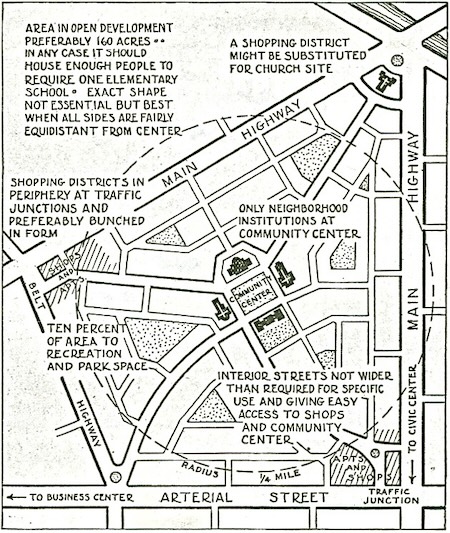
They had good ideas, inherited from Garden City thought: planned, compact industrial towns and utopian communities, which by and large have withstood the test of time
Like today, planning activities of a century ago sought improved residential quality, including a scheme which correlated scaled streets according to use, local stores, the community school, parks, playgrounds, open space, and social interaction among neighbors.
Some even thought about how to sell the message, and the intended audience for the neighborhood focal point. For instance, Shelby Harrison characterized the then-nascent neighborhood unit studies of his colleague Clarence Perry at the Russell Sage Foundation:
We need to reach large numbers of citizens who are not thinking very much in social or planning terms — among them builders, real estate developers, and local civic leaders. It won’t be so familiar to them, and the line of thought will have to be presented in some detail if the idea is to be made clear.
Shelby Harrison to Thomas Adams, December 1926, Papers, Regional Planning Association, Cornell University.
Voices from history
These principles were later criticized for oversimplicity, “architectural determinism,” and what we would today call a lack of concern for social equity. The community planning tradition attempted to incorporate the social cohesion observed in successful organic communities into new areas, assuming that such cohesion came with the provision of successful communities’ physical facilities. With the provision of churches, local stores, and other structures at the community level, the thought leaders of the time assumed all else would follow.
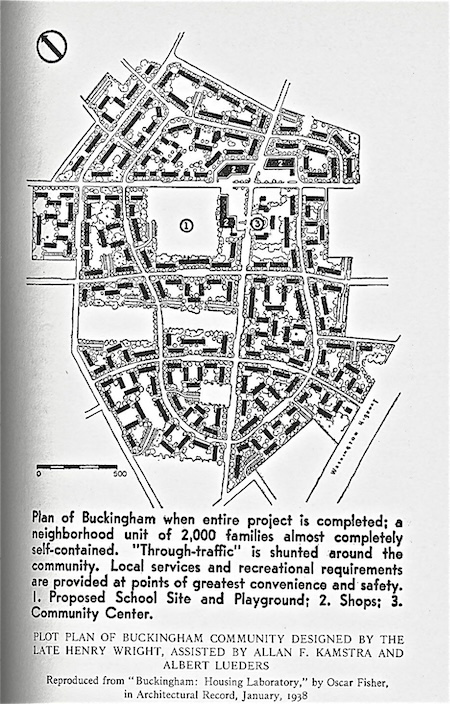
British sociologist Maurice Broady said it best in 1966. Architectural determinism was given credence in the neighborhood unit, he explained, not because it could be shown to be valid, but because it was hoped it would be so.
Broady elaborated on the British case, where the cohesion observed in low income areas was attempted in planned communities:
Of course people do meet each other and chat in pubs and corner shops. But not all pubs and corner shops engender… neighborliness. It is true that neighborliness is induced by environmental factors. Of these, however, the most relevant are social and economic rather than physical.
Maurice Broady, “Social Theory in Architectural Design,”Robert Gutman, ed., People and Buildings, (New York: Basic Books, 1972), p. 174.
In 1952, as cited above, Catherine Bauer summarized how early planners often failed to understand broader forces shaping urban development, or overlooked the consequences of their assumptions.
Implementation today
Do we risk overselling today’s land use concepts, without taking heed of social and market realities? Absent large swaths of single-entity ownership, redevelopment of our current urban landscape is not easy — with limited raw land available for straightforward development without sophisticated mitigation solutions.
Today’s urban redevelopment is often beset immediately with particular expectations or requirements to help solve urban and regional problems such as affordable housing and transportation. As these are elements of cost, a developer must find a way to contribute to the resolution of these issues within the allowances of the project pro forma.
Allocation of funds towards provision of transportation and affordable housing infrastructure and/or mitigation must be balanced against design and constructability decisions (constrained site construction and demolition challenges, quality of building materials, lighting, etc.), allocations of uses, parking and open/street spaces and vegetation.
The bottom line? Today’s prescriptive goals for sustainable communities — not so different from those of the last century — require reality checks against the challenges of design, regulation and financing, and must be addressed at an integrated, practical level.
After all, as Olmsted said long ago, beware of selling implementation with Utopia.
This piece originally ran on Resurgence: A Journey.

The Pitfalls of the 15-Minute City
The concept, touted as "hyper-local," can fail to take into account local conditions and historical inequities in American cities.
Planning for Love, Part 3: Enhancing human connection through walkability
In the third and final installment of this series, author Hannah Kosoff examines what her research findings say about modern dating and urban form.
Arlington's 'pop-up park' activates a vacant plaza
Third spaces don't have to be permanent.

Planetizen Federal Action Tracker
A weekly monitor of how Trump’s orders and actions are impacting planners and planning in America.

Amtrak, CN end decades-long dispute with eight-year agreement
The new operating agreement establishes an updated framework for the companies to work together, including processes to resolve disputes.

Judges permit Denver to divert 77,000 acre feet from the Colorado River for reservoir expansion
Overuse and climate change have caused the Colorado River’s water levels to plummet.

NYC DOT wants faster, more permanent street upgrades
The city is examining ways to build more concrete infrastructure without getting entangled in 'decades-long' projects.

'Something we’ve never seen before:' rising utility rates could strain city finances nationwide
Data centers, climate change and other factors have caused utility rates in the United States to increase by 38% since 2020.

Trump to overrule local leaders, lease millions of acres of America’s Pacific Island territories’ seafloors to mining companies
International law says that the Indigenous people of America’s territories have a right to prior and informed consent regarding projects that impact their countries.

FREE Course: Walkable City 1: Why Walkability?
After describing his path towards focusing on walkability as the essence of good planning, Jeff Speck marches through his five principal reasons for making more walkable places.
Reinventing Malls: Planning Alchemy—Turning Gray Fields Into Gold
The course focuses on the opportunities and imperatives that shape reinvention of mall sites.

Harvard University Graduate School of Design
KFH Group Inc.
Greater Baltimore Committee
The Architects Foundation
University of Cincinnati Online
The Pocatello Development Authority
The Urban Renewal Agency of the City of Pocatello

