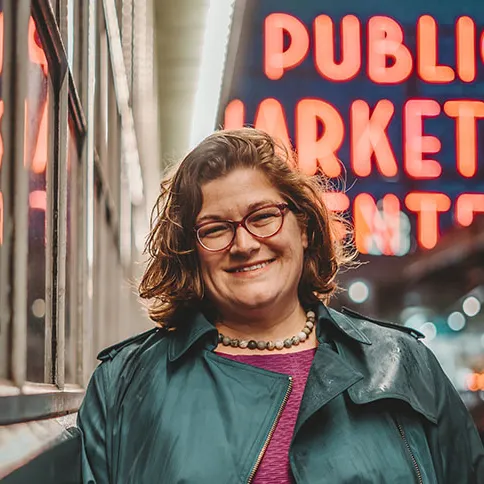
Jess Zimbabwe
Jess Zimbabwe is Executive Director of Environmental Works Community Design Center in Seattle
Contributed 12 posts
Jess Zimbabwe is Executive Director of Environmental Works Community Design Center in Seattle, a nonprofit that plans, designs, and advocates for community-centered environments. Previously, she founded the consulting practice Plot Strategies and served as the founding Director of the Daniel Rose Center for Public Leadership, a partnership of the National League of Cities and the Urban Land Institute. Earlier, she led the Mayors’ Institute on City Design and was Community Design Director at Urban Ecology in Oakland. Jess serves on the boards of Futurewise, the National Main Street Center, Grow America, and Colloqate. She is a licensed architect, certified city planner, and LEED Accredited Professional, and teaches urban planning at the University of Washington.
wish you were here: liveblog from the Association for Community Design Annual Conference
<p> I’m watching local Rochester-area advocates respond to presentations by three panelists on the subject of “Community Food Supply and Environmental Justice” at the <a href="http://communitydesign.org/Annual_Conference.htm">Association for Community Design annual conference</a>. We’re here hosted by the Rochester <a href="http://www.rrcdc.org/">Regional Community Design Center</a>.
Take a ride on the Scwebebahn
I’d been obsessed with it ever since I saw <a href="http://www.imdb.com/title/tt0203632/"><em>The Princess and the Warrior</em></a>. (Between that and the funicular in <em><a href="http://www.imdb.com/title/tt0085549/">Flashdance</a></em>, there is just something about bad-ass chicks that commute via unique transit.) So, when I found myself with an unexpected free morning in Essen, Germany, after especially cooperative weather for photographing the day before, I hopped on the S-Bahn towards Wuppertal to see the famed train. <p class="MsoNormal"> <img src="http://farm4.static.flickr.com/3405/3506113776_77e7083411_d.jpg" width="500" height="375" /> </p>
Cul-de-sacs verboten?: Tim Kaine and Roman Polanski on dead-end streets
<p> As you may have heard in yesterday's <a href="/podcast">Planetizen Podcast</a>, Virginia Governor Tim Kaine <a href="http://www.washingtonpost.com/wp-dyn/content/article/2009/03/21/AR2009032102248.html">doesn't like cul-de-sacs</a>. </p> <p> Most news reports on the story have claimed that the state is "forbidding," "banning," or even "outlawing" the cul-de-sac. In fact, Virginia municipalities can still design, build, and approve any road patterns they wish, but the State will no longer agree to foot the bill for the ongoing maintenance of cul-de-sacs. The news item came up in a staff meeting yesterday and one colleague told us that a friend he was having dinner with declared the move "Un-American!" </p>
post-Starbucks planning
<p class="MsoNormal"> <span style="font-size: 10pt; font-family: 'Arial','sans-serif'">Starbucks stores have seen a lot of protests. Due to its international brand recognition, the chain became an easy mark for activists looking to draw media attention to concerns from <a href="http://www.dailyprincetonian.com/archives/2002/09/30/news/5504.shtml">genetic engineering</a> to <a href="http://www.iww.org/en/node/4267">union busting</a>, from <a href="http://www.msnbc.msn.com/id/16692792/">store placements in historically sensitive locations</a> to <a href="http://laughingsquid.com/reverend-billy-arrested-at-astor-place-starbucks/">the company’s opposition to Ethiopia’s application to trademark three types of coffee</a>.
Liveblog from the MICD Santa Rosa Technical Assistance Team Session
<p> In early 2008, the <a href="http://www.micd.org">Mayors' Institute on City Design</a> received a generous gift from the <a href="http://www.micd.org/news/micd_tat_pr.htm">Edward W. Rose III Family Fund</a>, directed through the <a href="http://www.nea.gov">National Endowment for the Arts</a>, to support technical assistance teams going into the communities of alumni mayors who have already attended one of our traditional Mayors' Institute sessions. The four cities that we selected for the pilot phase of this work were Santa Rosa, CA, Lincoln, NE, Cincinnati, OH, and Tulsa, OK. </p>