A subway extension that would cut across the Los Angeles basin has cleared another legal hurdle, despite the efforts of a coalition of opponents in the city of Beverly Hills.


"Some very good news for [Los Angeles County] Metro and the Purple Line Extension subway project arrived on Friday: in a federal lawsuit brought against the Federal Transit Administration, U.S. District Court Judge George Wu upheld the FTA’s prior approval of the project," reports Steve Hymon for Metro's The Source.
What that means in plain terms: "Metro can move forward with finalizing a $1.2-billion federal grant and $307-million federally-backed loan to help pay for the project’s second phase between Wilshire/La Cienega in Beverly Hills and Century City."
The project in question has been referred to in the past as the "Subway to the Sea," though it stops well short of the Pacific coastline. The fate of this Purple Line stands in contrast to the Purple Line extension planned for the suburbs of Maryland, which was recently dealt a legal blow.
Read the full story: U.S. Judge upholds federal approval of Purple Line Extension project

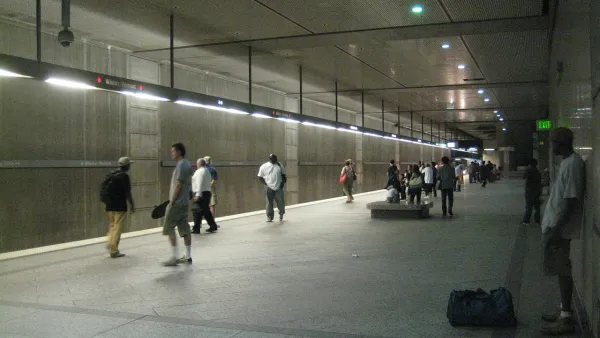
Purple Line Extension Gets $1.6 Billion Boost in Los Angeles
The Purple Line subway extension is picking up momentum in Los Angeles. With construction already underway on the first phase, the second phase should commence in 2018.
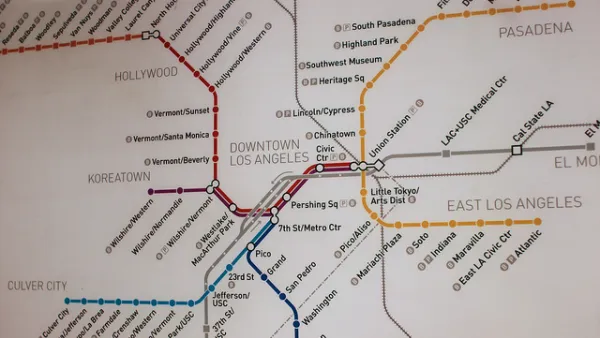
Los Angeles Breaks Ground on Purple Line Subway Extension
The long awaited groundbreaking for work on Los Angeles’s Purple Line Extension commenced. The project is expected to open in 2023.
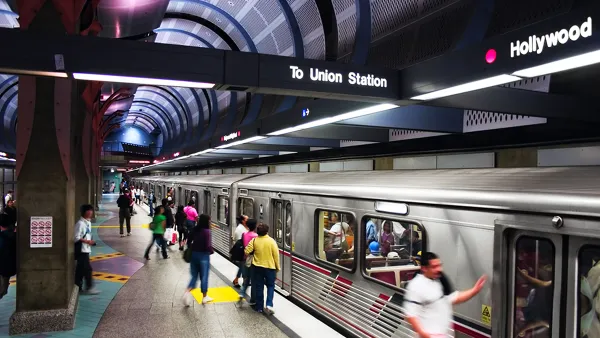
$2.1 Billion in Federal Transit Funding for the 'Subway to the Sea' in Los Angeles
Los Angeles will receive its largest-ever federal grant, $1.25 billion, to help fund the Purple Line subway, aka the "Subway to the Sea." Also on its way is an $856 million loan from the TIFIA program.

Planetizen Federal Action Tracker
A weekly monitor of how Trump’s orders and actions are impacting planners and planning in America.

Amtrak, CN end decades-long dispute with eight-year agreement
The new operating agreement establishes an updated framework for the companies to work together, including processes to resolve disputes.

Judges permit Denver to divert 77,000 acre feet from the Colorado River for reservoir expansion
Overuse and climate change have caused the Colorado River’s water levels to plummet.

Boston has spent millions making the Green Line more accessible — and there’s no end in sight
While the city has invested millions into expanding and adding platforms to the Green Line to make it more accessible, new train cars set to arrive next year will be too tall for disabled passengers to board without raising the current platforms.

Idaho may see an 18% drop in federal surface transit funding — the largest estimated cut in the US
Transit systems in rural communities are much more reliant on federal funding to provide their services.

How ‘post-disaster gentrification’ alters neighborhoods after natural calamities
After hurricanes, fires or other calamities, the original residents of a community are often replaced by younger, wealthier residents.

FREE Course: Walkable City 1: Why Walkability?
After describing his path towards focusing on walkability as the essence of good planning, Jeff Speck marches through his five principal reasons for making more walkable places.
Reinventing Malls: Planning Alchemy—Turning Gray Fields Into Gold
The course focuses on the opportunities and imperatives that shape reinvention of mall sites.

City of Wisconsin Rapids
Harvard University Graduate School of Design
KFH Group Inc.
The Architects Foundation
University of Cincinnati Online
The Pocatello Development Authority
The Urban Renewal Agency of the City of Pocatello