You will be forgiven for thinking you are looking at an East Coast commuter rail line: It's electrified with level boarding, mostly 15-minute headways, with bike and luggage racks, operating 22 hours a day from Denver's Union Station to the airport.


Don't look for the "Train to the Plane" at Union Station. Instead, "it goes by name 'RTD University of Colorado A Line', which takes its name as a result of the first sponsorship through the Regional Transportation District's naming rights program," states Monte Whaley of The Denver Post (listen and watch here). During construction, it's referred to as the East Line.
Public-private partnership, cost, rail cars
The highly anticipated line is electric commuter rail, which is part of the Eagle P3 project, the nation's first full public-private partnership for transit.
As a June 2010 Planetizen post on the project indicates, "RTD board voted 13-0 to select a team called Denver Transit Partners, composed of "Fluor Enterprises Inc., Australia's Macquarie Capital Group and transit contractor Balfour Beatty Rail Inc. to build and operate a $2.1 billion portion of FasTracks". They will operate the line for 40 years."
"Local RTD taxes combined with a $1.03 billion federal grant and $450 million from Denver Transit Partners — the 34-year concessionaire that will build, operate and maintain the trains," writes Whaley.

According to an RTD FasTracks fact sheet (pdf) on the electric commuter rail vehicles and service that includes a comparison to light rail, the vehicles will be manufactured by Hyundai Rotem USA which calls them electric multiple units, or EMUs (not to be confused with the Australian ostrich-like bird).
[Note East and West Coast issues that have arisen with Hyundai Rotem commuter rail cars].
Days, hours and frequency of operation; stops and fares
Whaley writes that the fare for the 23-mile, 37-minute trip to the airport from Union Station is $9. RTD's A Line webpage indicates that the seven-day, 22-hour service and frequencies are truly oriented for airport travel:
-
3 - 6 a.m., every dayService every 30 minutes
-
6 a.m. - 8 p.m., every dayService every 15 minutes
-
8 p.m. - 1 a.m., every dayService every 30 minutes
Commuter rail will operate on a zone-based fare. There are seven stations in three zones, plus the airport (DIA) in its own zone, according to the fares page:

RTD indicates that the A Line will bring "train service into new neighborhoods and employment areas along Interstate 70."
With the inception of the new rail service to DIA in April, expect the airport's low accessibility rating to improve.
In addition to the A Line, look for two new electrified commuter rail lines to be opening next year: Gold Line and the first segment of the Northwest Rail. A fourth line will open in 2018.
Hat tip: Annie Dawid.
FULL STORY: RTD announces Union Station-to-DIA rail line will open April 22, 2016

Denver's B Line to Westminster Now Open for Service
After Monday's celebrations at the new, electrified commuter rail line's only two stations, Union Station and Westminster Station, commuters now have the option of taking an 11-minute, six-mile ride to Denver, costing $2.60.
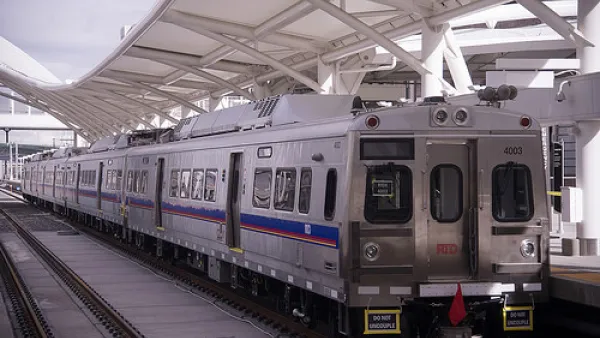
Denver's Commuter Rail Cars: Same as SEPTA's But Without the Defects
Denver's transit agency is running very similar Hyundai Rotem EMUs on their new A Line to the airport. The car shells are imported from South Korea and assembled in the same Philadelphia plant as SEPTA's problem-plagued Silverliner V cars.
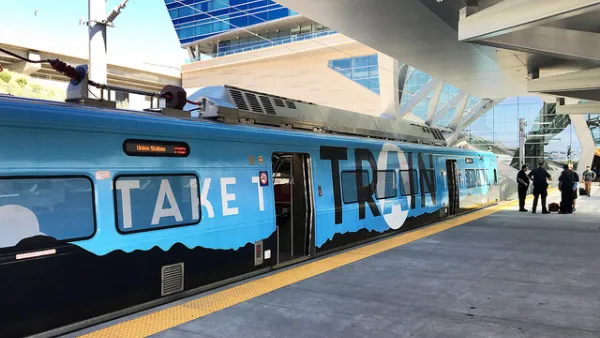
Denver's New Commuter Train to the Plane Achieves Record Ridership
Ridership on the electrified A Line, which opened to great fanfare on Earth Day, reached a weekday average of 16,910 as of June 5. The 23-mile line operates from Union Station to Denver International Airport. Not all is perfect though.

The state-sanctioned urbicide of Austin
People don’t kill cities. Freeways do.

US to reduce Colorado River water deliveries to Mexico
A new Colorado Treaty amendment reduces Mexico’s Colorado River water allocation by 250,000 acre feet.

New Jersey’s second-largest city bans standalone data centers
Jersey City will continue to allow co-location facilities, such as those meant for research institutions that store their own data.

Amtrak not solely to blame for New Jersey commuter rail's unreliability, report finds
A new study from the Garden State Initiative found that NJ Transit’s budget grew 20% across a 4 year period, but reliability declined significantly over the same period.

EPA erases limits on planet-warming pollution from power plants
Under Monday’s plan, power plants would still have some limits on how much mercury, arsenic and other contaminants they can emit.

Phoenix announces new on-demand transit service, more frequent RAPID buses
Both new services will launch in October, and are part of Phoenix's Project Effective Access Solutions for Easing Congestion.

FREE Course: Walkable City 1: Why Walkability?
After describing his path towards focusing on walkability as the essence of good planning, Jeff Speck marches through his five principal reasons for making more walkable places.
Reinventing Malls: Planning Alchemy—Turning Gray Fields Into Gold
The course focuses on the opportunities and imperatives that shape reinvention of mall sites.

Eagle County Government
Harvard University Graduate School of Design
Nashville Planning Department
The Architects Foundation
University of Cincinnati Online
The Pocatello Development Authority
The Urban Renewal Agency of the City of Pocatello
Journal of the American Planning Association