On Sept. 13, the Hudson Yards Subway Station, the new Manhattan terminal for the #7 line that terminates in Flushing, Queens, will open with a grand ribbon-cutting ceremony considering the $2.4 billion cost for the one mile extension.


The new No. 7 station at 34th Street and11th Avenue "is expected to initially attract about 32,000 passengers each weekday," writes Emma G. Fitzsimmons for The New York Times. "Because tracks were built as far south as 25th Street, the Metropolitan Transportation Authority (MTA) will have more space to store trains, which officials said would improve service for all No. 7 train riders."
The train currently terminates at the city's busiest subway station at Times Square—42nd Street / Port Authority Bus Terminal on Seventh and Eighth Avenues, and Broadway in Midtown Manhattan," per Wikipedia.

Image credit: Metropolitan Transportation Authority of the State of New York (via Flickr).
San Francisco, where a new plan to build-out its own limited subway using largely local funding was warmly received, should take notice of the new station for another reason: "It is the first subway extension paid for by the city in more than 60 years," notes Fitzsimmons.
Eric Jaffe of CityLab describes the "innovative funding scheme" used to finance the extension financing:
[Former Mayor Michael] Bloomberg wanted the 7 train so badly that rather than wait for the MTA to drum up the money (he’d still be waiting), the administration said the city itself would foot the bill. The funding structure they devised, known as “tax incremental financing,” was an innovative one—at least by the standards of U.S. transportation funding. The city issued bonds for the construction to be repaid by future tax revenue from developers whose property value would soar once the extension was complete.
The scheme works since Hudson Yards is such a massive project, as Planetizen contributing editor Philip Rojc notes in his June 30 post on the development, explaining why TIF financing made sense.
"Development on the West Side is generating so much money in fees and taxes, officials say, that for the first time in a decade, the city will not have to take money out of its budget to make payments on the $3 billion in bonds used to build parks and a subway line in the district."
Gov. Andrew Cuomo may cite the self-financing as reason why the City needs to contribute more to close M.T.A's funding gap, an on-going state-city conflict.
Construction has been underway since 2007 during which time the neighborhood has undergone a "drastic makeover," writes Fitzsimmons.
In what was once a desolate industrial area, cranes dot the skyline as buildings sprout in the Hudson Yards district, which is roughly west of Eighth Avenue between 30th and 42nd Streets. The Jacob K. Javits Convention Center received a nearly half-billion dollar renovation, and tourists flock to the nearby High Line.
Click here to read Jaffe's six other "fun facts about the new 7 Train extension."
Read the full story: No. 7 Subway Station to Open on Far West Side After Series of Delays

NYC ARC Alternative Proposed: Extend The Subway!
Details are now just emerging about a proposal from NYC Mayor Bloomberg to further extend the IRT #7 line from the West Side station by a planned, massive new development, Hudson Yards. Cheaper than a commuter rail tunnel, it would serve NJ Transit.
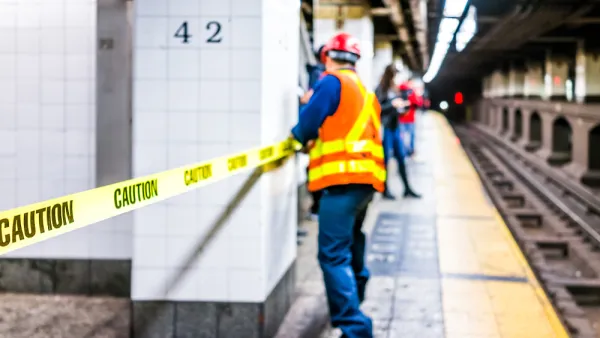
Why New York City's Flooding Its Own Subway Entrances
MTA reassured disoriented New Yorkers that it's flooding subway entrances on purpose, to test barriers that it hopes will guard the system against another Sandy.
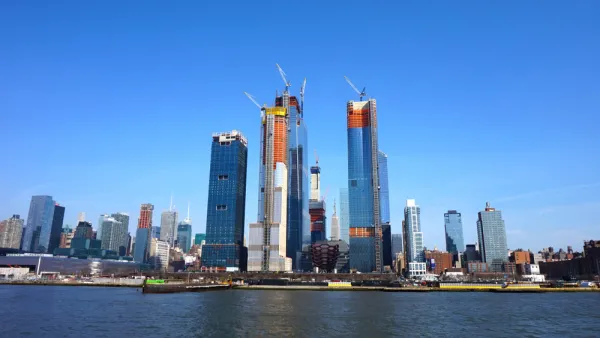
How Mega-Project Financing Tools Gerrymander Distressed Communities
The developers of Hudson Yards received $1.2 billion in financing from the EB-5 program, all made possible by a map that gerrymandered the project into the same neighborhood as Harlem public housing.

Planetizen Federal Action Tracker
A weekly monitor of how Trump’s orders and actions are impacting planners and planning in America.

Amtrak, CN end decades-long dispute with eight-year agreement
The new operating agreement establishes an updated framework for the companies to work together, including processes to resolve disputes.

Judges permit Denver to divert 77,000 acre feet from the Colorado River for reservoir expansion
Overuse and climate change have caused the Colorado River’s water levels to plummet.

Alabama scores up to $2.5 billion federal loan for largest infrastructure project in state’s history
The Mobile River Bridge and Bayway Project aims to ease congestion at Alabama’s worst bottleneck.

Trump is considering data centers on 6 states' public land — some state officials say they had no idea
If the administration approves the proposed projects, data center and data center-related developments will cover 17,600 acres of public land.

Despite court ruling, Trump is keeping nearly all wind projects in the US on hold
At least 110 wind energy projects have not heard from the government since a federal judge ruled that the Trump administration's freeze on wind turbine clearances was likely illegal.

FREE Course: Walkable City 1: Why Walkability?
After describing his path towards focusing on walkability as the essence of good planning, Jeff Speck marches through his five principal reasons for making more walkable places.
Reinventing Malls: Planning Alchemy—Turning Gray Fields Into Gold
The course focuses on the opportunities and imperatives that shape reinvention of mall sites.

KFH Group Inc.
Greater Baltimore Committee
Eagle County Government
The Architects Foundation
University of Cincinnati Online
The Pocatello Development Authority
The Urban Renewal Agency of the City of Pocatello