The tax would be a wholesale tax paid by fuel suppliers as has become more common in the last two years, not a retail tax at the gas pump. The Democratic governor's main problem may be his timing—the house flipped to Republican control.


"The plan calls for a 6.5 percent wholesale surtax on gasoline -- separate from the existing 28.5 cents-per-gallon tax already levied," writes David Montgomery, political reporter at the St. Paul Pioneer Press (PP). "That means the tax would bring in more money when gas prices increase" [and less when prices decrease.]
This is a huge reversal from 2013 when the Minnesota Democratic Farmer Labor Party (DFL) controlled both houses of the Minnesota State Legislature and DFL Gov. Mark Dayton rejected their 7.5-cent gallon tax increase, as noted in April, 2013. "Elections have consequences," as the saying goes.
The Republican fix for crumbling roads and structurally deficient bridges: "shift money from public transit to roads," writes Montgomery.
"My gosh, should we spend a billion on a train when we can't fill potholes?" said incoming House Speaker Kurt Daudt.
"Daudt said a gas tax increase is 'incredibly unpopular'", reminiscent of what Dayton told the then-Democrat controlled House earlier:
The Democratic governor, who fears that a gas tax increase lacks popular approval, maintained his support for "raising sales taxes in the seven-county Twin Cities metro area for light-rail and bus transit", but the Democratic chairman of the House transportation committee canceled a meeting in which they would take up a bill authorizing the regional sales tax. [Planetizen 2013].
Dayton remains committed to "a half-percent increase in the sales tax in the seven-county metro area," writes Montgomery about the Twin Cities metro region, double what was proposed in 2013, with revenue devoted to public transit.
The collapse of the I-35W bridge over the Mississippi River in Minneapolis on August 1, 2007 may be a distant memory for the incoming speaker. The bridge failure, including the death of 13 people, may have inspired the legislature in 2008 to successfully override the third veto by then-Republican Gov. Tim Pawlenty which resulted in an incremental 7.5-cent gas tax increase.
Michigan Gov. Rick Snyder had proposed converting the fuel excise tax to a wholesale sales tax in the fall, but the legislature opted for a general sales tax increase ballot proposal instead.
Hat tip to AASHTO Daily Transportation Update
Read the full story: Minnesota Governor Wants to Limit Tax Increases to Transportation Funding
Plunging Fuel Prices Could Bring Plunging Fuel Taxes
It was considered a given by many analysts that global oil prices would only increase as world oil demand outstripped supply, so switching to percentage-based fuel taxes from per-gallon taxes made sense, until OPEC chose not to restrict their output.
Minnesota Governor Backs Off Raising State Gas Tax
MN Gov. Mark Dayton, fearing that a statewide gas tax increase lacks popular support, will not back the legislature's proposal to raise it, but has affirmed his support for a regional general sales tax for transit. But it may not be that easy.
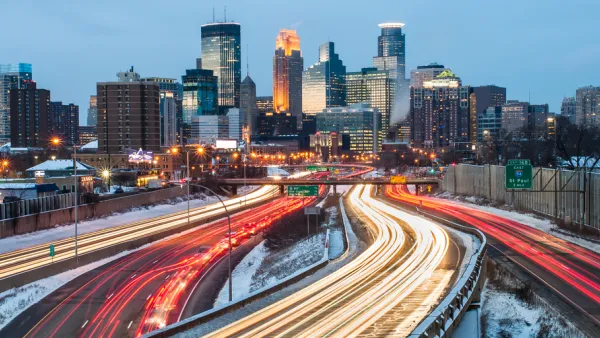
New Minnesota Governor Prepares for Gas Tax Hike Battle
Democratic Gov. Tim Walz, who took office on Jan. 7, wants to hike the state's 28.6-cents gas tax, 15% lower than the national average, so cities like Duluth won't have to ask voters to pass sales tax increases to fund local road repairs.

Washington state to charge fee to drivers with fuel-efficient cars
Revenue from the fee will go towards supporting the state’s highways.

Illinois considers spending $1 billion in taxpayer money on data center
A quantum computing campus and data center are currently under construction in Chicago.

Trump to blast ‘hydrocarbon highway’ through ‘world’s longest art gallery’
Environmental and historic preservation groups are suing to stop the project.

NYC, state sue feds over mixed-immigration-status housing assistance rule
The state’s lawsuit argues that the rule change violates the Administrative Procedure Act.

Michigan to turn neighborhood into virtual power plant
Residents will soon be able to divert their excess energy to the grid in exchange for compensation.

Data center, mining project swarm to long-awaited Alaska railroad line
The state-owned railroad approved final plans for the spur line this week; the project is expected to cost $311 million, mostly funded by the federal government

FREE Course: Walkable City 1: Why Walkability?
After describing his path towards focusing on walkability as the essence of good planning, Jeff Speck marches through his five principal reasons for making more walkable places.
Reinventing Malls: Planning Alchemy—Turning Gray Fields Into Gold
The course focuses on the opportunities and imperatives that shape reinvention of mall sites.

City of Charlotte
City of Rosemead
Rutgers University, Edward J. Bloustein School of Planning and Public Policy
University of Michigan School for Environment and Sustainability (SEAS)
Hunter College, City University of New York (CUNY)
The Architects Foundation
University District Partnership