David Alpert and Jarrett Walker go head to head debating the merit of streetcar systems in many United States cities and suburbs and their efficiency at creating urban, walkable communities.


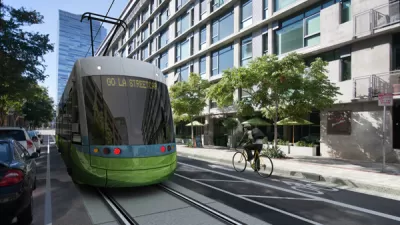
Recently, there have been many critics of cities building streetcar systems as a form of mass transit. In a post on CityLab, David Alpert defends the streetcar transit system, stating that while perfect transit with frequent, speedy service is the goal, good transit (despite some of its shortfalls) is still worth supporting.
For Alpert, greater walkability and urbanization is a momentum game, "even an expensive, sub-optimal transit solution—such as a less-frequent streetcar with no dedicated lane —can push the cycle in the right direction. If it draws population and turns car drivers into transit riders even part of the time, then it will build political support for even better transit systems down the road.” Indeed, Alpert goes on to say that these streetcars can be especially helpful for street-space challenged cities, as they "can make up for a lack of lane space with their length, since they can be much longer than buses and carry more people more efficiently."
In a response to Alpert's post, Jarrett Walker of Human Transit attacked the streetcar as not achieving the main goals of mass transit, to provide access to happiness and economic mobility for large numbers of human beings. Walker questions Alpert's main assumptions, asking why should "the 'imperfect good that we start with' be the streetcar instead of a really liberating transit system run, for now, by buses? Why must we start with a hunk of decontextualized technology rather than our liberty and opportunity to go where we want to go?"
Walker's main qualm with Alpert's argument is his argument that streetcars can create the much needed walkable environments, in the United States, as current ones are too expensive for most to live in. Indeed, Walker explains how "[t]he sheer abundance of places that need to be made more walkable is actually the strongest argument against the streetcars-in-traffic campaign. In transit, if it doesn't scale, it doesn't matter. Streetcars-in-traffic have helped enrich a few superdense districts, but they are far too slow, unreliable, and expensive to scale to the size of our urban mobility problem—at least not as long as they remain stuck in traffic... If you want to see how a city massively expands the usefulness of transit, and thus the potential for transit-oriented lives, look to what is happening in Houston. Massive, scalable, high-frequency bus grids that are useful for getting all over the city, and that can be created now."
FULL STORY: Hey, Streetcar Critics: Stop Making 'Perfect' the Enemy of 'Good'

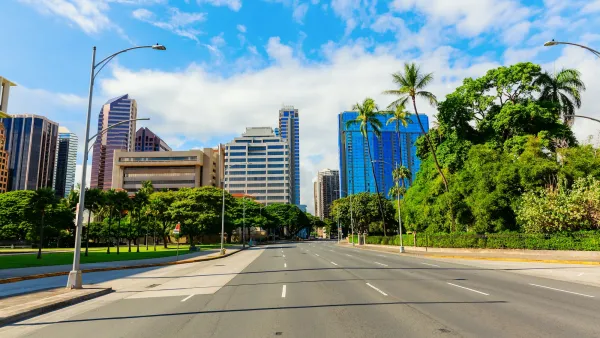
Paradise Lost, Paradise Found: Planning for People Rather Than Cars in Hawai'i
With better planning Honolulu can become an active travel paradise. Replace car sewers with pedestrian promenades, and build urban villages where it is easy to get around without driving.
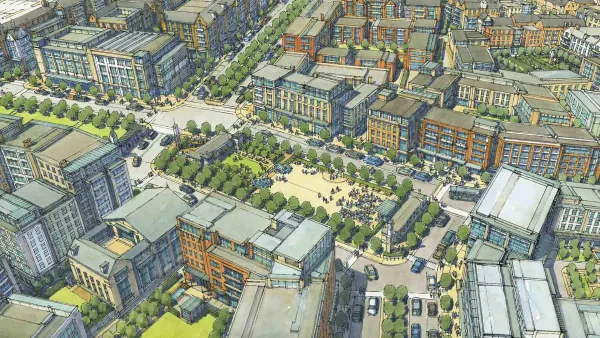
700-Acre Master-Planned Community Planned in Utah
A massive development plan is taking shape for lakefront property in Vineyard, Utah—on the site of a former U.S. Steel Geneva Works facility.
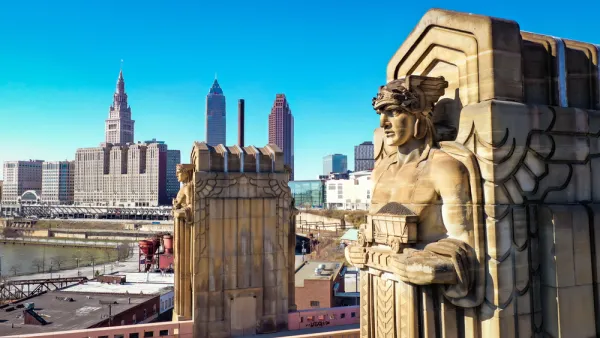
Parking Requirements Removed Near Cleveland Transit Stops
Transit oriented parking reform has arrived in Cleveland.

Planetizen Federal Action Tracker
A weekly monitor of how Trump’s orders and actions are impacting planners and planning in America.

The state-sanctioned urbicide of Austin
People don’t kill cities. Freeways do.

US to reduce Colorado River water deliveries to Mexico
A new Colorado Treaty amendment reduces Mexico’s Colorado River water allocation by 250,000 acre feet.

5 New England states march closer to 800 megawatt wind energy project
Securing federal approval for the project may be complicated under the Trump administration, which has historically been hostile towards domestic wind power.

Baltimore to break ground on $50 million Transit Priority Project
The project will bring faster bus trips, safer streets and better bike connections to Baltimore.

Airbnb launches $250 million 'last-dollar financing' housing accelerator, makes first investment in Austin
The company will put $6.4 million towards affordable housing development in Texas’ capital.

FREE Course: Walkable City 1: Why Walkability?
After describing his path towards focusing on walkability as the essence of good planning, Jeff Speck marches through his five principal reasons for making more walkable places.
Reinventing Malls: Planning Alchemy—Turning Gray Fields Into Gold
The course focuses on the opportunities and imperatives that shape reinvention of mall sites.

Eagle County Government
Harvard University Graduate School of Design
Nashville Planning Department
The Architects Foundation
University of Cincinnati Online
The Pocatello Development Authority
The Urban Renewal Agency of the City of Pocatello
Journal of the American Planning Association