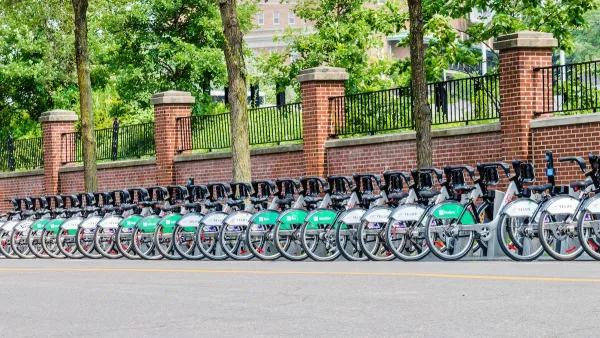
With debts in excess of $30 million owed to the city of Montreal, and unhappy customers in New York City and Chicago refusing to pay for outstanding bills, the Bixi bike-share company has been forced to file for bankruptcy protection.


The pioneering publicly-backed bike-share company Bixi has been forced to seek bankruptcy protection amid "legal disputes, software glitches, upgrade delays," and withheld payments, reports Andy Riga. The company's international expansion, which was intended to finance bike-share operations in Montreal, and the failure to sell its international operations are being blamed for the company's collapse.
Bixi owes the city of Montreal $38 million and suppliers about $9 million. "The city said it sent Bixi a letter on Jan. 15 demanding the money it is owed," notes Riga. "Unable to pay, Bixi filed for bankruptcy protection on Monday (Jan. 20)."
According to Montreal's mayor, the company still plans to operate its bike-share system in the city this year. There's no word on how the bankruptcy filing may affect systems aligned with Bixi in other cities.
UPDATE (1/22/14): In an article in The Atlantic Cities, Sarah Goodyear relays this statement on the status of several Bixi-aligned systems: "Mia Birk, vice president of Alta Bicycle Share, which operates eight Bixi-provided bike-share systems in the United States and Melbourne, Australia, said in an email shortly after the bankruptcy announcement that operations of those systems would be unaffected."
"Our systems across the country — in Washington, D.C., Boston, New York City, Chicago, the Bay Area, Columbus, OH, and Chattanooga, TN — are up and running and ABS will ensure that they continue to operate without interruption,” Birk wrote. “Given our plans to expand current systems and launch new systems this year, we're in constant communication with both PBSC as well as its suppliers to ensure we can do so successfully.”
Read the full story: Bixi files for bankruptcy protection
Montreal Bike Share Breaks Ridership Record With 13 Million Rides
The Bixi system introduced a winter pilot project last year, leading to a rise in winter cycling.

Montreal Shatters Stereotypes on Cold Weather Biking
A combination of infrastructure, connectivity, and quality equipment has made the Canadian city’s bike share system successful despite frigid winters and challenging geography.
Are Montreal and Toronto in Danger of Losing Their Bike Share Systems?
Montreal's Bixi is one of the most replicated bike-sharing systems in the world, but the publicly backed company has struggled with financial troubles since debuting in 2008. Outstanding payments due to Bixi are the latest threat to the company.

Desperate measures: Advocates weigh draining Lake Powell to fill Colorado River
Draining the reservoir could reduce evaporation losses by a couple hundred thousand acre-feet.

Eastern Nebraska is running out of electricity
Data centers and electrification are straining eastern Nebraska’s grid, throttling economic development.

Move over, LA: St. Louis gears up for Olympics, invests millions in downtown redevelopment
The Missouri city will host the 2028 Olympic soccer group stage and knockout matches.

Mass. votes against statewide minimum lot size for single-family homes
Over 2 million residents voted on Question 7; it was decided by just over 30,000 votes.

Maryland’s $15 billion bridge project gains key approval
The Maryland Transit Authority said the project will create over 60,000 jobs and add $23 billion to the local economy.

‘No clear next steps’ for Chicago's permanent festival grounds
Eleventh Ward Ald. Nicole Lee has suggested Soldier Field as a possible location for the permanent event space.

FREE Course: Walkable City 1: Why Walkability?
After describing his path towards focusing on walkability as the essence of good planning, Jeff Speck marches through his five principal reasons for making more walkable places.
Reinventing Malls: Planning Alchemy—Turning Gray Fields Into Gold
The course focuses on the opportunities and imperatives that shape reinvention of mall sites.

City of Rosemead
Rutgers University, Edward J. Bloustein School of Planning and Public Policy
One Hundred Miles
University of Michigan School for Environment and Sustainability (SEAS)
Hunter College, City University of New York (CUNY)
The Architects Foundation
City of Cambridge
Montrose County
The Pocatello Development Authority