New Hampshire will consider a Republican bill in 2014 to tie the gas tax to inflation, increasing it by about 4 cents next year should it pass. The Senate killed a House bill in May to increase the gas tax by 12 cents over 3 years.


"Sen. Jim Rausch, a Derry Republican and chairman of the Senate Transportation Committee, has a new proposal that would link future increases in the gas tax to the rate of inflation, starting with a roughly 4-cent hike in 2014," writes Ben Leubsdorf. The circumstances behind the May defeat were posted on May 29 with an unsuccessful attempt to increase the Iowa gas tax.
The 18-cent state gasoline excise tax or road toll, as it is called in N.H., unchanged for 22 years, falls on the low end [PDF] among state gas taxes.
While Senate President Chuck Morse, a Salem Republican, said he won't block Rausch’s bill from being introduced, he won't support it.
“I continue to oppose any increase in the gas tax; I believe it hurts the families of New Hampshire who can least afford it and it burdens our businesses trying to make ends meet in a fragile economy,” Morse said in a statement.
Had he wished, Morse could have prevented the bill from being heard because the May Senate vote meant that "the subject matter of the (gas tax) bill cannot be resurrected again in the current two-year session", with the subject matter determined "at the discretion of the Senate President," wrote John DisTaso of the Union Leader on May 23.
Unlike the House bill sponsored by Rep. David Campbell, D-Nashua, which died in the Senate due to bipartisan opposition, Rausch's bill does not explicitly raise the gas tax, but by linking it to the Consumer Price Index, there would be an immediate increase in the tax.
In 2014, the increase would reflect CPI change between 2003 and 2013, and going forward, the rate would be automatically adjusted every four years starting in 2018....Final CPI numbers aren’t yet available for 2013, but Rausch estimated the 2014 increase would come in at a little above 4 cents, and that future increases would be “a penny or less” based on the current inflation trend.
Watch for how the House votes on a bill to allow one casino. As we noted in May, Campbell stated that the Senate killed his bill as "retribution for the gambling vote", i.e. because the House defeated that bill.
Neighboring states Vermont and Massachusetts passed bills to increase their gas taxes in April and July, respectively.
Read the full story: Republican state senator proposes linking N.H. gas tax hikes to inflation
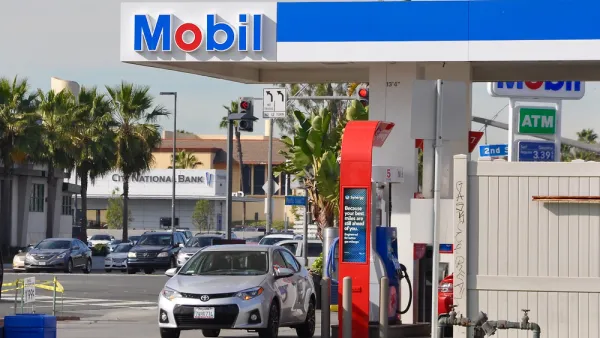
Democrats Balk at Gov. Newsom's Gas Tax Holiday
Saving motorists 3 cents a gallon may be a slam dunk for Republican leaders in the California legislature who opposed hiking the gas tax in the first place, but Democratic leaders are reluctant to tamper with a hard-fought legislative and ballot win.
Biden Proposes Gas Tax Holiday to Reduce Gas Prices
President Biden asked Congress on June 22 to suspend federal fuel taxes, unchanged since 1993, for three months to provide motorists 'relief' at the pump. Additionally, he asked states to follow suit and for oil companies to increase refining.
ICYMI: 12 States Hiked Gas Taxes on Monday
On July 1, Illinois and Ohio increased gas taxes by double digits: 19 cents per gallon and 10.5 CPG, respectively, followed by California at 5.6 CPG, all due to legislation passed this year or in 2017. Diesel tax hikes were even higher.

Planetizen Federal Action Tracker
A weekly monitor of how Trump’s orders and actions are impacting planners and planning in America.

California plans to bury El Niño’s downpour
If the state plays its cards right, it may be able to store a billion acre-feet of El Niño’s water in aquifers.

Desperate measures: Advocates weigh draining Lake Powell to fill Colorado River
Draining the reservoir could reduce evaporation losses by a couple hundred thousand acre-feet.

Mamdani’s pied-à-terre tax survives legal challenge
A panel of judges found that the plaintiffs failed to demonstrate injury as a result of New York City's implementation of the tax.

Eastern Nebraska is running out of electricity
Data centers and electrification are straining eastern Nebraska’s grid, throttling economic development.

Seattle passes record-breaking transit services expansion
Proposition 1 will double the city’s transit tax to add 95,000 more bus trips and preserve 180,000 bus trips annually.

FREE Course: Walkable City 1: Why Walkability?
After describing his path towards focusing on walkability as the essence of good planning, Jeff Speck marches through his five principal reasons for making more walkable places.
Reinventing Malls: Planning Alchemy—Turning Gray Fields Into Gold
The course focuses on the opportunities and imperatives that shape reinvention of mall sites.

City of Rosemead
Rutgers University, Edward J. Bloustein School of Planning and Public Policy
One Hundred Miles
University of Michigan School for Environment and Sustainability (SEAS)
Hunter College, City University of New York (CUNY)
The Architects Foundation
City of Cambridge
Montrose County
The Pocatello Development Authority