Gas tax increases can mean more road funding, period, particularly where constitutional restrictions prohibit spending gas tax revenues on other modes, as exists in Pa.; yet all modes will benefit from the 28-cent gas tax increase legislation.


Angie Schmitt writes that transit will definitely benefit from the bill that Gov. Tom Corbett signed on Monday that is estimated to increase wholesale gas taxes by 28-cents over three years. This increase includes the elimination of the 12-cent state excise tax on gasoline.
Philadelphia transit agency SEPTA gets a big funding boost, enough to spare disastrous service cuts. Pittsburgh transit will also get some much welcome financial stability after years of uncertainty, fare hikes, and threats to service.
According to The Daily Pennsylvanian, the bill "will provide about $350 million in funding to SEPTA, which would have closed nine of its 13 regional rail lines by 2023 if it did not receive the extra funds." Read more about the "Doomsday Plan" the agency had prepared.
The below email from the Pittsburgh Post-Gazette explains how public transit received funding from the bill. Pennsylvania is one of 30 states that restricts gas tax revenues to road-only applications according to Brookings "Fueling Transportation Finance: A Primer on the Gas Tax" (PDF).
Transit will get funding from a variety of sources, but nothing from the Oil Company Franchise Tax. The Pa Turnpike currently pays PennDOT $450 million a year, $200 million of which goes to roads-bridges and $250 million to transit. The $200 million will be redirected to transit. Some "nonrestricted" vehicle fees that aren't constitutionally reserved for roads-bridges will go to transit, as will a share of the increases in traffic fines.
Walking and biking are also big winners, writes Sarah Stuart, whose group, PA Walks and Bikes, had been lobbying the legislature all year to ensure that active transportation funding would be in the bill.
As (PennDOT Secretary Barry) Schoch told advocates Monday night, “This is the biggest step forward for the bicycle and pedestrian modes of transportation in the history of Pennsylvania.”
Stuart lists four ways in which active transportation benefits, including:
- Sets an annual minimum of $2 million of that fund to be spent on bicycle and pedestrian facilities;
- Explicitly states that Pennsylvania’s comprehensive transportation system includes Pennsylvania’s “numerous bicycle and pedestrian facilities,” which will make it easier for bicycle/pedestrian projects to compete for highway funds.
Stuart credits all the groups working "with the Keystone Transportation Funding Coalition and the health groups that collaborated on Walk Ride PA" for the funding for active transportation.
According to the Pittsburgh Post-Gazette, the legislation "will result in a net increase in the state gasoline tax of 9.5 cents per gallon starting Jan. 1; another 9.7 cents for 2015; and at least 8 cents for 2017." It is anticipated that gas retailers will pass "all or most" of the tax to motorists, writes Dustin Hockensmith of The Patriot-News.
Ryan Holeywell of Governing writes that the new law "will eventually mean more than $2.3 billion annually in additional funds for transportation infrastructure."
Read the full story: Pennsylvania Transportation Bill a “Dramatic Win” for Biking and Walking


London Low-Emissions Zone Prompts Shift to Active Modes
More children are using active transportation modes to get to school in the wake of a policy that charges drivers to enter a low-emissions zone in central London.
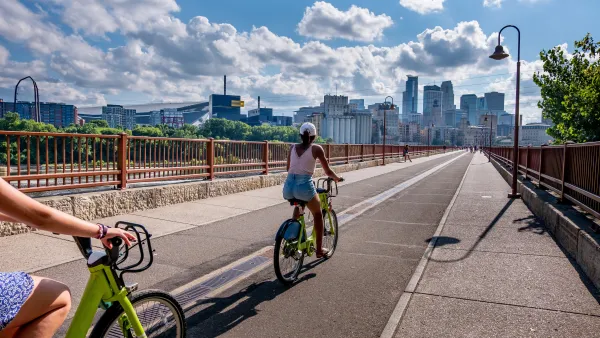
Minnesota Awards Active Transportation Grants
The grants are aimed at helping cities create action plans for improving their bike and pedestrian networks.
New App Rewards Green Transportation with Deals
Miles brings the frequent flyer concept to ground level by offering rewards for your daily commute.

Planetizen Federal Action Tracker
A weekly monitor of how Trump’s orders and actions are impacting planners and planning in America.

Amtrak, CN end decades-long dispute with eight-year agreement
The new operating agreement establishes an updated framework for the companies to work together, including processes to resolve disputes.

Judges permit Denver to divert 77,000 acre feet from the Colorado River for reservoir expansion
Overuse and climate change have caused the Colorado River’s water levels to plummet.

Philadelphia to invest $2 billion into upgrading city airports as PHL places last in customer satisfaction
Modernizations to Philadelphia's airports will include baggage system upgrades and a new automated parking garage guidance system.

The LA housing policies making developers turn away from the city
Despite LA’s housing shortage, developers say the city’s "mansion-tax" and pandemic-era policies make it an unappealing place to build housing.

New density bill would require 7 California cities to establish regional transit hubs
The bill would also require major cities in California to permit high-rise residential buildings.

FREE Course: Walkable City 1: Why Walkability?
After describing his path towards focusing on walkability as the essence of good planning, Jeff Speck marches through his five principal reasons for making more walkable places.
Reinventing Malls: Planning Alchemy—Turning Gray Fields Into Gold
The course focuses on the opportunities and imperatives that shape reinvention of mall sites.

City of Wisconsin Rapids
Harvard University Graduate School of Design
KFH Group Inc.
The Architects Foundation
University of Cincinnati Online
The Pocatello Development Authority
The Urban Renewal Agency of the City of Pocatello