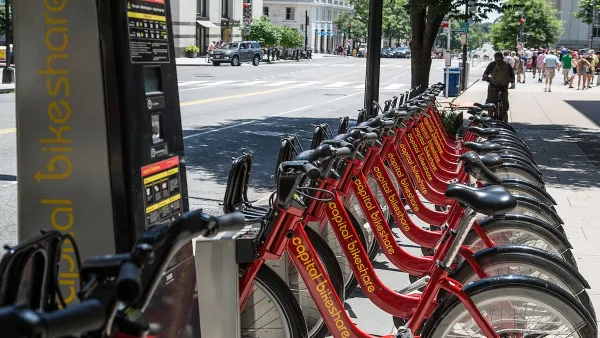
With 174 stations in DC, and more than 200 throughout the region, Capital Bikeshare has logged almost 5 million rides since it launched in 2010. The program's immense popularity has caused some problems however, with demand often outstripping supply.


"Born in 2010, the bike-share service has spread to Arlington and Alexandria, signed a contract for expansion into Montgomery County and this year is approaching 1 million trips logged by subscribers," writes Nicole Chavez. "In some ways, such rapid growth is a nice problem to have. But it can still be a problem."
"Those who have paid $75 for an annual subscription for unlimited trips of up to 30 minutes sometimes can’t get wheels when they want them," she explains. "Other times, they get the bike but not the slot to dock it in. And workers constantly struggle to balance the number of bikes and empty spaces in bicycle stations across the city. In 2010, one van shifted about 300 bikes a day. Now, six vans move 1,000 bikes daily, from 5 a.m. to 1 the next morning."
“It’s hard, because we are stuck in traffic like everyone else,” said Eric Gilliland, Capital Bikeshare’s director of operations.
Read the full story: As Capital Bikeshare expands in popularity and size, it runs into logistical issues

CaBi Breaks Ridership Record — Again
Washington D.C.’s bike share system is extremely popular with both residents and visitors.

DC Bike Share Growing Fast, But Regional Gaps Remain
The wildly popular system ‘frays at its geographic edges,’ making its use less effective outside the central District.
DC Micromobility Use Keeps Growing
Capital Bikeshare saw its fourth straight month of record ridership.

Desperate measures: Advocates weigh draining Lake Powell to fill Colorado River
Draining the reservoir could reduce evaporation losses by a couple hundred thousand acre-feet.

Eastern Nebraska is running out of electricity
Data centers and electrification are straining eastern Nebraska’s grid, throttling economic development.

Malls are becoming the midtowns of the future
Mall and office park redevelopments are a generational opportunity to create new nodes of urbanity.

NYC breaks ground on anti-flooding infrastructure project
New York City's new system will reduce stormwater flows to local sewers by 90%.

One Kentucky town’s secret to affordable housing
The Smoketown Community Land Trust has already built seven affordable homes for community members.

Houston gains petal-shaped cooling infrastructure to make streets more ‘delightful’
The city has installed the pavilions along 15 blocks in Houston.

FREE Course: Walkable City 1: Why Walkability?
After describing his path towards focusing on walkability as the essence of good planning, Jeff Speck marches through his five principal reasons for making more walkable places.
Reinventing Malls: Planning Alchemy—Turning Gray Fields Into Gold
The course focuses on the opportunities and imperatives that shape reinvention of mall sites.

City of Rosemead
Rutgers University, Edward J. Bloustein School of Planning and Public Policy
One Hundred Miles
University of Michigan School for Environment and Sustainability (SEAS)
Hunter College, City University of New York (CUNY)
The Architects Foundation
City of Cambridge
Montrose County
The Pocatello Development Authority