As California rushes to begin building the first phase of its controversial high-speed rail project, the decision to select a builder based more on cost than technical competence is being scrutinized by state and federal lawmakers.


High-speed rail skeptic Ralph Vartabedian looks at the growing controversy surrounding the selection of a construction team led by Tutor Perini Corp. to build the first segment of California's high-speed rail network. "Tutor Perini Corp. won the competition to build the first 29 miles of the high-speed rail route on a low bid of $985 million, even though its design quality, safety plan and engineering, among other factors, ranked at the bottom of five teams seeking the work."
"A state Senate committee, a subcommittee of the U.S. House of Representatives and the state auditor, among others, are looking at a variety of issues and allegations about the project, even as the state begins buying the first parcels of land ahead of the planned start of construction in July."
A couple of "unusual" moves by the state - weighing the decision to focus on cost and discarding a plan to disqualify the two lowest bidders - may have been decisive in Tutor Perini's selection, contends Vartabedian.
Read the full story: Builder of 1st phase of California's bullet train faces scrutiny

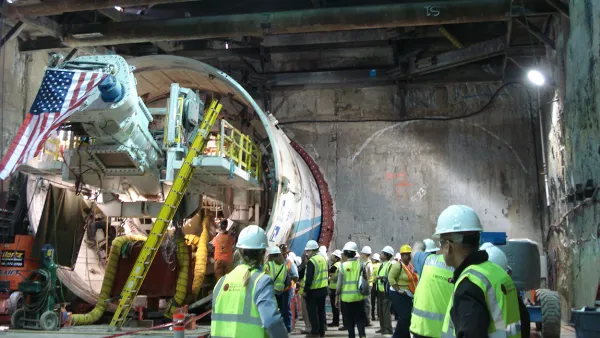
Subway Project Budget 'Running on Fumes' in San Francisco
The high-profile Central Subway is in danger of running out of money, according to a federal watchdog.

The Consultants Behind the CA High-Speed Rail Debacle
The state's high-speed rail project is billions of dollars over budget and years behind schedule. A major problem is that consultants have been running the show from the start, say critics.
California High-Speed Rail's Second Construction Contract: $1.36 Billion
A week after the groundbreaking ceremony for California's beleaguered high speed rail project, a second construction contract has been awarded. The rail authority will now build 29 miles north and 65 miles south of Fresno to the Kern County line.

Planetizen Federal Action Tracker
A weekly monitor of how Trump’s orders and actions are impacting planners and planning in America.

California plans to bury El Niño’s downpour
If the state plays its cards right, it may be able to store a billion acre-feet of El Niño’s water in aquifers.

Chicago breaks ground on $3 billion megadevelopment
The new neighborhood, titled Foundry Park, will one day host 3,700 residences.

Desperate measures: Advocates weigh draining Lake Powell to fill Colorado River
Draining the reservoir could reduce evaporation losses by a couple hundred thousand acre-feet.

This road in NYC is infamously dangerous — and Mamdani can't fix it
New York City's Ocean Parkway is known for reckless driving, but the power to implement safety measures lies with the state rather than the city.

One of Denver’s busiest corridors to gain BRT
The project will span 18 miles and contain 74 bus rapid transit stations.

FREE Course: Walkable City 1: Why Walkability?
After describing his path towards focusing on walkability as the essence of good planning, Jeff Speck marches through his five principal reasons for making more walkable places.
Reinventing Malls: Planning Alchemy—Turning Gray Fields Into Gold
The course focuses on the opportunities and imperatives that shape reinvention of mall sites.

City of Rosemead
Rutgers University, Edward J. Bloustein School of Planning and Public Policy
One Hundred Miles
Hunter College, City University of New York (CUNY)
The Architects Foundation
University of Cincinnati Online
City of Cambridge
Montrose County
The Pocatello Development Authority