The builder of the first phase of California's high-speed rail project has been selected after a competitive bid process. The winning team had the lowest bid, but also the lowest technical score.


With a bid that came in $200 million under expectations, the Tutor Perini/Zachry/Parsons joint venture has beat out four other bids to win the contract to build the first 28-mile segment of California's high-speed rail project, reports Isabel Angell.
"Bids were judged both on cost and the technical aspects of the plan, like how well they grasped the project to the likelihood of staying on schedule. More weight was given to the cost of the proposal. The winning Tutor Perini/Zachry/Parsons proposal got the full 70 points for cost, but received the lowest technical score with 20.55 out of a possible 30."
Read the full story: California High-Speed Rail Gets First Contractor

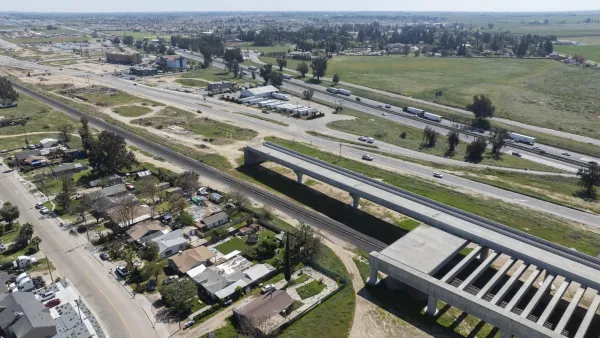
California rail builders sign MOU advancing statewide high-speed network
The agreement aims to create an interconnected high-speed rail network and bring down the cost of construction.

California High-Speed Rail wants to leverage data center revenue to fund trains
By positioning the rail line as a tech and renewable energy corridor, the agency hopes to increase revenue opportunities.
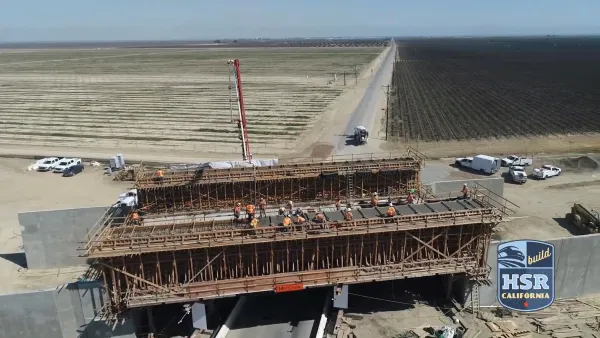
California High-Speed Rail Slashes $1.7B From 2026 Budget
The CHSRA plans to complete the Central Valley segment of the line and begin revenue service as soon as possible.

Planetizen Federal Action Tracker
A weekly monitor of how Trump’s orders and actions are impacting planners and planning in America.

California plans to bury El Niño’s downpour
If the state plays its cards right, it may be able to store a billion acre-feet of El Niño’s water in aquifers.

Chicago breaks ground on $3 billion megadevelopment
The new neighborhood, titled Foundry Park, will one day host 3,700 residences.

Want to study the Missouri River? Soon, you may need unanimous approval from 10 states
Legislation would require 10 governors’ permission to study or build projects moving water outside the basin.

Desperate measures: Advocates weigh draining Lake Powell to fill Colorado River
Draining the reservoir could reduce evaporation losses by a couple hundred thousand acre-feet.

This road in NYC is infamously dangerous — and Mamdani can't fix it
New York City's Ocean Parkway is known for reckless driving, but the power to implement safety measures lies with the state rather than the city.

FREE Course: Walkable City 1: Why Walkability?
After describing his path towards focusing on walkability as the essence of good planning, Jeff Speck marches through his five principal reasons for making more walkable places.
Reinventing Malls: Planning Alchemy—Turning Gray Fields Into Gold
The course focuses on the opportunities and imperatives that shape reinvention of mall sites.

City of Rosemead
Rutgers University, Edward J. Bloustein School of Planning and Public Policy
One Hundred Miles
Hunter College, City University of New York (CUNY)
The Architects Foundation
University of Cincinnati Online
City of Cambridge
Montrose County
The Pocatello Development Authority