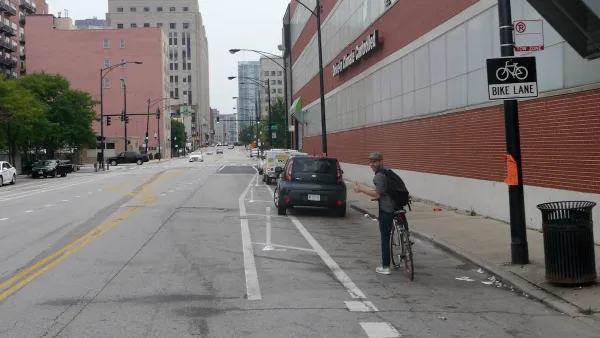
Art Golab reports on Mayor Rahm Emanuel's plan to make Chicago "the bike friendliest city in the country," which the mayor hopes will attract and keep high tech companies and their workers. The best part? The entire city benefits!


Cyclists, rejoice! This past Sunday, Chicago Mayor Rahm Emanuel announced plans for a network of protected bicycle lanes that he hopes will appeal to local tech company workers who favor cycling over driving and have been fleeing the city for more bicycle-friendly areas. The mayor stated that once the project is completed, he hopes "the type of companies that have been leaving for the coast will stay in the city of Chicago."
The proposed project will include buffered bike lanes and bicycle signals to ensure the utmost safety for cyclists and drivers. Writes Golab, "by the end of the year, Chicago will have 22 miles of protected bike lanes, bringing the total to 33 miles. The cost," according to the city Transportation Commissioner Gabe Klein, "is about $140,000 a mile."
Other street infrastructure projects in the works in Chicago include a new "Neighborhood Greenway" on Berteau Avenue Between Lincoln Avenue and Clark Street on the North Side, and a "road diet" expansion of pedestrian and bicycle areas along part of South Chicago Avenue on the South Side.
Read the full story: More bike lanes planned for city
A Buffer is Better
What's the best street design to keep bicyclists safely out of the door zone? A buffered bike lane beats a conventional bike lane or "wide curb lane" according to a recent study published in TRB, based on observations in Chicago and Cambridge, Mass.

Chicago bike lane projects spark backlash from businesses, gentrification fears
A battle is brewing over Chicago's street space.
Chicago Pilot Would Keep Bike and Bus Lanes Clear — Without the Police
A proposal supported by many city officials and road safety advocates would shift right-of-way enforcement to ‘Rapid Response Aides’ to free up police resources and clear blocked lanes more quickly.

Desperate measures: Advocates weigh draining Lake Powell to fill Colorado River
Draining the reservoir could reduce evaporation losses by a couple hundred thousand acre-feet.

Eastern Nebraska is running out of electricity
Data centers and electrification are straining eastern Nebraska’s grid, throttling economic development.

Malls are becoming the midtowns of the future
Mall and office park redevelopments are a generational opportunity to create new nodes of urbanity.

NYC breaks ground on anti-flooding infrastructure project
New York City's new system will reduce stormwater flows to local sewers by 90%.

One Kentucky town’s secret to affordable housing
The Smoketown Community Land Trust has already built seven affordable homes for community members.

Houston gains petal-shaped cooling infrastructure to make streets more ‘delightful’
The city has installed the pavilions along 15 blocks in Houston.

FREE Course: Walkable City 1: Why Walkability?
After describing his path towards focusing on walkability as the essence of good planning, Jeff Speck marches through his five principal reasons for making more walkable places.
Reinventing Malls: Planning Alchemy—Turning Gray Fields Into Gold
The course focuses on the opportunities and imperatives that shape reinvention of mall sites.

City of Rosemead
Rutgers University, Edward J. Bloustein School of Planning and Public Policy
One Hundred Miles
University of Michigan School for Environment and Sustainability (SEAS)
Hunter College, City University of New York (CUNY)
The Architects Foundation
City of Cambridge
Montrose County
The Pocatello Development Authority