The Governor's Highway Safety Association released a report citing an uptick in pedestrian fatalities in the first half of 2010 and speculates on all sorts of reasons for this except poor road design.


David Alpert writes about coverage of the GHSA report in the Washington Post and Examiner, which he says "reveal the intense windshield perspective still pervasive in mainstream media":
The GHSA report speculates that increased pedestrian fatalities are result of all sorts of trends like distracted driving and walking, or even efforts to get more people walking like First Lady Michelle Obama's "Let's Move" campaign. What's not discussed is the fact that the rate of fatalities may be falling and the all-too-infrequently discussed root cause that our streets are not designed to accommodate pedestrians:
"It's easy to blame iPods or Michelle Obama, but more important to work to make the roadway network actually usable by pedestrians. That's the real way to improve both the numbers of people walking and their safety."
Thanks to Erik Weber
Read the full story: Maryland road safety head, Post's Halsey blame pedestrians and even Michelle Obama for fatalities
Getting Buy-In On A New Urbanist Vision
Alamo Heights, a suburb of San Antonio, grapples with whether to adopt a "New Urbanist" (but slightly more traditional) approach to its major thoroughfare to improve pedestrian and bicycle access.
Traffic Calmed
This video from StreetFilm shows the extensive traffic calming efforts taken by one beach community in Australia.
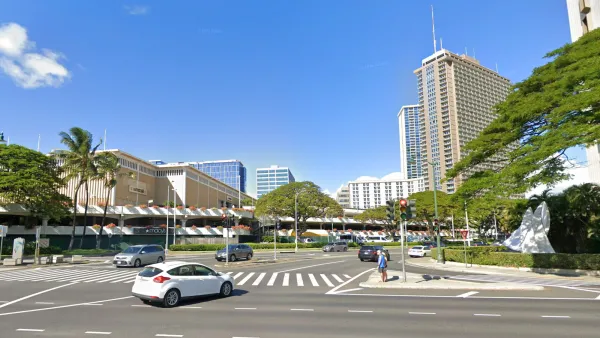
Hawaii DOT takes action after reporters call attention to dangerous crosswalk
The state made changes to a treacherous intersection after reporting revealed that traffic light timing was posting a threat to pedestrians.

Planetizen Federal Action Tracker
A weekly monitor of how Trump’s orders and actions are impacting planners and planning in America.

California plans to bury El Niño’s downpour
If the state plays its cards right, it may be able to store a billion acre-feet of El Niño’s water in aquifers.

Desperate measures: Advocates weigh draining Lake Powell to fill Colorado River
Draining the reservoir could reduce evaporation losses by a couple hundred thousand acre-feet.

Bay area voters pass ‘crucial lifeline’ for transit
Proposition RTM, which will fund Bay Area transit, has approval from 61% of voters as of 9:45 p.m. on Nov. 3.

Voters across the country reject data centers
Dozens of communities voted on measures to restrict the buildout of data centers.

US buildings threatened, destroyed by fires set to triple by 2060
Researchers found a high fire risk for socioeconomically vulnerable neighborhoods in the American West.

FREE Course: Walkable City 1: Why Walkability?
After describing his path towards focusing on walkability as the essence of good planning, Jeff Speck marches through his five principal reasons for making more walkable places.
Reinventing Malls: Planning Alchemy—Turning Gray Fields Into Gold
The course focuses on the opportunities and imperatives that shape reinvention of mall sites.

City of Rosemead
Rutgers University, Edward J. Bloustein School of Planning and Public Policy
One Hundred Miles
Hunter College, City University of New York (CUNY)
The Architects Foundation
University of Cincinnati Online
City of Cambridge
Montrose County
The Pocatello Development Authority