Small cities around the country with high unemployment are desperate for jobs, but when an Amazon distribution center moves into town, it's not all good news.


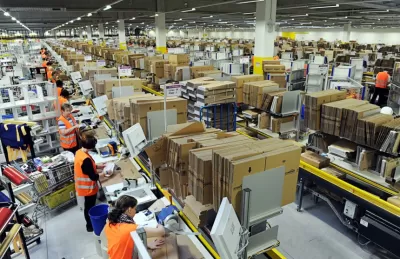
San Bernardino, a city located in the Inland Empire of Southern California, was excited to get an Amazon distribution center, but some worry the company, which is now the city's biggest employer, is holding down wages. "San Bernardino, the unemployment rate that was as high as 15 percent in 2012 is now 5 percent," Alana Semuels reports for The Atlantic. But "[t]he median household income in 2016, at $38,456, is 4 percent lower than it was in 2011." This phenomenon is not uncommon in cities with lots of Amazon jobs. "A report from the Institute for Local Self-Reliance found that Amazon paid 11 percent less than the average warehouse in the Inland Empire; a similar analysis by The Economist found that workers earn about 10 percent less in areas where Amazon operates than similar workers employed elsewhere," Semuels writes.
Cities competing for these distribution centers don't consider it possible to make demands of the online retailer, which could find other locations. "These places, often located in the outskirts of major cities, have lost retail and manufacturing jobs and, in many cases, are still recovering from the recession and desperate to attract economic activity," Semuels writes. In fact, they often offer Amazon incentives in tax deals and infrastructure built specifically for the distribution center. "If these places don’t get a new Amazon facility, they won’t instead get companies like Stater Brothers that are willing to come in and pay double or triple the minimum wage for jobs that don’t require a college education."
The company also encourages a high level of competition between its warehouse employees, Semuels reports. "They’ll run competitions such as a 'Power Hour' in which workers are encouraged to work as hard as they can for a prize. One recent prize was a cookie." Some in San Bernardino have tried to start unions, but those efforts have not gained traction. "Randy Korgan, the business representative and Director of the Teamsters Local 63, which represents the Stater Brothers employees, told me that his office frequently gets calls from Amazon employees wanting to organize. But organizing is difficult because people fear losing their jobs if they speak up," Semuels writes.
FULL STORY: What Amazon Does to Poor Cities

The Stark Differences Between the Two Californias
Many think the two geographic divisions in CA are north and south, but this article uses economic data to show that the real division is between coastal and inland. These differences transcend economics and are revealed in public policies as well.

Hydrogen-Powered Train to Launch in Southern California
The 9-mile rail line could be a welcome breath of fresh air for one of the region’s most polluted communities.
Labor Unions Fight for Affordable Housing
Workers find it increasingly difficult to access affordable housing near their jobs.

Planetizen Federal Action Tracker
A weekly monitor of how Trump’s orders and actions are impacting planners and planning in America.

The state-sanctioned urbicide of Austin
People don’t kill cities. Freeways do.

US to reduce Colorado River water deliveries to Mexico
A new Colorado Treaty amendment reduces Mexico’s Colorado River water allocation by 250,000 acre feet.

5 New England states march closer to 800 megawatt wind energy project
Securing federal approval for the project may be complicated under the Trump administration, which has historically been hostile towards domestic wind power.

Baltimore to break ground on $50 million Transit Priority Project
The project will bring faster bus trips, safer streets and better bike connections to Baltimore.

Airbnb launches $250 million 'last-dollar financing' housing accelerator, makes first investment in Austin
The company will put $6.4 million towards affordable housing development in Texas’ capital.

FREE Course: Walkable City 1: Why Walkability?
After describing his path towards focusing on walkability as the essence of good planning, Jeff Speck marches through his five principal reasons for making more walkable places.
Reinventing Malls: Planning Alchemy—Turning Gray Fields Into Gold
The course focuses on the opportunities and imperatives that shape reinvention of mall sites.

Eagle County Government
Harvard University Graduate School of Design
Nashville Planning Department
The Architects Foundation
University of Cincinnati Online
The Pocatello Development Authority
The Urban Renewal Agency of the City of Pocatello
Journal of the American Planning Association