As part of Human Settlements Day at COP-23 on November 11, Planners for Climate Action will feature representatives of professional planners associations and planning school associations worldwide.


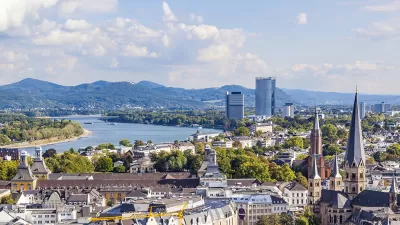
Planners for Climate Action will launch at COP-23 in Bonn as a stakeholder group under the Marrakesh Partnership in the UN Framework Convention on Climate Change (UNFCCC). Planners for Climate Action will be part of Human Settlements Day on November 11 at COP-23, beginning at 11:30 am in the Davos Room, Bonn Zone.
Cities emit a significant portion of the world's greenhouse gases while providing homes to concentrated populations that are highly vulnerable to the impacts of climate change. Over the past decade or so, sub-national governments have been rising in visibility in the UN climate discussions. At the 2014 Ban Ki-moon Climate Summit several new stakeholder groups reflecting government perspectives were added. The 2015 Paris Agreement explicitly mentions "cities and subnational authorities" as one type of non-Party stakeholder that is invited to "scale up" its efforts.
Urban and regional planners have a key role to play in helping cities address climate change. Compact urban development patterns may make public transportation more viable, leading to reduced greenhouse gas emissions; meanwhile in the long-term land use controls will profoundly affect the exposure of vulnerable populations to climate-related natural hazards such as flooding and landslides. The role of city and regional planners and plans in addressing climate change is made explicit in the 2030 Agenda for Sustainable Development as well as in the New Urban Agenda. Despite this, city planners and their organizations have been outside the purview of the UNFCCC Marrakesh Partnership. This step forward will be important for our profession and our schools, and to the degree that we have substance to offer that others do not, for the global climate change process.
The launch will feature UN-Habitat Executive Director Joan Clos, and Hakima El Haite, special envoy for climate change, Kingdom of Morocco; and Imia Seruiratu, minister for agriculture, minister for rural and maritime development and national disaster management, Government of Fiji; high-level champion, Marrakesh Partnership for Global Climate Action.
There will be two planners roundtables. One, moderated by Shipra Narang Suri, coordinator of UN-Habitat's Urban Planning and Design Branch, will bring representatives of professional planners organizations together, including Didier Vancutsem, secretary general, International Society of City and Regional Planners (ISOCARP), Clive Harridge, secretary general, Commonwealth Association of Planners (CAP), Jeff Soule, director of outreach and international programs, American Planning Association (APA), and Shi Nan, secretary general, Urban Planning Society of China (UPSC).
The second roundtable, organized by Global Planning Education Association Network (GPEAN) and moderated by me, will include Divya Leducq, associate professor in Urban and Regional Planning, Polytechnic College of the University of Tours (France); Association for the Development of Planning Education and Research (APERAU); Shuaib Lwasa, associate professor, Department of Geography, Makerere University, Uganda; Association of African Planning Schools (AAPS); Benjamin Davy, professor of Land Policy, Land Management, Municipal Geoinformation, TU Dortmund University (Germany); vice president, Association of European Schools of Planning (AESOP); Azime Tezer, professor of Urban and Regional Planning, Istanbul Technical University, Turkey; Association of Planning Schools of Turkey (TUPOB); Ricardo Villasis-Keever, faculty member, Universidad Autónoma de San Luis Potosí, Mexico; Asociación Latinoamericana de Escuelas de Urbanismo y Planificación (ALEUP); and Barbara Norman, foundation chair of Urban and Regional Planning, University of Canberra, Australia, Australia and New Zealand Association of Planning Schools (ANZAPS)
There will also be a meeting of planners' association and planning school association representatives with UN officials at COP-23 to lay out the working plans for the new stakeholder group. The US Association of Collegiate Schools of Planning will be represented at this meeting by Michael Boswell of California Polytechnic, San Luis Obispo.

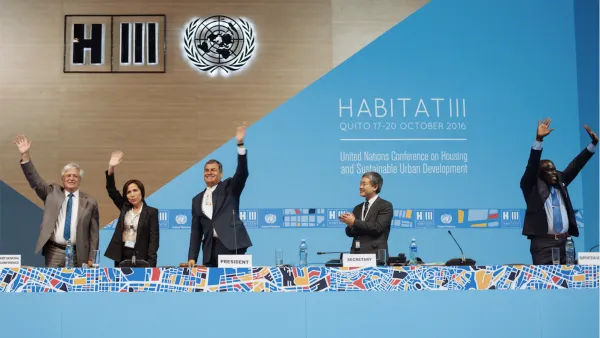
Will Planners Lead the New Urban Agenda?
The United Nation’s New Urban Agenda has created a playbook for planning advocates. It opens possibilities for building inclusive, integrated urban planning in countries where planning has been top-down and limited in scope.
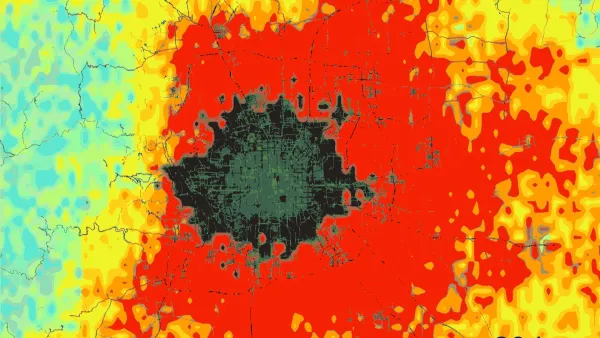
Five Key Takeaways from the 2018 World Urban Forum
Insight into the hard work of implementing the New Urban Agenda.
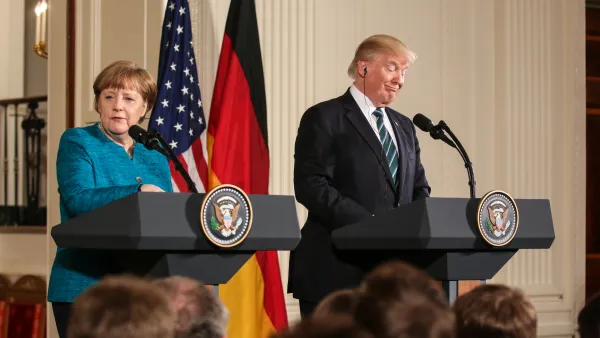
Host Nation Reveals Embarrassment as Climate Talks End
It's not so easy weaning itself from dirty coal power, one reason why Germany likely won't meet its 2020 greenhouse gas reduction targets. But they will have plenty of company, though all targets are voluntary.

Planetizen Federal Action Tracker
A weekly monitor of how Trump’s orders and actions are impacting planners and planning in America.

Amtrak, CN end decades-long dispute with eight-year agreement
The new operating agreement establishes an updated framework for the companies to work together, including processes to resolve disputes.

Judges permit Denver to divert 77,000 acre feet from the Colorado River for reservoir expansion
Overuse and climate change have caused the Colorado River’s water levels to plummet.

San Diego may kill one-third of its bus routes as budget crisis looms
Under the city's proposed plan, 21% of Metropolitan Transit System riders would lose access to transit services.

Philadelphia to invest $2 billion into upgrading city airports as PHL places last in customer satisfaction
Modernizations to Philadelphia's airports will include baggage system upgrades and a new automated parking garage guidance system.

The LA housing policies making developers turn away from the city
Despite LA’s housing shortage, developers say the city’s "mansion-tax" and pandemic-era policies make it an unappealing place to build housing.

FREE Course: Walkable City 1: Why Walkability?
After describing his path towards focusing on walkability as the essence of good planning, Jeff Speck marches through his five principal reasons for making more walkable places.
Reinventing Malls: Planning Alchemy—Turning Gray Fields Into Gold
The course focuses on the opportunities and imperatives that shape reinvention of mall sites.

City of Wisconsin Rapids
Harvard University Graduate School of Design
KFH Group Inc.
The Architects Foundation
University of Cincinnati Online
The Pocatello Development Authority
The Urban Renewal Agency of the City of Pocatello

