Urbanites' complaints about gentrification have much in common with suburbanites' complaints about commutes. Scarcity due to the ridiculous amount of land zoned for single-family housing deserves as much blame for displacement as gentrification.


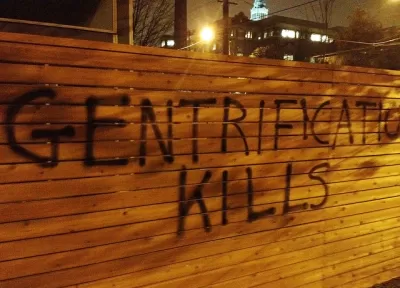
"The only thing worse than listening to suburbanites bitch about being stuck in traffic? Listening to local politicians pretend they can actually do something to "Make Commutes Great Fast Again."
"Way, way back in the '50s and '60s, people got it into their heads that they had a constitutional right to live in the suburbs and drive in or through the center of a city—to jobs, to stores, to stadiums, to hookers, to suburbs on the other side of the city—going seventy miles an hour. Our local politicians can't bring themselves to tell these entitled shits the truth: It's never going to be the 1960s around here again, when expressways were expressways, not parking lots. We can't build our way out of this. We can only build alternatives to cars, aka mass transit. (Preferably rapid transit, which is grade-separated transit. Without taking lanes away from cars, which we aren't going to do, BRT is not rapid transit. It's an oxymoron.) Mayors and city council members and county council members in cities with with [sic] functioning mass transit systems don't have to make serious faces and reassure entitled drivers that they're gonna do something to speed up their commutes.
"At roughly same time suburbanites got it into their heads that they're entitled to drive through the center of the city at 70 MPH, urbanites got it into their heads that the center of the city is cheapest place to live. ("Downtown, where the folks are broke!") And for a while the center of the city was the cheapest place to live. But that's no longer the case."
More from Dan Savage's article after the jump.
Read the full story: Doing Something Real About Gentrification and Displacement

Push and Pull: The Link Between Walkability and Affordability
The increased demand for walkable urban spaces could make them more and more exclusionary if cities don’t pursue policies to limit displacement and boost affordability.
When Costs of Living Outpace Housing Costs
Even when they qualify for affordable rents, tenants in high-cost neighborhoods find themselves shut out of essential amenities and services.
Atlanta BeltLine Raises the Specter of 'Environmental Gentrification'
Large-scale adaptive reuse projects like the BeltLine in Atlanta receive praise in many circles. But they can also release a flurry of speculation, severely threatening affordability.

Planetizen Federal Action Tracker
A weekly monitor of how Trump’s orders and actions are impacting planners and planning in America.

Amtrak, CN end decades-long dispute with eight-year agreement
The new operating agreement establishes an updated framework for the companies to work together, including processes to resolve disputes.
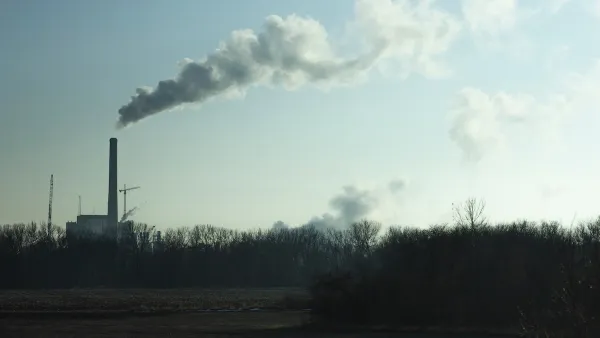
Nation's most wind-powered state turns to coal as data centers increase energy demand
For the first time in decades, Iowa has increased its generation of coal power.

Alabama scores up to $2.5 billion federal loan for largest infrastructure project in state’s history
The Mobile River Bridge and Bayway Project aims to ease congestion at Alabama’s worst bottleneck.

Trump is considering data centers on 6 states' public land — some state officials say they had no idea
If the administration approves the proposed projects, data center and data center-related developments will cover 17,600 acres of public land.

Despite court ruling, Trump is keeping nearly all wind projects in the US on hold
At least 110 wind energy projects have not heard from the government since a federal judge ruled that the Trump administration's freeze on wind turbine clearances was likely illegal.

FREE Course: Walkable City 1: Why Walkability?
After describing his path towards focusing on walkability as the essence of good planning, Jeff Speck marches through his five principal reasons for making more walkable places.
Reinventing Malls: Planning Alchemy—Turning Gray Fields Into Gold
The course focuses on the opportunities and imperatives that shape reinvention of mall sites.

KFH Group Inc.
Greater Baltimore Committee
Eagle County Government
The Architects Foundation
University of Cincinnati Online
The Pocatello Development Authority
The Urban Renewal Agency of the City of Pocatello