January marked an unprecedented contraction for Walmart, which closed 269 stores, including all 105 of its small format Walmart Express stores.


Maria Halkias reports on the impending closure of 20 Walmart Express stores in Texas—all of the small format stores in the state, in fact. The headline of the article exclaims the failure of the retail behemoth's "rural store experiment."
Between November 2014 and February 2015, Walmart opened the Walmart Express stores in Texas as part of a pilot program to go small and put the tiny (by Walmart standards) stores in rural markets 10 to 15 miles between its Supercenters. Walmart has about 600 stores in Texas, including Sam’s Clubs.
This month, Walmart said it decided to ditch the concept, which even had miniature carts to navigate the store’s narrow aisles, and stick with its larger stores.
Halkias notes that the closures will come as a relief to mom and pop stores in some of these towns—those that weathered the competition from the Walmart stores while they existed. Other towns, however, will no longer have a grocery store.
In contrast to Halkias's coverage of the rural closures, is the national coverage of the larger announcement by Walmart earlier in January that it was closing 269 stores around the world, including 154 stores in the United States, and all 102 of its Express stores.
For coverage in the New York Times by Hiroko Tabuchi, for instance, the closures of the Express stores are an urban failure. Furthermore, Tabuchi speculates that the closures are an indication of "turmoil faced by brick-and-mortar retail across a variety of fronts. Web merchants are gobbling up a growing share of shopping dollars, their vast online catalogs rendering Walmart’s sprawling superstores increasingly less relevant. And consumers are spending less on traditional retail items like apparel."
FULL STORY: Not too little to fail: Wal-Mart’s rural store experiment ends


Proposed Walmart drone pad draws backlash in North Carolina
Residents opposing the Walmart delivery drone facility say they're worried about privacy and noise.
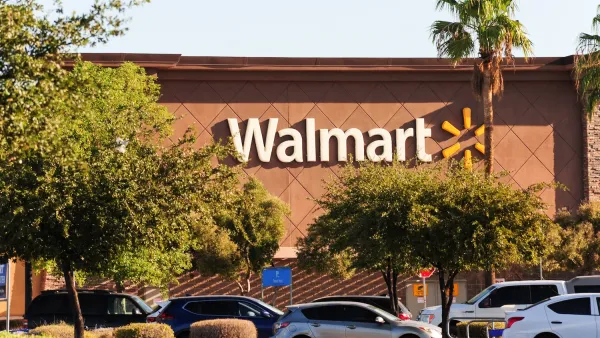
Walmart Announces Nationwide EV Charging Network
The company plans to install electric car chargers at most of its stores by 2030.
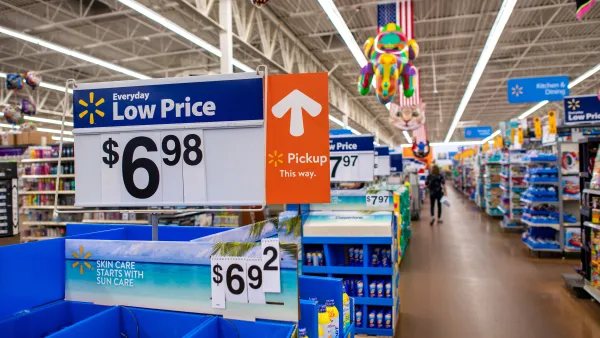
The Walkable Urbanism of Big Box Stores
For residents of many U.S. small towns and exurbs, the local Walmart offers a surprising benefit missing elsewhere in their communities: walkability.

Planetizen Federal Action Tracker
A weekly monitor of how Trump’s orders and actions are impacting planners and planning in America.

The state-sanctioned urbicide of Austin
People don’t kill cities. Freeways do.

US to reduce Colorado River water deliveries to Mexico
A new Colorado Treaty amendment reduces Mexico’s Colorado River water allocation by 250,000 acre feet.

5 New England states march closer to 800 megawatt wind energy project
Securing federal approval for the project may be complicated under the Trump administration, which has historically been hostile towards domestic wind power.

Baltimore to break ground on $50 million Transit Priority Project
The project will bring faster bus trips, safer streets and better bike connections to Baltimore.

Airbnb launches $250 million 'last-dollar financing' housing accelerator, makes first investment in Austin
The company will put $6.4 million towards affordable housing development in Texas’ capital.

FREE Course: Walkable City 1: Why Walkability?
After describing his path towards focusing on walkability as the essence of good planning, Jeff Speck marches through his five principal reasons for making more walkable places.
Reinventing Malls: Planning Alchemy—Turning Gray Fields Into Gold
The course focuses on the opportunities and imperatives that shape reinvention of mall sites.

Eagle County Government
Harvard University Graduate School of Design
Nashville Planning Department
The Architects Foundation
University of Cincinnati Online
The Pocatello Development Authority
The Urban Renewal Agency of the City of Pocatello
Journal of the American Planning Association