Faced with a court ordered requirement to provide its fair share of affordable housing, one New Jersey town's residents have lashed out with some anti-Semitic overtones against plans for a new development.


Writing in The Atlantic, Alana Semuels lays out the long, arduous road of getting affordable housing built in New Jersey, a state which once was a leader in affordable housing construction. The town of Howell, NJ provides a good microcosm of what's happening in other areas, although with some unique arguments presented. Several local residents have argued against the affordable housing as, among other things, it would allow a community of Hasidic Jews to enter the community and "take over."
Community leaders have rebuffed the negative comments of residents and have stood in support of the affordable housing, including Mayor William Gotto who has tried to dispel rumors that the affordable housing will be for Hasidic Jews only, as one internet commenter posted on a popular city blog.
…town leaders are going ahead with the plans for the development, despite the vitriol. Gotto says he wants people like his daughter, who may become a teacher, to be able to live near him; other town-council members say they want to keep the town affordable for the working class. They’ve begun to craft plans about how to meet the rest of their obligations for affordable housing, even as a small group of residents continues to protest. Those protests will likely last until the housing is actually built, a process that could take years.
Read the full story: The Pervasive Fear of Affordable Housing in New Jersey

Study: Affordable Housing Development Raises Nearby Property Values
More evidence that a common talking point of affordable housing opposition is more fear than fact.
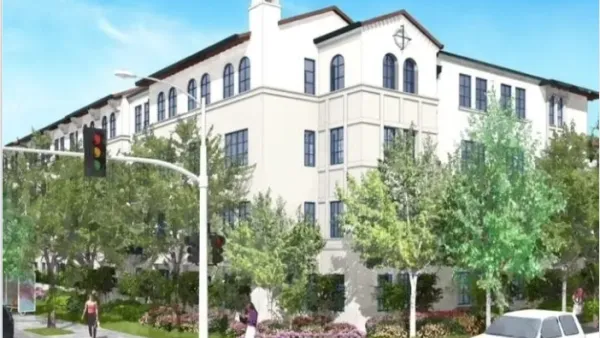
Local Group Ordered to Pay $500K Bond for Delaying Affordable Housing Project
What starts as a familiar story about a local group wielding the California Environmental Quality Act to delay an affordable housing project includes a surprise twist: another state law requires the group to cover some of the cost of the delay.
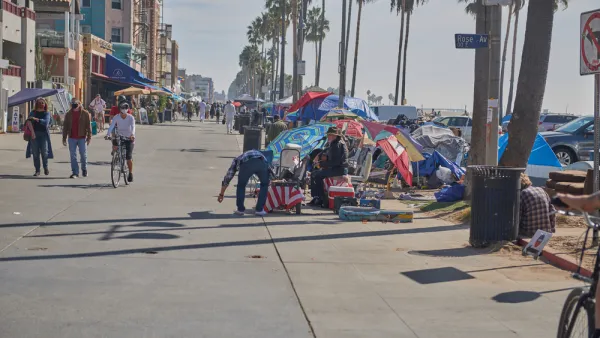
Locals Vehemently Oppose Venice Beach Homeless Housing
The controversies about homelessness in what was once a beach community full of hippies and surfers has boiled over in response to a large proposed development of supportive housing on a surface parking lot owned by the city.

Planetizen Federal Action Tracker
A weekly monitor of how Trump’s orders and actions are impacting planners and planning in America.

California plans to bury El Niño’s downpour
If the state plays its cards right, it may be able to store a billion acre-feet of El Niño’s water in aquifers.

Desperate measures: Advocates weigh draining Lake Powell to fill Colorado River
Draining the reservoir could reduce evaporation losses by a couple hundred thousand acre-feet.

Mamdani’s pied-à-terre tax survives legal challenge
A panel of judges found that the plaintiffs failed to demonstrate injury as a result of New York City's implementation of the tax.

Eastern Nebraska is running out of electricity
Data centers and electrification are straining eastern Nebraska’s grid, throttling economic development.

Seattle passes record-breaking transit services expansion
Proposition 1 will double the city’s transit tax to add 95,000 more bus trips and preserve 180,000 bus trips annually.

FREE Course: Walkable City 1: Why Walkability?
After describing his path towards focusing on walkability as the essence of good planning, Jeff Speck marches through his five principal reasons for making more walkable places.
Reinventing Malls: Planning Alchemy—Turning Gray Fields Into Gold
The course focuses on the opportunities and imperatives that shape reinvention of mall sites.

City of Rosemead
Rutgers University, Edward J. Bloustein School of Planning and Public Policy
One Hundred Miles
University of Michigan School for Environment and Sustainability (SEAS)
Hunter College, City University of New York (CUNY)
The Architects Foundation
City of Cambridge
Montrose County
The Pocatello Development Authority