An op-ed explains the significance of the 2016 presidential election for the political clout of the Department of Housing and Urban Development. Those supporting the agenda of HUD, according to this argument, should be wary of a Republican victory.


As an affordable housing professional and urban planner, I think a lot about the future of HUD. Recently, I've been worrying about the future of HUD under a Republican president. While HUD has thrived under Democratic presidents, Republican presidents have done their best to undermine the agency.
The Lyndon Johnson administration created the Department of Housing and Urban Development (HUD)to address the persistent disparities in urban neighborhoods that resulted in the urban race riots of the 1960s. Significant housing policies, such as FHA homeownership insurance and the creation of public housing, had already been implemented under the previous democratic administrations of Roosevelt and Truman.
The creation of HUD by President Johnson organized the federal government's response to inadequate housing amongst the poor and also provided significant funding for the creation of affordable housing by the private sector. Between 1941 and 1973, HUD created more than 1 million units of affordable housing, either through public housing or privately owned, federally subsidized housing. HUD also began to effectively combat racist housing policy around the country. All of this changed in 1973 under the Nixon Administration.
The Republican administrations of Nixon, Ford, and Reagan significantly reduced the scope of HUD. Nixon implemented a moratorium on all new affordable housing production programs in 1974 and, the Reagan Administration virtually abolished funding for new affordable housing. Under Reagan, HUD became little more than a caretaker of its existing housing and an administrator of rental subsidy programs such as Section 8. Although President Clinton and then HUD Secretary Andrew Cuomo (now Governor of New York) tried to make HUD more efficient, the administration of George W. Bush produced continued threats to HUD's budget. Republican presidential candidate Mitt Romney even threatened to dismantle the Cabinet-level agency.
So what does all this mean for us in 2016? Fundamentally, HUD has three basic missions: 1) provide affordable housing, 2) eliminate discrimination in housing, and 3) advocate for and create holistic community development programs for America's urban areas. All three missions will be under assault in a Republican administration.
The current Republican Congress has proposed significant cuts to the 2015 HUD budget. If the proposed cuts to the budget were implemented, 100,000 American families would be at risk of homelessness due to the elimination of rental subsidy vouchers for these families, and funding for capital improvements to existing affordable housing or the creation of new affordable housing would be cut between 20 to 25 percent.
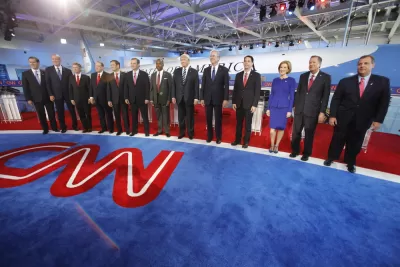
Given the xenophobic nature of most of our Republican Presidential candidates, I doubt discrimination in housing would be a big policy priority. Another low priority for a Republican administration would be advocacy for urban issues. Most American cities, even in reliably Republican states such as Texas, are overwhelmingly Democratic. Why would Republicans advocate for urban issues when their voting base overwhelmingly lives in rural and exurb areas?
2012 presidential candidate Mitt Romney called for the elimination of HUD and the transformation of Section 8 rental subsidies into block grants to states. Romney would easily be considered a moderate in the 2016 Republican presidential field. Am I ready for President Trump, Cruz, Bush, Rubio, or Carson? As an affordable housing professional, I'm confident that anyone of these candidates would do their best to eliminate funding to sorely needed affordable housing programs. As an urban planner who cares deeply about the urban environment and the strength of our cities, I worry that these candidates would ignore the fact that the strength of our country and the majority of American citizens live in cities.

Judge halts 'hasty' HUD changes to homelessness grants
Service providers said the sudden changes would have imperiled thousands of Americans and forced more people into homelessness.

HUD suspends federal funds for LA homelessness agency
HUD is freezing LA's access to Continuum of Care funds after allegations of fraud at the county's homelessness agency.

HUD: US homelessness grew by 27% since 2013
Despite the alarming increase in unhoused Americans, HUD is asking for a budget reduction.

Planetizen Federal Action Tracker
A weekly monitor of how Trump’s orders and actions are impacting planners and planning in America.

California plans to bury El Niño’s downpour
If the state plays its cards right, it may be able to store a billion acre-feet of El Niño’s water in aquifers.

Chicago breaks ground on $3 billion megadevelopment
The new neighborhood, titled Foundry Park, will one day host 3,700 residences.

California High-Speed Rail Authority CEO resigns after $600,000 scandal
Under Ian Choudri, the authority used taxpayer dollars to fund first class flights and trips to nightclubs.

Want to study the Missouri River? Soon, you may need unanimous approval from 10 states
Legislation would require 10 governors’ permission to study or build projects moving water outside the basin.

Desperate measures: Advocates weigh draining Lake Powell to fill Colorado River
Draining the reservoir could reduce evaporation losses by a couple hundred thousand acre-feet.

FREE Course: Walkable City 1: Why Walkability?
After describing his path towards focusing on walkability as the essence of good planning, Jeff Speck marches through his five principal reasons for making more walkable places.
Reinventing Malls: Planning Alchemy—Turning Gray Fields Into Gold
The course focuses on the opportunities and imperatives that shape reinvention of mall sites.

City of Rosemead
Rutgers University, Edward J. Bloustein School of Planning and Public Policy
One Hundred Miles
Hunter College, City University of New York (CUNY)
The Architects Foundation
University of Cincinnati Online
City of Cambridge
Montrose County
The Pocatello Development Authority

