A group of passionate rowers deserve some of the credit in the remarkable comeback story of Cleveland's Cuyahoga River.


Daniel J. McGraw identifies a key partner in the process of reimagining Cleveland's Cuyahoga River. "Clevelanders are rethinking the waterway — and rowers deserve some of the credit," writes McGraw. "The attention they’ve helped to shift toward the river has helped spawn the creation of a riverfront park, spurred economic development in an empty industrial area of Cleveland, and helped change the regional consciousness that the waterways — Lake Erie and the Cuyahoga River, among others — in Northeast Ohio are fundamental assets…"
Rowers, according to the article began their fight by bringing attention to public access to the river. Those early efforts, according to McGraw, are paying off with more momentum in recent years: "Cleveland Metroparks is currently constructing bike trail paths along the river, and Rivergate Park will be the hub for many of these trails that link areas south of Cleveland to Lake Erie. Numerous businesses have relocated to once-empty warehouse space."
Read the full story: How Rowers Got Cleveland to Rethink a River

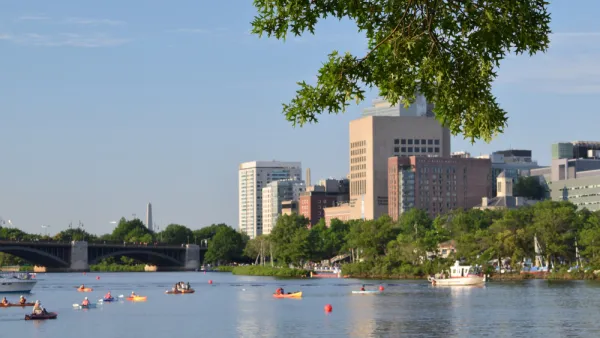
Urban Rivers Everywhere Follow the Cuyahoga's Lead
On the 50th anniversary of the Cuyahoga River catching fire in Cleveland, it's a good time for urban river keepers everywhere to reevaluate their work and redouble their efforts to make safe and healthy rivers for everyone.
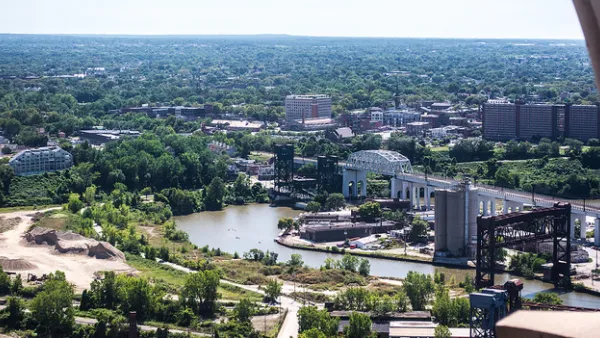
Paddling the Cuyahoga River in Cleveland, 50 Years After in Burned
One of the great environmental success stories in the nation, manifested by the joy of paddling a river.
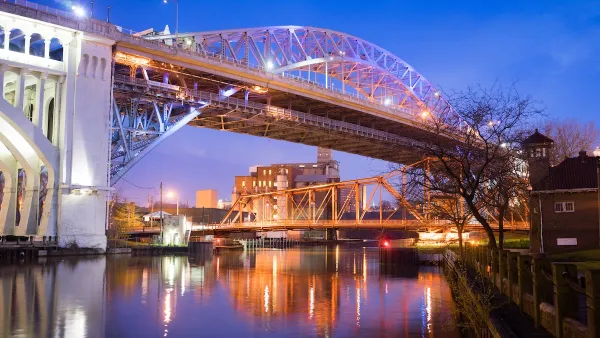
Defunct Streetcar Bridge Could Become Cleveland’s ‘Low Line’
The city will develop a plan to transform an unused streetcar deck on the Veterans Memorial Bridge into a connector for bikes and pedestrians as well as a welcoming public space.

Planetizen Federal Action Tracker
A weekly monitor of how Trump’s orders and actions are impacting planners and planning in America.

Amtrak, CN end decades-long dispute with eight-year agreement
The new operating agreement establishes an updated framework for the companies to work together, including processes to resolve disputes.

Judges permit Denver to divert 77,000 acre feet from the Colorado River for reservoir expansion
Overuse and climate change have caused the Colorado River’s water levels to plummet.

Boston has spent millions making the Green Line more accessible — and there’s no end in sight
While the city has invested millions into expanding and adding platforms to the Green Line to make it more accessible, new train cars set to arrive next year will be too tall for disabled passengers to board without raising the current platforms.

Idaho may see an 18% drop in federal surface transit funding — the largest estimated cut in the US
Transit systems in rural communities are much more reliant on federal funding to provide their services.

How ‘post-disaster gentrification’ alters neighborhoods after natural calamities
After hurricanes, fires or other calamities, the original residents of a community are often replaced by younger, wealthier residents.

FREE Course: Walkable City 1: Why Walkability?
After describing his path towards focusing on walkability as the essence of good planning, Jeff Speck marches through his five principal reasons for making more walkable places.
Reinventing Malls: Planning Alchemy—Turning Gray Fields Into Gold
The course focuses on the opportunities and imperatives that shape reinvention of mall sites.

City of Wisconsin Rapids
Harvard University Graduate School of Design
KFH Group Inc.
The Architects Foundation
University of Cincinnati Online
The Pocatello Development Authority
The Urban Renewal Agency of the City of Pocatello