A sixteen-year old teaches skateboarding to low-income youth as a viable means of transportation and for community building in Addis Ababa, Ethiopia.


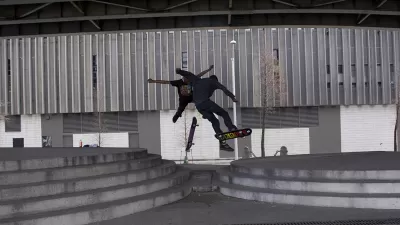
Skateboarding has not been recognized as a legitimate mode of transportation outside of a handful of cities such as Portland, Oregon. Per EMBARQ's post on Sustainability Cities Collective, however, in Addis Ababa, Ethiopia, a 16-years-young Abenezer Temesgen is challenging the cultural bias against skateboarding by teaching it as a primary mode of transportation.
EMBARQ summarizes Temesgen's vision for his organization Ethiopia Skate: "For low-income children who cannot afford bicycles, yet still need to access education and job opportunities, skating can get them to where they need to be just a little faster. Added to this, skating demands practice, it demands a community to learn from, and it promotes a healthy, active lifestyle."
Taxis are the main mode of transportation in Addis Ababa, where rapid growth has occurred with little regard for public space. In such a place, Ethiopia Skate's mission to teach skateboarding, and its campaign to build a skate park, could bring affordable mobility to youth while providing much needed gathering places.
Read the full story: Community Building Through Skateboarding in Addis Ababa

The Ratio of Older People to Children Grew in Every State
Older adults outnumber youth in 11 U.S. states.
How Public Spaces Exclude Teen Girls
Adolescent girls face unique challenges and concerns when navigating public spaces. We can design cities with their needs in mind.

Students Drive Solutions for Environmental Justice Through Video Challenge
The Environmental Justice Video Challenge empowers students and communities to collaboratively address environmental inequities through innovative data-driven strategies, resulting in impactful projects and fostering local leadership.

Planetizen Federal Action Tracker
A weekly monitor of how Trump’s orders and actions are impacting planners and planning in America.

California plans to bury El Niño’s downpour
If the state plays its cards right, it may be able to store a billion acre-feet of El Niño’s water in aquifers.

Desperate measures: Advocates weigh draining Lake Powell to fill Colorado River
Draining the reservoir could reduce evaporation losses by a couple hundred thousand acre-feet.

Mamdani’s pied-à-terre tax survives legal challenge
A panel of judges found that the plaintiffs failed to demonstrate injury as a result of New York City's implementation of the tax.

Eastern Nebraska is running out of electricity
Data centers and electrification are straining eastern Nebraska’s grid, throttling economic development.

Seattle passes record-breaking transit services expansion
Proposition 1 will double the city’s transit tax to add 95,000 more bus trips and preserve 180,000 bus trips annually.

FREE Course: Walkable City 1: Why Walkability?
After describing his path towards focusing on walkability as the essence of good planning, Jeff Speck marches through his five principal reasons for making more walkable places.
Reinventing Malls: Planning Alchemy—Turning Gray Fields Into Gold
The course focuses on the opportunities and imperatives that shape reinvention of mall sites.

City of Rosemead
Rutgers University, Edward J. Bloustein School of Planning and Public Policy
One Hundred Miles
University of Michigan School for Environment and Sustainability (SEAS)
Hunter College, City University of New York (CUNY)
The Architects Foundation
City of Cambridge
Montrose County
The Pocatello Development Authority