Are the grand plans for reviving Cleveland put forth by city leaders - and hyped by the architecture critic at the city's main newspaper - fantasies masking the city's elemental problems or goals worth pursuing?


In the coverage of Cleveland's current state, Michael D. Roberts and his journalistic colleagues see "a tale of two cities: the perception of a downtown revival contrasted with the reality of enormous job and population loss and the abandonment of neighborhoods."
"No one creates the perception of revival more than Steven Litt, The Plain Dealer's architecture critic, who writes frequently and voluminously of plans to advance the city," claims Roberts. "Litt has become the keeper of the civic flame, a voice that holds out the promise of prosperity and metropolitan glory. But when Litt extols the virtues of ambitious new development plans, he sews a promise of renaissance that's more fantasy than fact."
"While Litt likes to hold out the promise of abstract plans, the weight of reality hangs over the town, a reality Cleveland elites never seem to grasp. Ever since they built our freeways, a highly effective series of escape and evasion routes from the town's core, city planning has become uncoordinated, with little long-range vision. That leads each generation to reinvent the city, shunning symmetry and common sense."
Read the full story: Fantasy Town
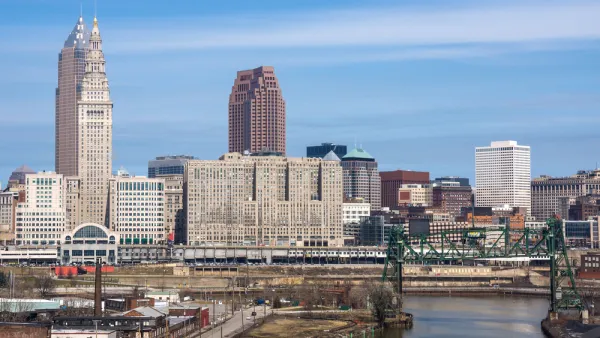
Watch the Documentary 'Cleveland: Confronting Decline in an American City'
In May, the documentary film "Cleveland: Confronting Decline in an American City" was made available in full on YouTube.

Learning loss and urban schools, part 2
Did test scores in progressive cities drop more post-COVID than test scores in moderate ones?
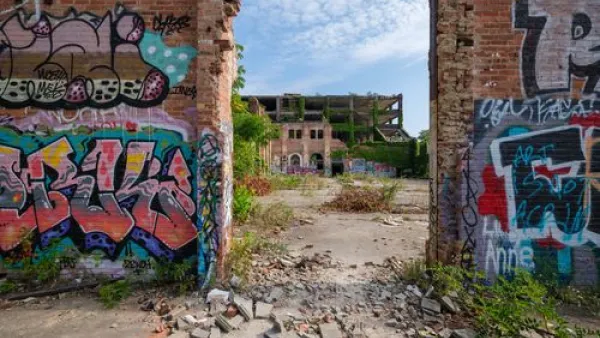
Cleveland is turning abandoned real estate into ‘housing innovation district,’ jobs
The city’s housing innovation district will bring pro-housing policies to disinvested neighborhoods.

Planetizen Federal Action Tracker
A weekly monitor of how Trump’s orders and actions are impacting planners and planning in America.

Washington state to charge fee to drivers with fuel-efficient cars
Revenue from the fee will go towards supporting the state’s highways.

Illinois considers spending $1 billion in taxpayer money on data center
A quantum computing campus and data center are currently under construction in Chicago.

Did data centers change how voters cast their ballots?
Texas, Ohio, and Georgia all flipped party control. But in rural counties, the effect of local data centers was mixed.

Amtrak invests in eight new Airo trainsets
The new trainsets will begin serving passengers in 2031.

HUD to end aid for mixed-immigration-status households
The new rule is projected to impact 80,000 people, nearly half of whom are children.

FREE Course: Walkable City 1: Why Walkability?
After describing his path towards focusing on walkability as the essence of good planning, Jeff Speck marches through his five principal reasons for making more walkable places.
Reinventing Malls: Planning Alchemy—Turning Gray Fields Into Gold
The course focuses on the opportunities and imperatives that shape reinvention of mall sites.

City of Charlotte
City of Rosemead
Rutgers University, Edward J. Bloustein School of Planning and Public Policy
University of Michigan School for Environment and Sustainability (SEAS)
Hunter College, City University of New York (CUNY)
The Architects Foundation
University District Partnership