For the first time in more than five decades, Boston's Charles River has been deemed clean enough for a swim. The first approved community swim since the 1950s that was held on Saturday represents a milestone for the city's famous "dirty water".


"Swimming in the Charles River, like playing in the street, is something generations of Boston children have been taught will lead to no good. At the very least, to a tetanus shot," writes Billy Baker.
"But since 1995, when the EPA gave the water quality a grade of D, the health of the river has improved dramatically, rising to a B in 2011, and now meeting the state standards for swimming most days of the summer. The bottom of the river remains a toxic mess, but if a swimmer can get in and out of the water without touching the squishy bottom, no tetanus shot is necessary."
"Over the past eight years, a group called the Charles River Swim Club has hosted a 1-mile race for elite swimmers, but Saturday morning was the first time officials permitted a swim to be held for the general public," notes Baker. "Getting the permit took six months."
Read the full story: Charles River opens for first public swim since the 1950s

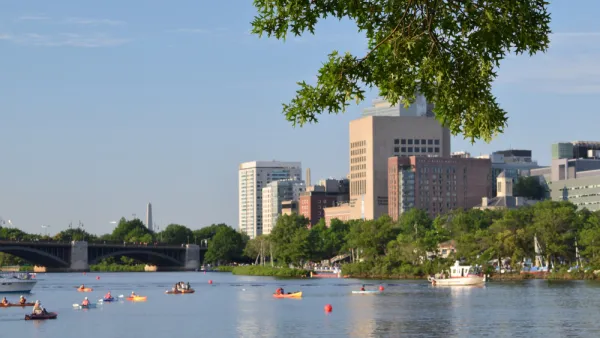
Urban Rivers Everywhere Follow the Cuyahoga's Lead
On the 50th anniversary of the Cuyahoga River catching fire in Cleveland, it's a good time for urban river keepers everywhere to reevaluate their work and redouble their efforts to make safe and healthy rivers for everyone.
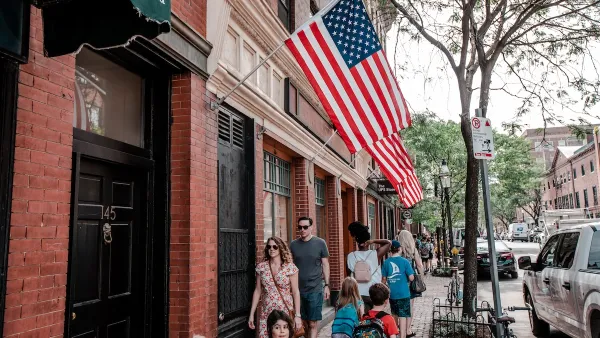
Boston is hard to build housing in: its chief of planning wants to keep it that way
Chief of Planning Kairos Shen said she would not make changes to Boston’s affordability requirements for new housing, which critics say have slowed down development.

Learning loss and urban schools, part 2
Did test scores in progressive cities drop more post-COVID than test scores in moderate ones?

Planetizen Federal Action Tracker
A weekly monitor of how Trump’s orders and actions are impacting planners and planning in America.

California plans to bury El Niño’s downpour
If the state plays its cards right, it may be able to store a billion acre-feet of El Niño’s water in aquifers.

Chicago breaks ground on $3 billion megadevelopment
The new neighborhood, titled Foundry Park, will one day host 3,700 residences.

Satanic place names
From streams and lakes to valleys and canyons, I mapped more than 1,000 places named after the Devil.

California High-Speed Rail Authority CEO resigns after $600,000 scandal
Under Ian Choudri, the authority used taxpayer dollars to fund first class flights and trips to nightclubs.

Want to study the Missouri River? Soon, you may need unanimous approval from 10 states
Legislation would require 10 governors’ permission to study or build projects moving water outside the basin.

FREE Course: Walkable City 1: Why Walkability?
After describing his path towards focusing on walkability as the essence of good planning, Jeff Speck marches through his five principal reasons for making more walkable places.
Reinventing Malls: Planning Alchemy—Turning Gray Fields Into Gold
The course focuses on the opportunities and imperatives that shape reinvention of mall sites.

City of Rosemead
Rutgers University, Edward J. Bloustein School of Planning and Public Policy
One Hundred Miles
Hunter College, City University of New York (CUNY)
The Architects Foundation
University of Cincinnati Online
City of Cambridge
Montrose County
The Pocatello Development Authority