Counter to the predictions of mass chaos due to inexperienced riders being unleashed on city streets, the launch of bike-sharing in New York and elsewhere increases safety for all cyclists.


"It took only a few days for reports of the first cycling accident involving New York’s new bike sharing program to begin circulating. But experts and growing experience from bike sharing programs in other cities make clear that bicycling can be a safe mode of transportation, and the presence of a bike sharing program is a boon to the safety of all bicyclists," reports Sophie Egan.
“A number of studies have looked at increased biking, and the result is that the more people bike in a community, the less likely they are to collide with motorists,” said David Vlahov, the dean of nursing at the University of California, San Francisco. “It is likely due to motorists becoming more aware or expecting more to be riding bicycles.”
"Transportation departments across the United States have begun to respond with creative improvements for safer roadways," Egan explains. "The National Association of City Transportation Officials has developed an exhaustive urban bikeway design guide based on a worldwide literature review, experiences from its 22 member cities and collaboration with traffic engineers, city planners and academic researchers. The guide informed new citywide bike safety plans for Seattle and San Francisco."
"Recommendations include protected or buffered bike lanes, colored pavement, shared lane markings, special intersection signals and detectors for bicycles, and bike boxes, the painted areas before intersections that allow bicyclists to get in front of the line of cars at a red light," she adds. "In addition to infrastructure, education and policy play a role."
Not only is such infrastructure good for cyclists, it improves the safety of all road users.
Read the full story: Bike Sharing Can Mean Safer Biking

2014 Declared the 'Year of the Bike Commuter'
"From cycletracks to helmet laws, 2014 has been a big year for bikes," according to Next City before looking back at what made 2014 such a big year for bikers.
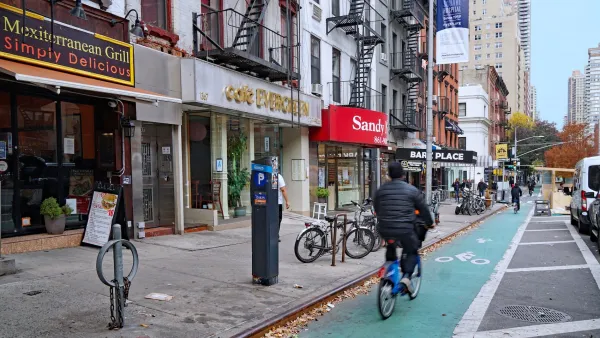
Study: Protected bike lanes increase Citi Bike rides by nearly 400 rides a month
An analysis of millions of NYC bike share rides reveals that only protected bike lanes have a 'statistically significant' increase in ridership.
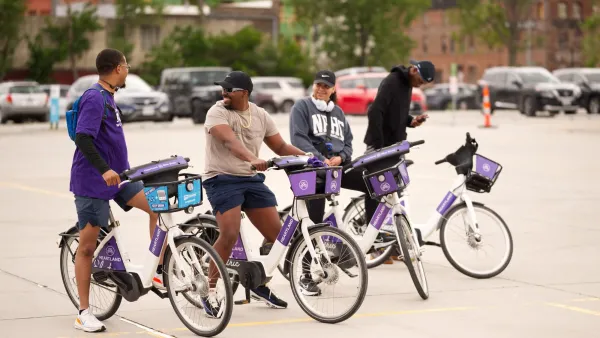
Omaha's 400 shared e-bikes are now free to all residents
Before eliminating fares for locals, the Heartland system only recovered 10%-15% of its operating costs through fare revenue.

Planetizen Federal Action Tracker
A weekly monitor of how Trump’s orders and actions are impacting planners and planning in America.

Amtrak, CN end decades-long dispute with eight-year agreement
The new operating agreement establishes an updated framework for the companies to work together, including processes to resolve disputes.

Northwest rail fans eager for Sept. 30 debut of Amtrak’s Airo fleet
Get ready for that new train smell and more seats. But they won’t go faster or run more frequently on the Cascades route in Washington and Oregon.

St. Louis Metro to test if single-car trains can reduce operating costs, maintain rider satisfaction
The pilot program will run from October to spring 2027, and begin with one single-car train operating on Metrolink’s Red and Blue lines.

Pennsylvania is building data centers in abandoned mines
Housing data centers in mines provides an alternative to destroying local forests and may spare residents from data centers’ noise and air pollution.

If Corpus Christi can’t revive desalination plant project, it may owe Texas $235 million
Earlier this month, city officials declined to pursue developing the plant for the second time in a year.

FREE Course: Walkable City 1: Why Walkability?
After describing his path towards focusing on walkability as the essence of good planning, Jeff Speck marches through his five principal reasons for making more walkable places.
Reinventing Malls: Planning Alchemy—Turning Gray Fields Into Gold
The course focuses on the opportunities and imperatives that shape reinvention of mall sites.

City of Thousand Oaks
City of Wisconsin Rapids
Harvard University Graduate School of Design
The Architects Foundation
University of Cincinnati Online
The Pocatello Development Authority
The Urban Renewal Agency of the City of Pocatello