A newly adopted master plan seeks to transform Philadelphia's underperforming industrial belt along the Lower Schuylkill River into a modern manufacturing hub.


Nicole Anderson examines the newly adopted Lower Schuylkill Master Plan, which seeks to revive 3,700 acres of Philadelphia’s Lower Schuylkill River. The plan, which was developed by the Philadelphia Industrial Development Corporation (PIDC) over the past 18 months, "calls for the creation of three 'campuses' along the river: An Innovation District, a Logistics Hub, and an Energy Corridor. In addition, the PIDC envisions 46-acres of green space, including 5 miles of trails winding along the river."
“The bulk of the land is privately owned and there is not a plan to do extensive public acquisition,” said Thomas Dalfo, senior vice president of real estate services for PIDC. “The intention of the plan is to make use of strategically placed public assets on the river along with targeted public investments in infrastructure.”
Read the full story: RIVER OF INDUSTRY

Learning loss and urban schools, part 2
Did test scores in progressive cities drop more post-COVID than test scores in moderate ones?

Philadelphia lawmakers fight to save 'Chinatown Stitch' from Trump cuts
The freeway cap project, approved and funded under the Biden administration, is now in jeopardy after the federal government rescinded all but $8 million in funding.
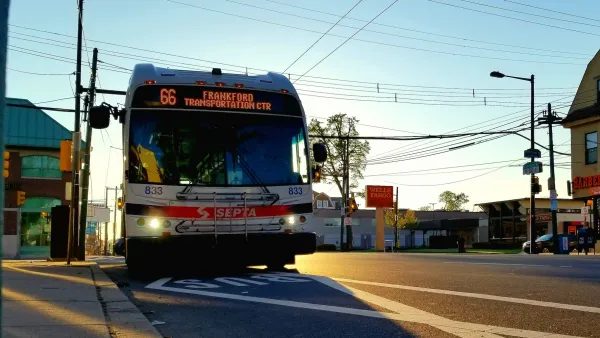
SEPTA's bus-mounted lane enforcement cameras cut travel times by up to 6%
The AI-assisted cameras have issued nearly 200,000 citations to drivers blocking bus lanes.

Planetizen Federal Action Tracker
A weekly monitor of how Trump’s orders and actions are impacting planners and planning in America.

California plans to bury El Niño’s downpour
If the state plays its cards right, it may be able to store a billion acre-feet of El Niño’s water in aquifers.

Desperate measures: Advocates weigh draining Lake Powell to fill Colorado River
Draining the reservoir could reduce evaporation losses by a couple hundred thousand acre-feet.

US buildings threatened, destroyed by fires set to triple by 2060
Researchers found a high fire risk for socioeconomically vulnerable neighborhoods in the American West.

LA residents may be allowed to paint their own crosswalks
Councilwoman Katy Yaroslavsky put out a motion instructing the Los Angeles Department of Public Transportation to study the feasibility of allowing volunteers to paint crosswalks.

Dallas moves to overhaul its zoning code
The city's zoning reform will allow more multi-family and mixed-use developments.

FREE Course: Walkable City 1: Why Walkability?
After describing his path towards focusing on walkability as the essence of good planning, Jeff Speck marches through his five principal reasons for making more walkable places.
Reinventing Malls: Planning Alchemy—Turning Gray Fields Into Gold
The course focuses on the opportunities and imperatives that shape reinvention of mall sites.

City of Rosemead
Rutgers University, Edward J. Bloustein School of Planning and Public Policy
One Hundred Miles
Hunter College, City University of New York (CUNY)
The Architects Foundation
University of Cincinnati Online
City of Cambridge
Montrose County
The Pocatello Development Authority