Sam Dillon eulogizes architect Pedro Ramirez Vazquez, who helped transition Mexico "from a mostly peasant society into a modern industrial state," as much with his political skills as his technical skills.


"Pedro Ramírez Vázquez, the architect who led many of Mexico’s landmark Modernist construction projects of the mid-20th century, including museums, the country’s largest sports stadium and the shrine that attracts its most important religious pilgrimage, died on Tuesday, his 94th birthday, in Mexico City."
"Over six decades in which much of Mexico evolved from a mostly peasant society into a modern industrial state, Mr. Ramírez and his collaborators built a series of monuments to Mexican culture, including the National Museum of Anthropology, the Azteca soccer stadium, the Legislative Palace and the Basilica of Guadalupe, all in Mexico City," notes Dillon. "Millions of Mexican Roman Catholic pilgrims converge on the basilica each spring."
“'To think of him as somebody who designed buildings is not to take account of all the roles he played,' said [Luis M. Castañeda, a professor of art history at Syracuse University], who interviewed Mr. Ramírez and has studied his archives. 'He wasn’t the one constructing the models or sketching the drawings; he was the one securing the commission from the president.'”
Read the full story: Pedro Ramírez Vázquez, Architect, Is Dead at 94
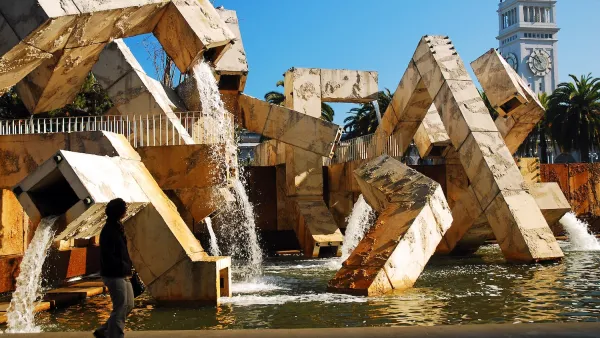
San Francisco to Dismantle its Polarizing Brutalist Fountain
The Vaillancourt Fountain stands as a symbol of the tension between the city’s past and future.
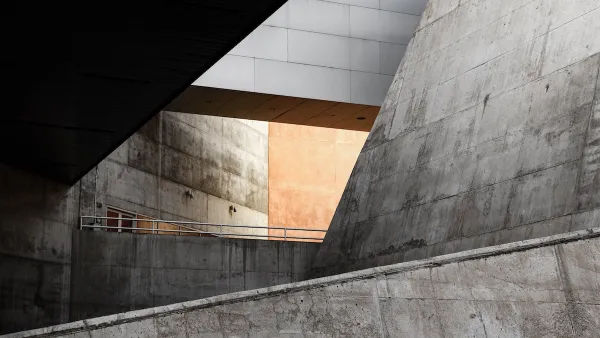
What ‘The Brutalist’ Teaches Us About Modern Cities
How architecture and urban landscapes reflect the trauma and dysfunction of the post-war experience.
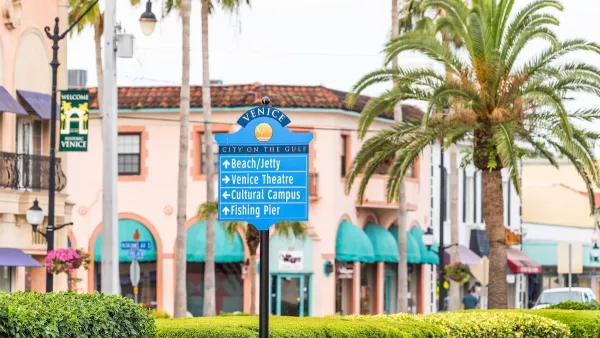
Learning From Venice, Florida
How a community planned in the 1920s has gracefully navigated change, offering a model for other places.

Planetizen Federal Action Tracker
A weekly monitor of how Trump’s orders and actions are impacting planners and planning in America.

Eastern Nebraska is running out of electricity
Data centers and electrification are straining eastern Nebraska’s grid, throttling economic development.

Study reveals best places in the U.S. for cycling, walking
New research from Streetlight Data examines bicycle and pedestrian miles per capita in the 100 largest U.S. cities by population.

DSA members accuse Mamdani of 'abandoning values' over housing redevelopment
New York City's mayor plans to replace about 2,000 units of public housing with private, mixed-income housing.

All sides of BRT debate unhappy with CDOT’s most recent move
The Colorado Department of Transportation is no longer considering center-running bus lanes for Colorado Boulevard.

Massachusetts bogs generate both power, and cranberries
Putting solar panels above farmland is one way Massachusetts is advancing toward its goal of net-zero carbon emissions by 2050.

FREE Course: Walkable City 1: Why Walkability?
After describing his path towards focusing on walkability as the essence of good planning, Jeff Speck marches through his five principal reasons for making more walkable places.
Reinventing Malls: Planning Alchemy—Turning Gray Fields Into Gold
The course focuses on the opportunities and imperatives that shape reinvention of mall sites.

City of Rosemead
Rutgers University, Edward J. Bloustein School of Planning and Public Policy
One Hundred Miles
University of Michigan School for Environment and Sustainability (SEAS)
Hunter College, City University of New York (CUNY)
The Architects Foundation
City of Cambridge
The Pocatello Development Authority
The Urban Renewal Agency of the City of Pocatello