Lafayette Park is a thriving and diverse neighborhood of high rises and townhouses designed by Mies van der Rohe. This unique modern architecture success story in Detroit is showcased in a new book "Thanks for the View, Mr. Mies."


"Thanks for the View, Mr. Mies is the kind of post-occupancy study that every great building deserves but few receive," says Kelsey Campbell-Dollaghan. "It's technical in parts, surveying the structural and environmental failures and successes of Mies's designs. But it's also incredibly personal, giving us a fine-grained look at the social ecology of the neighborhood." The book is a detailed compilation of experiences, interviews, essays and photographs by three residents Danielle Aubert, Lana Cavar and Natasha Chandani. They discuss how pool parties, wildlife, and barbershops contribute to the neighborhood's vibrancy, but Campbell-Dollaghan observes, "A major theme is diversity: Mies’s white-box apartments enable a culture of individualization that bred enthusiastic and loyal residents."
Lafayette Park is located in one of the most segregated cities in the country, but the building is home to a diverse mix of age, ethnicity, and occupation, a tribute to those enthusiastic and loyal residents. Although Lafayette Park could have faced the same urban blight experienced by many other modernist high-rises, says Campbell-Dollaghan, the neighborhood has remained healthy due to "the collective intelligence of Mies, urban planner Ludwig Hilbersheimer, and landscape architect Alfred Caldwell," and "a combination of factors ranging from its proximity to downtown, to its historical pedigree, to its community of friendly neighborhoods."
Read the full story: An Unlikely Success Story For Modern Architecture, Mies, And Detroit


Learning loss and urban schools, part 2
Did test scores in progressive cities drop more post-COVID than test scores in moderate ones?
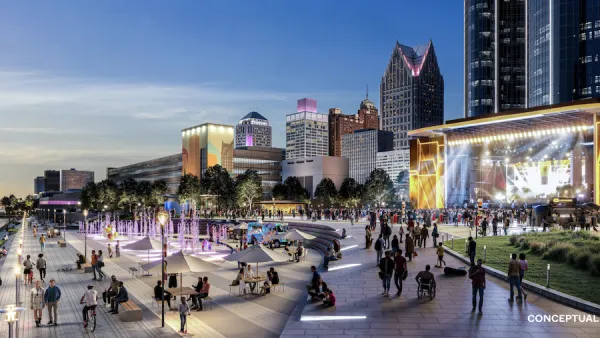
Detroit to transform waterfront with $2.2 billion investment
Developers will convert about 18 acres of unused parking lot space into civic spaces.
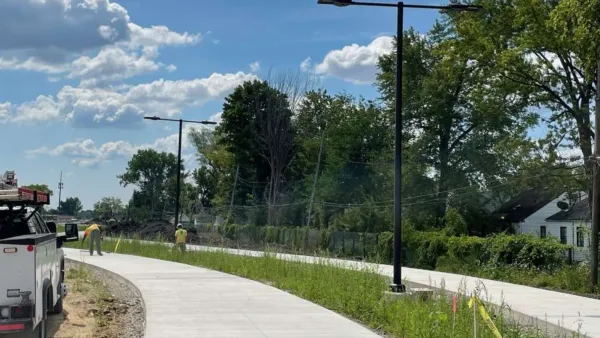
Detroit greenway brings revival — and fears of displacement
The planned Joe Louis Greenway is already bringing change to the neighborhoods near it.

Planetizen Federal Action Tracker
A weekly monitor of how Trump’s orders and actions are impacting planners and planning in America.

Chicago breaks ground on $3 billion megadevelopment
The new neighborhood, titled Foundry Park, will one day host 3,700 residences.

This MA town is drowning in its own sewage — and residents like it that way
Susan Murcott, a waste water expert, said if Carlisle didn't address their leaking sewage, the problem could turn “deadly.”

Iowa taxpayers are paying thousands to clean manure out of their water
While the Clean Water Act makes states responsible for regulating factory farms that discharge pollutants, Iowa has turned a blind eye to the polluting farms.

Amtrak cuts ribbon on Seattle Airo maintenance facility
The $250 million, nearly 100,000-square-foot building can house an entire Cascades Airo trainset.

To power data centers, Google seeks autonomous control of thousands of homes’ electricity
The tech company has signed a deal to indirectly pay Mid-Atlantic residents to reduce their power demand when the grid is strained.

FREE Course: Walkable City 1: Why Walkability?
After describing his path towards focusing on walkability as the essence of good planning, Jeff Speck marches through his five principal reasons for making more walkable places.
Reinventing Malls: Planning Alchemy—Turning Gray Fields Into Gold
The course focuses on the opportunities and imperatives that shape reinvention of mall sites.

City of Rosemead
Rutgers University, Edward J. Bloustein School of Planning and Public Policy
One Hundred Miles
The Architects Foundation
University of Cincinnati Online
Montrose County
The Pocatello Development Authority
The Urban Renewal Agency of the City of Pocatello