The bike-share bandwagon is getting awfully full! On Friday came news that Mayor Nutter will ask Philadelphia's city council for $3 million to help fund a city-wide bike-share program that could hit the streets by early 2014.


Paul Nussbaum reports on promising news from the City of Brotherly Love, which may become the next big American city to develop a city-wide bike-share program. Although it's been studying the idea for five years, deputy mayor for transportation Rina Cutler said that Philadelphia waited to pursue such a program until the city could establish more bike lanes and bike-friendly streets.
According to Nussbaum, "[t]he city envisions contributing $3 million, with an additional $5 million to $6 million from federal, state or private funds, to buy the bikes, set up the stations, and establish the program. The operating costs of the program are to be paid for by riders, advertising on bikes and stations, and corporate sponsors, under the city's plan."
"Russell Meddin, the founder of Bike Share Philadelphia and a longtime advocate of the concept, hailed the administration's announcement. 'I think anything that will bring bike sharing to Philadelphia is great. It's been a hard road,' he said. 'We've been working on this for six years.'"
"He urged city officials to plan for more bikes and more use than currently envisioned [650 by early 2014 and 550 more in 2015]. 'Washington, Minneapolis, Boston - they're all playing incredible catch-up now to fill out their systems because they didn't start with enough.'"
Read the full story: Nutter to seek Council appropriation for Philadelphia bike-share program
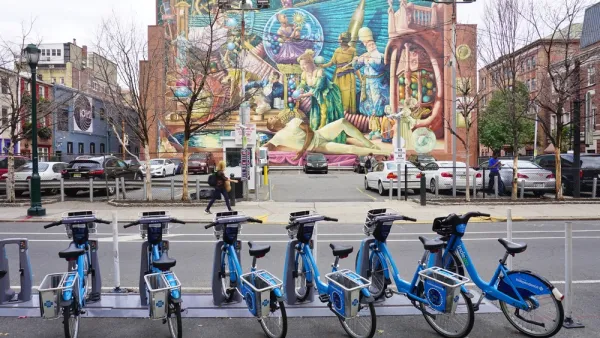
Philly's Indego Bike Share Goes Electric
Bike share riders in Philadelphia will have the option of trying something a little zippier.
Learning loss and urban schools, part 2
Did test scores in progressive cities drop more post-COVID than test scores in moderate ones?
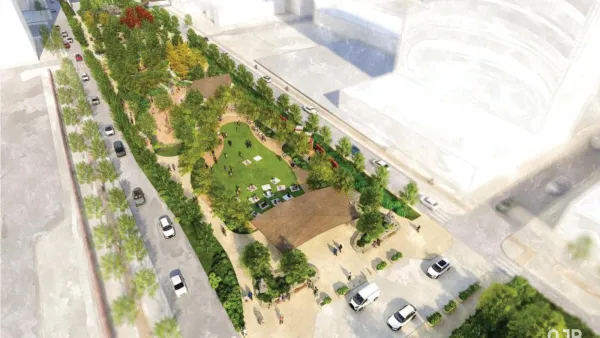
Philadelphia lawmakers fight to save 'Chinatown Stitch' from Trump cuts
The freeway cap project, approved and funded under the Biden administration, is now in jeopardy after the federal government rescinded all but $8 million in funding.

Planetizen Federal Action Tracker
A weekly monitor of how Trump’s orders and actions are impacting planners and planning in America.

Eastern Nebraska is running out of electricity
Data centers and electrification are straining eastern Nebraska’s grid, throttling economic development.

Study reveals best places in the U.S. for cycling, walking
New research from Streetlight Data examines bicycle and pedestrian miles per capita in the 100 largest U.S. cities by population.

DSA members accuse Mamdani of 'abandoning values' over housing redevelopment
New York City's mayor plans to replace about 2,000 units of public housing with private, mixed-income housing.

All sides of BRT debate unhappy with CDOT’s most recent move
The Colorado Department of Transportation is no longer considering center-running bus lanes for Colorado Boulevard.

Massachusetts bogs generate both power, and cranberries
Putting solar panels above farmland is one way Massachusetts is advancing toward its goal of net-zero carbon emissions by 2050.

FREE Course: Walkable City 1: Why Walkability?
After describing his path towards focusing on walkability as the essence of good planning, Jeff Speck marches through his five principal reasons for making more walkable places.
Reinventing Malls: Planning Alchemy—Turning Gray Fields Into Gold
The course focuses on the opportunities and imperatives that shape reinvention of mall sites.

City of Rosemead
Rutgers University, Edward J. Bloustein School of Planning and Public Policy
One Hundred Miles
University of Michigan School for Environment and Sustainability (SEAS)
Hunter College, City University of New York (CUNY)
The Architects Foundation
City of Cambridge
The Pocatello Development Authority
The Urban Renewal Agency of the City of Pocatello