In advance of Grand Central's 100th birthday next year, the Municipal Arts Society (MAS) asked three architecture firms to rethink the station's public spaces for the next 100 years. The results were unveiled last week.


From the bold to the incremental, SOM, WXY, and Foster+Partners presented their competing visions for MAS's Grand Central The Next 100 project last week at the non-profit's annual Summit for New York City. Jaclyn Hersh discusses the designs, which each, "used the existing Grand Central as a springboard to create
infrastructure that stimulates and interacts with the public realm,
connecting the terminal to the street and larger neighborhood." A neighborhood, it should be added, which is destined for a significant transformation in the Bloomberg administration's proposed upzoning for the area.
According to Laura Kusisto, writing in The Wall Street Journal, "The most visually striking proposal, designed by Skidmore Owings, is a
halo suspended between two new office buildings that would move up and
down. It would give visitors a view of the city from different heights,
similar to the London Eye."
Read the full story: Foster, SOM and WXY Explore Grand Ideas for the Next 100 Years at Grand Central Terminal
Recounting One of America's Greatest Preservation Victories
As New York's Grand Central Terminal celebrates its 100th birthday, Kent Barwick recalls how he and a motley group of advocates including Jacqueline Kennedy Onassis saved the building from being buried beneath a skyscraper.
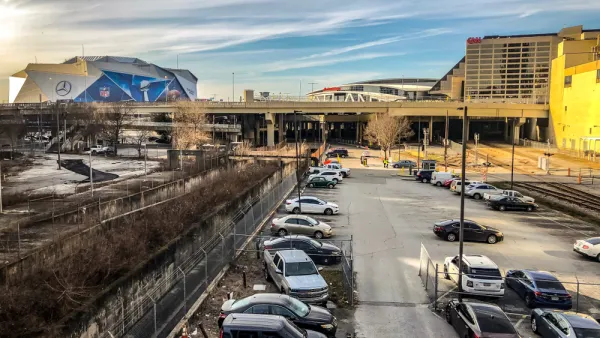
Latest Plans for Atlanta's 'The Gulch' Megaproject Focuses on the Public Realm
The latest round of plans and designs released for The Gulch by developer Centennial Yards Company plots increased walkability and urban design choices that respond to the existing built environment.
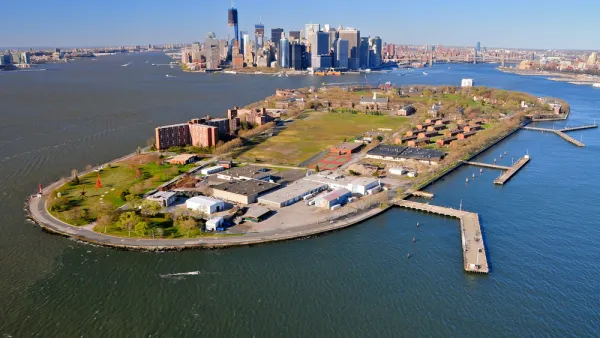
Massive Climate Research Center Planned for Governors Island, Rezoning Now Included
A speculative but exceedingly ambitious plan is pressing for air time in New York City.

Planetizen Federal Action Tracker
A weekly monitor of how Trump’s orders and actions are impacting planners and planning in America.

California plans to bury El Niño’s downpour
If the state plays its cards right, it may be able to store a billion acre-feet of El Niño’s water in aquifers.

Desperate measures: Advocates weigh draining Lake Powell to fill Colorado River
Draining the reservoir could reduce evaporation losses by a couple hundred thousand acre-feet.

Mamdani’s pied-à-terre tax survives legal challenge
A panel of judges found that the plaintiffs failed to demonstrate injury as a result of New York City's implementation of the tax.

Eastern Nebraska is running out of electricity
Data centers and electrification are straining eastern Nebraska’s grid, throttling economic development.

Seattle passes record-breaking transit services expansion
Proposition 1 will double the city’s transit tax to add 95,000 more bus trips and preserve 180,000 bus trips annually.

FREE Course: Walkable City 1: Why Walkability?
After describing his path towards focusing on walkability as the essence of good planning, Jeff Speck marches through his five principal reasons for making more walkable places.
Reinventing Malls: Planning Alchemy—Turning Gray Fields Into Gold
The course focuses on the opportunities and imperatives that shape reinvention of mall sites.

City of Rosemead
Rutgers University, Edward J. Bloustein School of Planning and Public Policy
One Hundred Miles
University of Michigan School for Environment and Sustainability (SEAS)
Hunter College, City University of New York (CUNY)
The Architects Foundation
City of Cambridge
Montrose County
The Pocatello Development Authority