Rick Hampson explores the New Urbanist vision for how cities will be designed and planned over the next 30 years, as told by the movement's co-founder, Andres Duany.


As America confronts the challenges of global warming, rising energy costs, increasing inequality, and impoverished governments over the next 30 years, Andres Duany - the "guru of the new metropolis" - believes New Urbanism is perfectly positioned to address those challenges.
Hampson describes Duany's vision for the future, which includes an overhaul of "conventional suburbia," replacing shopping malls with town centers and building townhouses instead of detached single-family homes, and the growth of "agrarian urbanism" and local governance.
Duany has more than a few critics, however, writes Hampson, including those who believe that New Urbanism's "planner knows best" philosophy is presumptuous and ineffective. Perhaps these criticisms would be more difficult to dismiss if Duany's vision wasn't delivered in true prescriptive form as, "what the doctor ordered for the next 30 years."
Thanks to Emily Williams
Read the full story: City living will feel like a blast from the past
New Urbanism Needs To Age To Become True Urbanism
In this episode of the KunstlerCast, James Howard Kunstler looks at New Urbanism, compares it to regular urbanism, and argues that criticized New Urbanist developments will get better with age.

PBS Takes on Urban Planning, Good and Bad, with '10 Towns' Special
Beginning with the first U.S. planned urban development, St. Augustine, Fla., and ending with one of Portland's newest neighborhoods, the Pearl District, host Geoffrey Baer takes us through ten developments that left their mark, for better or worse.
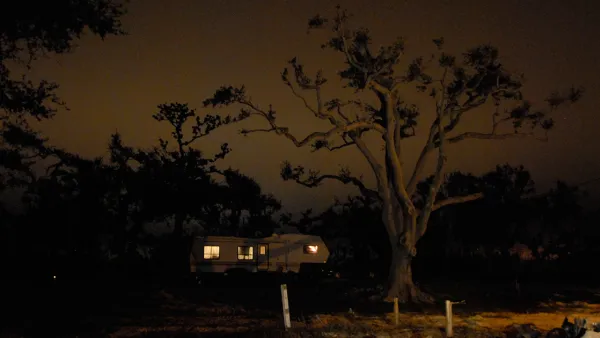
The Katrina Cottage Legacy
The New Urbanist Katrina Cottages initiative for the Gulf Coast appeared to be a failure but their legacy lives on in the SmartDwellings and in the Tiny House movement.

Planetizen Federal Action Tracker
A weekly monitor of how Trump’s orders and actions are impacting planners and planning in America.

California plans to bury El Niño’s downpour
If the state plays its cards right, it may be able to store a billion acre-feet of El Niño’s water in aquifers.

Desperate measures: Advocates weigh draining Lake Powell to fill Colorado River
Draining the reservoir could reduce evaporation losses by a couple hundred thousand acre-feet.

Los Angeles just elected an urban planner as its mayor
Transportation analysts are optimistic that Raman will be more aggressive in addressing transit issues than Bass.

Mamdani’s pied-à-terre tax survives legal challenge
A panel of judges found that the plaintiffs failed to demonstrate injury as a result of New York City's implementation of the tax.

Eastern Nebraska is running out of electricity
Data centers and electrification are straining eastern Nebraska’s grid, throttling economic development.

FREE Course: Walkable City 1: Why Walkability?
After describing his path towards focusing on walkability as the essence of good planning, Jeff Speck marches through his five principal reasons for making more walkable places.
Reinventing Malls: Planning Alchemy—Turning Gray Fields Into Gold
The course focuses on the opportunities and imperatives that shape reinvention of mall sites.

City of Rosemead
Rutgers University, Edward J. Bloustein School of Planning and Public Policy
One Hundred Miles
University of Michigan School for Environment and Sustainability (SEAS)
Hunter College, City University of New York (CUNY)
The Architects Foundation
City of Cambridge
Montrose County
The Pocatello Development Authority