Forget for a minute what the answer to that question may be, and focus first on why the two ideas are associated with each other. As Dave Reid explains, it's no accident, but rather the result of a relentless marketing scheme by the auto industry.


In the inaugural edition of "Car Culture," Urban Milwaukee's regular series on "the history of our love affair with the automobile, and its true costs and consequences," Reid begins with a historical examination of the association of the automobile with freedom.
Reid argues that, "U.S. automakers successfully sold the American public that access to an automobile is 'freedom', and that an automobile is an inalienable right, not a responsibility. For decades millions of dollars have been spent marketing this concept to us. It is so ingrained in our belief system that I've actually had friends tell me ‘my car is freedom'."
Reid includes two very persuasive advertisements to prove his point, one a Ford television commercial from 1955 and, the other, a Dodge television commercial from 2010. Different era, same message: the car = freedom.
Read the full story: Car Culture: Freedom Brought to You by the American Auto Industry

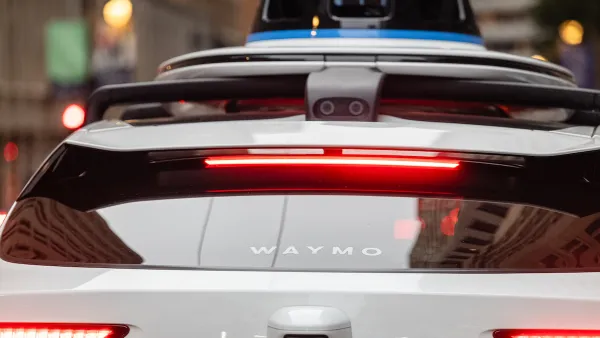
NHTSA Launches Investigations Into Two More Self-Driving Automakers
The federal agency is responding to reports of crashes and erratic behavior from Waymo and Zoox vehicles.
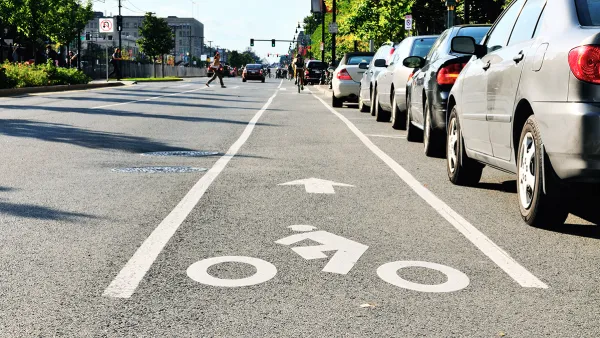
Ford Introduces Dooring Prevention Feature
The company’s 2024 Mustang models will include an Exit Warning to prevent drivers from hitting cyclists when opening their doors.
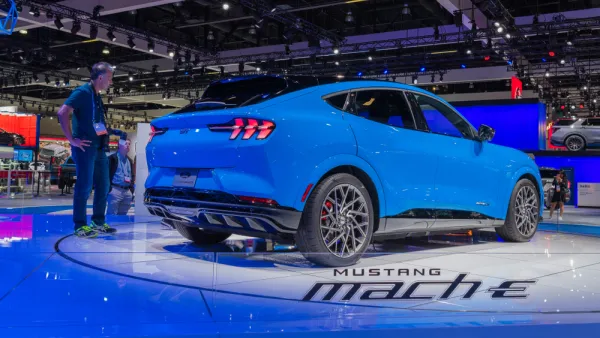
Ford Wants to Be First in the Affordable Electric Vehicle Market
The latest wave of popular electric vehicles, think Teslas and GMC Hummer EVs, are well outside of the price range of normal, thrifty Americans. Ford wants to change that.

Planetizen Federal Action Tracker
A weekly monitor of how Trump’s orders and actions are impacting planners and planning in America.

‘Going backwards:’ Baltimore mayor, students rally against state's transit funding plan
Maryland's proposed six-year plan provides no funding for Baltimore’s BMORE bus program and reduces its road maintenance funding.

Detroit to transform waterfront with $2.2 billion investment
Developers will convert about 18 acres of unused parking lot space into civic spaces.

$2 trillion in economic growth may hide in ‘micropolitan communities’
Small cities hold 39% of America’s population, but receive only 10% of U.S. venture capital investment.

'I can't live in this:' Mississippi town besieged by power plant noise
A plant powering Elon Musk’s xAI data centers is subjecting Southaven, Mississippi residents to ceaseless noise.

Battered from federal attacks, Louisiana's offshore wind industry refuses to give up
State Representative Joe Orgeron expressed hope that the state could revitalize its wind industry once President Trump leaves office.

FREE Course: Walkable City 1: Why Walkability?
After describing his path towards focusing on walkability as the essence of good planning, Jeff Speck marches through his five principal reasons for making more walkable places.
Reinventing Malls: Planning Alchemy—Turning Gray Fields Into Gold
The course focuses on the opportunities and imperatives that shape reinvention of mall sites.

One Hundred Miles
County of Mendocino
planning NEXT
The Architects Foundation
University of Cincinnati Online
Montrose County
Northern Illinois Transit Authority (NITA)
The Pocatello Development Authority