In a cruel twist, a historic house associated with Chinese architects who championed the notion that 'a great nation should hold dear its historic patrimony', and deemed by authorities an 'immovable cultural relic,' was recently demolished.


In a city that seemed largely immune to the rapid rate at which entire historic neighborhoods have been raised to make room for Beijing's building frenzy, the recent demolition of a building that in the 1930s housed two of China's most fabled architectural historians struck a nerve far outside preservationist circles. The house, which was once home to Ivy League-educated architects Liang Sicheng and Lin Huiyin, was located in the Dongcheng district neighborhood of Beijing.
According to reporter Andrew Jacobs, "In a flurry of articles and editorials last week, the national news media denounced the demolition as a wanton violation of the country's laws and an affront to Chinese history."
"Even if distraught by the loss of a house he had tried so hard to save, He Shuzhong, one of the city's best-known preservation advocates, said he had found some solace in the unusually vociferous public uproar. The outrage, he said, was tied not only to the realization that Beijing had lost too much of its past, but also to a sense that the city's frenetic pursuit of modernization and material excess had left many citizens feeling adrift."
Read the full story: In Beijing’s Building Frenzy, Even an ‘Immovable Cultural Relic’ Is Not Safe

Beijing Disappearing
Wrecking crews continue to clear the old hutongs of Beijing, replacing them with modern streets and skyscrapers. Meanwhile, a handful of scavengers work to save pieces of history from the wreckage.
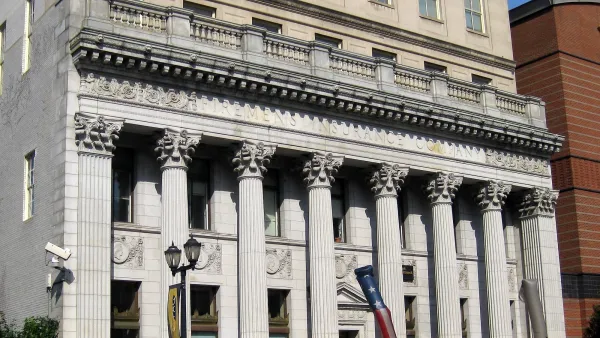
Historic Newark building to become affordable housing
The century-old building will be converted into nearly 200 homes with ground-floor retail.

A call for people-centered historic preservation
'Managing the Magic of Old Places' offers a new vision for preservation that maintains its relevance while prioritizing the lived experience of residents of historic places.

Planetizen Federal Action Tracker
A weekly monitor of how Trump’s orders and actions are impacting planners and planning in America.

Amtrak, CN end decades-long dispute with eight-year agreement
The new operating agreement establishes an updated framework for the companies to work together, including processes to resolve disputes.

Judges permit Denver to divert 77,000 acre feet from the Colorado River for reservoir expansion
Overuse and climate change have caused the Colorado River’s water levels to plummet.

NYC DOT wants faster, more permanent street upgrades
The city is examining ways to build more concrete infrastructure without getting entangled in 'decades-long' projects.

'Something we’ve never seen before:' rising utility rates could strain city finances nationwide
Data centers, climate change and other factors have caused utility rates in the United States to increase by 38% since 2020.

Trump to overrule local leaders, lease millions of acres of America’s Pacific Island territories’ seafloors to mining companies
International law says that the Indigenous people of America’s territories have a right to prior and informed consent regarding projects that impact their countries.

FREE Course: Walkable City 1: Why Walkability?
After describing his path towards focusing on walkability as the essence of good planning, Jeff Speck marches through his five principal reasons for making more walkable places.
Reinventing Malls: Planning Alchemy—Turning Gray Fields Into Gold
The course focuses on the opportunities and imperatives that shape reinvention of mall sites.

Harvard University Graduate School of Design
KFH Group Inc.
Greater Baltimore Committee
The Architects Foundation
University of Cincinnati Online
The Pocatello Development Authority
The Urban Renewal Agency of the City of Pocatello