Branden Klayko reports on the pioneering project planned by innovative Philadelphia design-build developers Onion Flats.


Planned for a site on the banks of the Schuylkill River, The Ridge is intended to become the nation's largest Passive House. Scheduled to be completed in 2014, the building will be prefabricated in a facility just outside Philadelphia.
Sustainable elements include power generated by a 200-kilowatt solar array and a completely permeable, green-roof covering the site.
The technical aspects of solving the net-zero energy puzzle are not the only challenges for Onion Flats. "What's going to be important is to demonstrate that it's easier to meet Passive House standards on large-scale buildings than small buildings," [Timothy] McDonald, [Principal] said. "We want to show that it's not only possible but also much easier to take on larger buildings without losing quality design."
Read the full story: Passive Progressive

A Giant Leap Forward for Low-Income Housing in Philadelphia
Inga Saffron reviews a trio of environmentally friendly rowhouses built for low-income families in Philadelphia's Logan neighborhood, which she proclaims are "superior to anything Philadelphia has done in half a century."

Philadelphia lawmakers fight to save 'Chinatown Stitch' from Trump cuts
The freeway cap project, approved and funded under the Biden administration, is now in jeopardy after the federal government rescinded all but $8 million in funding.
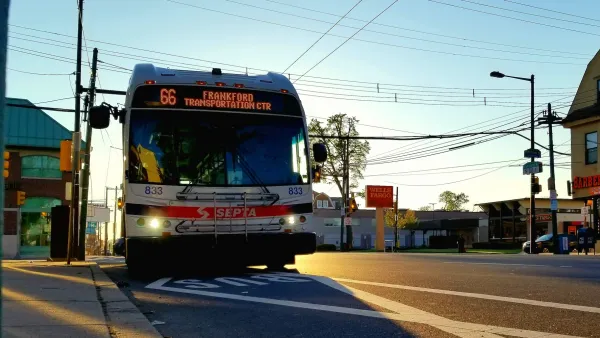
SEPTA's bus-mounted lane enforcement cameras cut travel times by up to 6%
The AI-assisted cameras have issued nearly 200,000 citations to drivers blocking bus lanes.

Planetizen Federal Action Tracker
A weekly monitor of how Trump’s orders and actions are impacting planners and planning in America.

Amtrak, CN end decades-long dispute with eight-year agreement
The new operating agreement establishes an updated framework for the companies to work together, including processes to resolve disputes.

Judges permit Denver to divert 77,000 acre feet from the Colorado River for reservoir expansion
Overuse and climate change have caused the Colorado River’s water levels to plummet.

Atlanta City Council unanimously backs $3.5 billion Beltline light rail project
The resolution was drafted after Atlanta Mayor Andre Dickens pulled support for the Atlanta Streetcar extension last year.

SEPTA to bring nearby frequent transit to over 1 million new riders as part of decade-long plan
The agency's Accelerate plan will also bring frequent transit to twice the amount of jobs that are currently located near it.

NYC plants over 18,000 trees, the most new foliage in a decade
Many of the trees were planted in communities vulnerable to extreme heat.

FREE Course: Walkable City 1: Why Walkability?
After describing his path towards focusing on walkability as the essence of good planning, Jeff Speck marches through his five principal reasons for making more walkable places.
Reinventing Malls: Planning Alchemy—Turning Gray Fields Into Gold
The course focuses on the opportunities and imperatives that shape reinvention of mall sites.

City of Thousand Oaks
City of Wisconsin Rapids
Harvard University Graduate School of Design
The Architects Foundation
University of Cincinnati Online
The Pocatello Development Authority
The Urban Renewal Agency of the City of Pocatello