Planners have debated for decades that surveillance cameras don't deter crime, more "eyes on the street" do. A recent study shows that the cameras are worth their expense, in some cases.


Results were best in Baltimore and Chicago, but not as much in Washington, D.C.
From the Urban Institute press release, authors of the study:
"Between 2007 and 2010, researchers from the Urban Institute's Justice Policy Center studied public surveillance systems in Baltimore, Chicago, and Washington, D.C., to measure the extent of their use, their effects on crime, their other benefits, and their costs.
While results varied by area, surveillance systems in Baltimore and Chicago produced more than enough benefits to justify their costs. No cost-benefit analysis was conducted in Washington, D.C., because the cameras didn't show a statistically significant impact on crime there.
Much of the cameras' success or failure depended on how they were set up and monitored, and how each city balanced privacy with security, said Nancy La Vigne, the study's lead researcher and the director of the Institute's Justice Policy Center.
"Overall, the most effective surveillance systems are those that are monitored by trained staff and have enough cameras to detect crimes in progress and investigate them after the fact," La Vigne observed."
Read the full story: Surveillance Cameras Cost-Effective Tools for Cutting Crime, 3-Year Study Concludes

Korea Prevents Crime Through Environmental Design
CPTED -- crime prevention through environmental design -- is catching on in Korea as a way to improve security.

Making Healthy Places
The editors of the book "Making Healthy Places," recently published in a second edition by Island Press, discuss the intersections of public health and planning, including key concepts such as green gentrification, health impact assessments, and AI.

Which U.S. Cities Have the Most Surveillance?
Atlanta has more surveillance residents per resident than any other U.S. city.

Planetizen Federal Action Tracker
A weekly monitor of how Trump’s orders and actions are impacting planners and planning in America.

‘Going backwards:’ Baltimore mayor, students rally against state's transit funding plan
Maryland's proposed six-year plan provides no funding for Baltimore’s BMORE bus program and reduces its road maintenance funding.
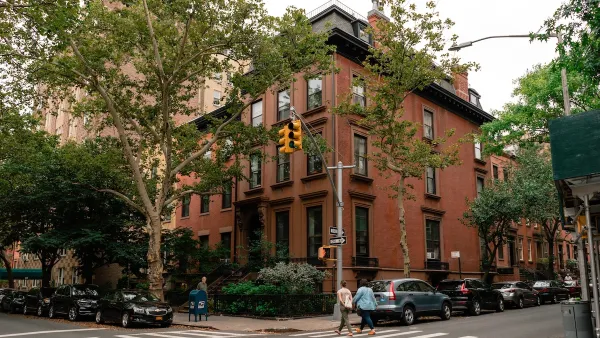
Mamdani sent nearly 6,000 pied-à-terre tax warnings to homes that didn’t qualify
A judge has ordered the administration to cancel thousands of pied-à-terre tax notices after it sent 35% of them erroneously.

Alaska takes public comment on new long-term plan for roads, bridges and more
Alaska's draft Statewide Transportation Improvement Program includes over $1 billion for the Alaska Marine Highway System.

A Colorado neighborhood is the testing ground for the future of home energy
A start up may have found a way to quickly bring geothermal energy to new communities.

Mamdani sent nearly 6,000 pied-à-terre tax warnings to homes that didn’t qualify
A judge has ordered the administration to cancel thousands of pied-à-terre tax notices after it sent 35% of them erroneously.

FREE Course: Walkable City 1: Why Walkability?
After describing his path towards focusing on walkability as the essence of good planning, Jeff Speck marches through his five principal reasons for making more walkable places.
Reinventing Malls: Planning Alchemy—Turning Gray Fields Into Gold
The course focuses on the opportunities and imperatives that shape reinvention of mall sites.

City of Thousand Oaks
City of Wisconsin Rapids
Harvard University Graduate School of Design
The Architects Foundation
University of Cincinnati Online
Northern Illinois Transit Authority (NITA)
The Pocatello Development Authority
The Urban Renewal Agency of the City of Pocatello