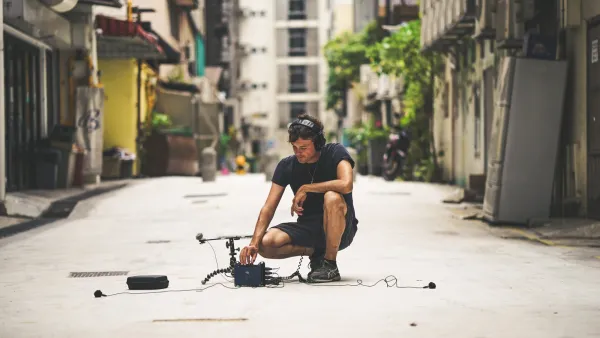
Adam E. Anderson says that there is a growing need for "a hybrid landscape architect/sound artist" to sculpt the sonic environment in public spaces.


Sound (or music, the composition of sound) has been used in built environments to try to baffle or control disruptive sounds, but Anderson argues for a greater role for sound design as a positive and proactive force in urban design:
"Our cities are rapidly growing and with it so does the production of noise pollution. Experts are greatly concerned about the possibility of universal deafness as the ultimate consequence as our cities produce untethered sound.
There is prominent research done, and being done in the recording of sonic environments that landscape architects can begin to pull from, in both built and non-built environments.
What if our landscapes could speak to us? How would our environmental relationships and connections change if our impacts received a verbal response?"
Read the full story: Sonic Spatialization: Constructing and Deconstructing Our Sonic Environments

The Sounds of Cities: Three Aural Vignettes
Monocle's The Urbanist podcast explores urban acoustic ecology to unveil the sonic signature of the coronavirus pandemic, the Greek island of Corfu, and Vienna streetscapes.
Cities Don't Have to Damage Hearing
Henry Grabar writes of the movement to design better sounds for urban environments.
Listening for Landslides
Researchers have developed a new technology to sense the acoustic conditions that indicate oncoming landslides.

Planetizen Federal Action Tracker
A weekly monitor of how Trump’s orders and actions are impacting planners and planning in America.

‘Going backwards:’ Baltimore mayor, students rally against state's transit funding plan
Maryland's proposed six-year plan provides no funding for Baltimore’s BMORE bus program and reduces its road maintenance funding.

Detroit to transform waterfront with $2.2 billion investment
Developers will convert about 18 acres of unused parking lot space into civic spaces.

LA to transform part of water treatment facility into new park
By rebuilding some of the Los Angeles-Glendale Water Reclamation Plant’s infrastructure, the city will free up 18,000 square feet to create a new green space for the public.

San Antonio approves $1.1 billion transit agenda
The agency has also begun construction of its Via Rapid Green line, which will service passengers from the San Antonio International Airport.

Guerilla urbanists’ DIY benches joined by sanctioned seats in Chicago
The group behind the original homemade benches said they will continue installing them across bench-less bus stops in Chicago.

FREE Course: Walkable City 1: Why Walkability?
After describing his path towards focusing on walkability as the essence of good planning, Jeff Speck marches through his five principal reasons for making more walkable places.
Reinventing Malls: Planning Alchemy—Turning Gray Fields Into Gold
The course focuses on the opportunities and imperatives that shape reinvention of mall sites.

One Hundred Miles
County of Mendocino
planning NEXT
The Architects Foundation
University of Cincinnati Online
Montrose County
Northern Illinois Transit Authority (NITA)
The Pocatello Development Authority