The Town & Country Planning Association of Britain recently released a report calling for more "garden cities" a la Ebenezer Howard. Famed British architect Richard Rogers thinks that's crazy.


In an op-ed from last week, chief executive of the TCPA, wrote:
"The radical nature of the Garden City Movement ideals remain of critical relevance to the 21st century, providing a foundation for high quality, attractive and inclusive places, creating new jobs and truly sustainable lifestyles."
Rogers, quoted in Building Design Magazine, isn't buying it:
"Garden cities were a fantastic idea 150 years ago but it's time that the TCPA woke up to today and to today's crisis," he says.
Read the full story: Rogers rejects call for more garden cities
England's First Planned Community - More than a Century Onwards
An inspiration for Ebenezer Howard and the first urban planning conference in Britain or America, Amanda Kolson Hurley looks at how Bournville has evolved.

The Evolution of Green Urbanism
Today’s "Eco" or "Green" Urbanism movement has ancient, cross-cultural roots. This history is worth contemplating for lessons relevant to sustainable planning and design.
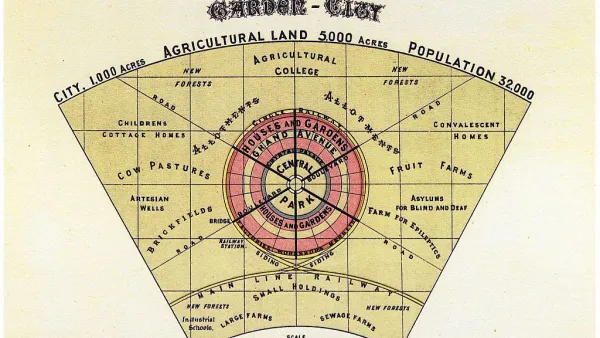
Are Garden Cities Sustainable?
The Garden City concept has a long and honorable pedigree within urban planning. Analysis of Sterling Ranch, a master-planned community outside of Denver, Colorado highlights some important issues around social and environmental sustainability.

Planetizen Federal Action Tracker
A weekly monitor of how Trump’s orders and actions are impacting planners and planning in America.

Eastern Nebraska is running out of electricity
Data centers and electrification are straining eastern Nebraska’s grid, throttling economic development.

Study reveals best places in the U.S. for cycling, walking
New research from Streetlight Data examines bicycle and pedestrian miles per capita in the 100 largest U.S. cities by population.

Next-generation nuclear reactors are coming to Texas
The reactors will not require towering containment structures thanks to new safety features.

California distributes $1.3 billion to prevent transit service cuts, bolster projects
Twenty-eight projects across California received a portion of the funding.

Pennsylvania Democrats have 15 affordability, clean energy bills for flipped state Senate
Bills in consideration include a bill supporting geothermal energy and a bill supporting solar on warehouses.

FREE Course: Walkable City 1: Why Walkability?
After describing his path towards focusing on walkability as the essence of good planning, Jeff Speck marches through his five principal reasons for making more walkable places.
Reinventing Malls: Planning Alchemy—Turning Gray Fields Into Gold
The course focuses on the opportunities and imperatives that shape reinvention of mall sites.

City of Charlotte
City of Rosemead
Rutgers University, Edward J. Bloustein School of Planning and Public Policy
University of Michigan School for Environment and Sustainability (SEAS)
Hunter College, City University of New York (CUNY)
The Architects Foundation
City of Cambridge
The Pocatello Development Authority
The Urban Renewal Agency of the City of Pocatello