A Michigan Senate committee voted against a bill to create a public-private partnership to oversee land acquisition, construction and management of the planned Detroit River International Crossing, putting the project on hold until at least 2011.


Supporters, chief among them outgoing Governor Jennifer Granholm, hoped the project would be an economic boon for the state by facilitating the exchange of goods between the U.S. and Canada, says Jeff Bennett. Currently, $1.2 billion of goods cross Michigan's border points each day, a significant portion consisting of auto parts and completed vehicles.
Approval of the project was ultimately complicated by the proposed public-private ownership structure and the state's braoder economic situation, Bennett writes:
"The issue became embroiled in politics as supporters and opponents argued over whether a private individual, specifically billionaire businessman Manuel Moroun, should have control of an international crossing. Supporters...said a new bridge would also create jobs and millions of dollars in annual toll revenue for Michigan. Opponents questioned why an economically depressed state would want to build another bridge."
Read the full story: Detroit-Windsor Bridge Won't Proceed This Year

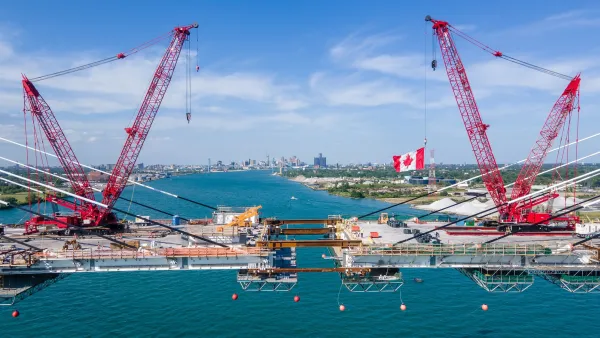
Trump’s Canada Bridge Threat Could Kill a Rare International Bikeway
The President says he won’t allow the new Gordie Howe International Bridge to open “until the United States is fully compensated for everything we have given” Canada.
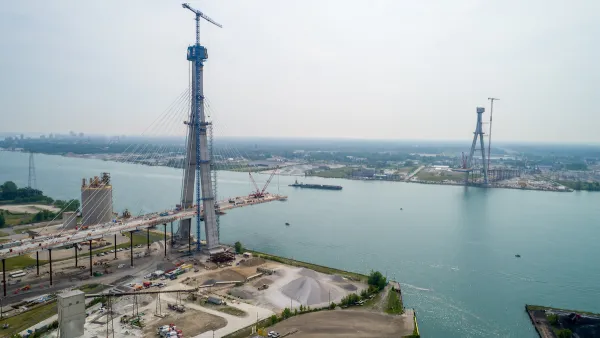
New International Bridge Rising Over the Detroit River
The Gordie Howe International Bridge is under construction, towering over the Detroit River at a height of 772 feet on the U.S. side of the river.
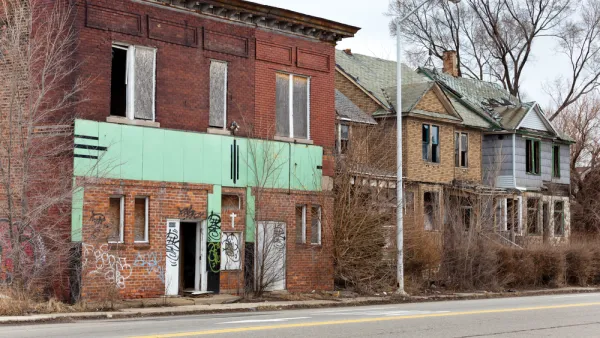
Why Canadian Cities Avoided Detroit's Fate
Simply put, this scholar says, it comes down to race. With far fewer non-white urban residents, Canadian cities didn't fall prey to the redlining, white flight, and incarceration problems that so heavily impacted cities like Detroit.

Planetizen Federal Action Tracker
A weekly monitor of how Trump’s orders and actions are impacting planners and planning in America.

California plans to bury El Niño’s downpour
If the state plays its cards right, it may be able to store a billion acre-feet of El Niño’s water in aquifers.

Chicago breaks ground on $3 billion megadevelopment
The new neighborhood, titled Foundry Park, will one day host 3,700 residences.

This road in NYC is infamously dangerous — and Mamdani can't fix it
New York City's Ocean Parkway is known for reckless driving, but the power to implement safety measures lies with the state rather than the city.

One of Denver’s busiest corridors to gain BRT
The project will span 18 miles and contain 74 bus rapid transit stations.

275,000 bus trips are at stake on Seattle's ballot
If passed, the Seattle Transit Measure would trigger a 0.3% sales tax and raise an average of $138 million per year to maintain and expand Seattle’s bus services.

FREE Course: Walkable City 1: Why Walkability?
After describing his path towards focusing on walkability as the essence of good planning, Jeff Speck marches through his five principal reasons for making more walkable places.
Reinventing Malls: Planning Alchemy—Turning Gray Fields Into Gold
The course focuses on the opportunities and imperatives that shape reinvention of mall sites.

City of Rosemead
Rutgers University, Edward J. Bloustein School of Planning and Public Policy
One Hundred Miles
Hunter College, City University of New York (CUNY)
The Architects Foundation
University of Cincinnati Online
City of Cambridge
Montrose County
The Pocatello Development Authority