Five finalists have been announced in a design competition to rethink the park near St. Louis' iconic Gateway Arch. Fast Co. Design takes a look at the contenders.


The Gateway Arch has been limited by physical barriers that have prevented it from being a successful urban amenity, according to organizers of the design competition.
"[O]n either sides, massive physical barriers that completely sever this prized public space from the rest of the city: To the west, I-70, a rumbling interstate offering limited and unsightly pedestrian access, and to the east, the Mississippi River, prone to flooding, and dividing downtown from blighted East St. Louis. In other words, the Arch, which was mean to symbolize unity and free passage, prevents both from taking place, while draining the downtown area of liveliness."
This post includes sketches, renderings and videos of proposed redesigns.
Read the full story: Can St. Louis's Arch Become a True Gateway, Rather Than a Black Hole? [Updated with VIDEO]

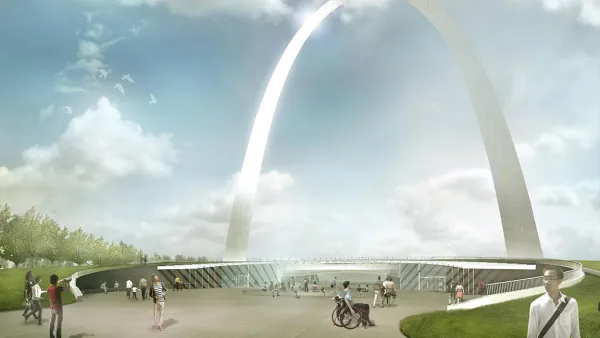
Renovated Park Space Open to the Public Beneath the St. Louis Gateway Arch
Little by little, the grounds, facilities, and amenities of the St. Louis Gateway Arch are reopening to the public. Expect work on this $380 million project to conclude later this year.
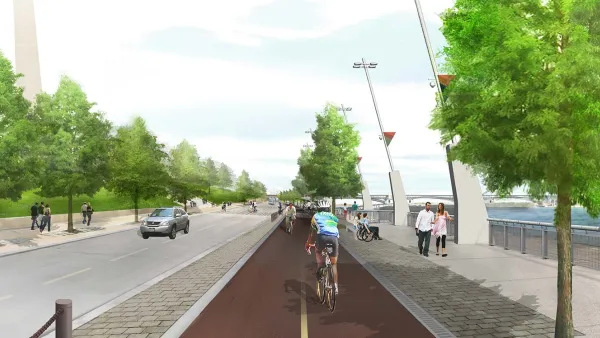
Open Today: Renovated Riverfront Path Below the Gateway Arch
Part of a $380 million renovation project on the Gateway Arch grounds, a new riverfront path is built two feet higher above the banks of the mighty Mississippi River.
A Park to Fit the Arch
New designs for the surrounding park offer a chance at a brighter future for the Eero Saarinen-designed Gateway Arch in St. Louis.

Planetizen Federal Action Tracker
A weekly monitor of how Trump’s orders and actions are impacting planners and planning in America.

Amtrak, CN end decades-long dispute with eight-year agreement
The new operating agreement establishes an updated framework for the companies to work together, including processes to resolve disputes.

Judges permit Denver to divert 77,000 acre feet from the Colorado River for reservoir expansion
Overuse and climate change have caused the Colorado River’s water levels to plummet.

NYC DOT wants faster, more permanent street upgrades
The city is examining ways to build more concrete infrastructure without getting entangled in 'decades-long' projects.

'Something we’ve never seen before:' rising utility rates could strain city finances nationwide
Data centers, climate change and other factors have caused utility rates in the United States to increase by 38% since 2020.

Trump to overrule local leaders, lease millions of acres of America’s Pacific Island territories’ seafloors to mining companies
International law says that the Indigenous people of America’s territories have a right to prior and informed consent regarding projects that impact their countries.

FREE Course: Walkable City 1: Why Walkability?
After describing his path towards focusing on walkability as the essence of good planning, Jeff Speck marches through his five principal reasons for making more walkable places.
Reinventing Malls: Planning Alchemy—Turning Gray Fields Into Gold
The course focuses on the opportunities and imperatives that shape reinvention of mall sites.

Harvard University Graduate School of Design
KFH Group Inc.
Greater Baltimore Committee
The Architects Foundation
University of Cincinnati Online
The Pocatello Development Authority
The Urban Renewal Agency of the City of Pocatello