This piece from Grist looks at Prairie Crossing, a planned community in Illinois that integrates agriculture into its village-like setting.


"Prairie Crossing was developed to conserve prairie, and it's not just a marketing slogan. Vicky and George Ranney, the developers, set aside 60 percent of the 677 acres in a land conservation easement; another 3,200 acres are protected within the Liberty Prairie Reserve, a conglomeration of public and private land connected to the community.
From the beginning, the Ranneys believed in agriculture as an essential component, so they established 100 acres strictly for growing food. 'This land was always farmland,' says Vicky. 'So we considered what people would like to live next to. We realized that sooner or later, there'd be a conflict between big agriculture and residential developments. People wouldn't find it comfortable to live next to pesticides and chemicals.'"
Prairie Crossing is a model of "agricultural urbanism", an idea being pushed by architect and planner Andres Duany.
Read the full story: Prairie Crossing in Illinois: The ‘urban’ farm of the future?

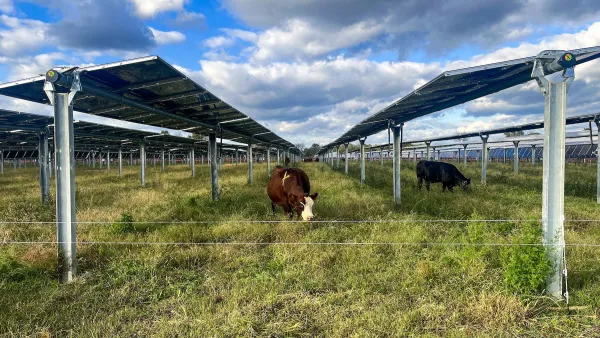
Cows at Tennessee's 'Silicon Ranch' graze under solar panels
The project aims to prove that agriculture and solar energy production can work in tandem.
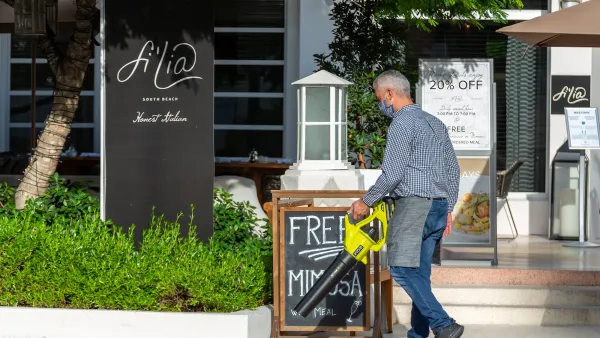
Florida Farm Bill Blocks Local Bans on Gas-Powered Tools
The law also paves the way for agricultural uses on land previously designated for conservation.
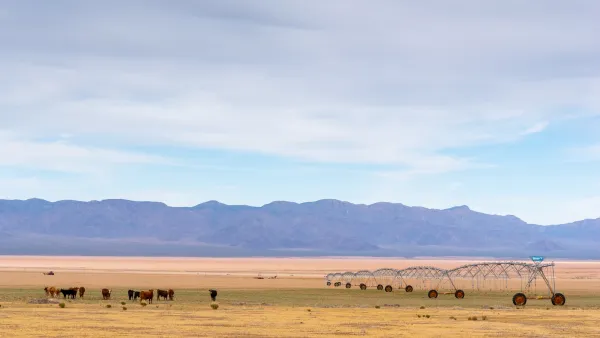
Arizona Tightens Groundwater Restrictions to Rein in Agribusinesses
The state is creating an ‘active management area’ in the western part of the state, where agribusinesses including a Saudi alfalfa exporter have practically free rein over water supplies.

Planetizen Federal Action Tracker
A weekly monitor of how Trump’s orders and actions are impacting planners and planning in America.

Northwest rail fans eager for Sept. 30 debut of Amtrak’s Airo fleet
Get ready for that new train smell and more seats. But they won’t go faster or run more frequently on the Cascades route in Washington and Oregon.

Trump is considering data centers on 6 states' public land — some state officials say they had no idea
If the administration approves the proposed projects, data center and data center-related developments will cover 17,600 acres of public land.

After decades of planning, Sacramento gains new light rail station
Trains will arrive every 15 minutes during peak hours and every 30 minutes during non-peak hours.

Massive tunnel-boring machine breaks ground on Gateway Project
The Trump administration revoked funding for the project in October 2025, and then restored it earlier this year.

Airo trainsets begin service on Amtrak Cascades route
The trains feature panoramic windows, complementary wifi and over 300 seats per train set.

FREE Course: Walkable City 1: Why Walkability?
After describing his path towards focusing on walkability as the essence of good planning, Jeff Speck marches through his five principal reasons for making more walkable places.
Reinventing Malls: Planning Alchemy—Turning Gray Fields Into Gold
The course focuses on the opportunities and imperatives that shape reinvention of mall sites.

City of Thousand Oaks
City of Wisconsin Rapids
Harvard University Graduate School of Design
The Architects Foundation
University of Cincinnati Online
Northern Illinois Transit Authority (NITA)
The Pocatello Development Authority
The Urban Renewal Agency of the City of Pocatello