After unification, many East German towns began losing jobs and population. In 2003, the government formed a group to study how these cities could best recover. The results are in.


The town of Dessau-Rosslau is one of the more extreme cases; it was formerly two separate towns, but population loss became so bad they were forced to merge to keep city services going.
One of the IBA [International Building Exhibition, the group studying the problem]'s more radical ideas is that of "city islands" in Dessau-Rosslau. The planners have "kind of disassembled the city into pixels and put it back together again using a cut-and-paste method," as Brückner explains. According to the concept, Dessau-Rosslau would abandon the model of a more compact central city, leaving only islands of houses. "Buildings will be cut out and in the empty spaces we will insert countryside," Brückner explains.
It's an idea that originates from a poll of the city's inhabitants."
Other cities are filling the gaps left by demolished buildings with giant art pieces.
Read the full story: Eastern German Project Provides Hope for Shrinking Cities

Detroit and Michigan on the Upswing
It's been 66 years since the Motor City last grew its population. Census data released last month revealed an increase of nearly 2,000 people last year, nearly half the state's population growth.
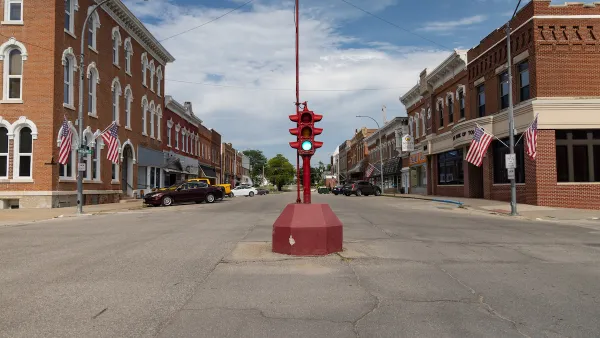
Iowa Towns Embrace a ‘Shrink Smart’ Approach
Population loss doesn’t have to be a harbinger of doom. Some rural communities are taking small but impactful steps to improve quality of life for their remaining residents.

'Supporting Shrinkage': Lessons for U.S. Cities
An excerpt from "Supporting Shrinkage: Better Planning and Decision-Making for Legacy Cities," written by Michael P. Johnson, Justin B. Hollander, Eliza W. Kinsey, and George R. Chichirau and published by SUNY Press.

Planetizen Federal Action Tracker
A weekly monitor of how Trump’s orders and actions are impacting planners and planning in America.

California plans to bury El Niño’s downpour
If the state plays its cards right, it may be able to store a billion acre-feet of El Niño’s water in aquifers.

Desperate measures: Advocates weigh draining Lake Powell to fill Colorado River
Draining the reservoir could reduce evaporation losses by a couple hundred thousand acre-feet.

Los Angeles just elected an urban planner as its mayor
Transportation analysts are optimistic that Raman will be more aggressive in addressing transit issues than Bass.

Mamdani’s pied-à-terre tax survives legal challenge
A panel of judges found that the plaintiffs failed to demonstrate injury as a result of New York City's implementation of the tax.

Eastern Nebraska is running out of electricity
Data centers and electrification are straining eastern Nebraska’s grid, throttling economic development.

FREE Course: Walkable City 1: Why Walkability?
After describing his path towards focusing on walkability as the essence of good planning, Jeff Speck marches through his five principal reasons for making more walkable places.
Reinventing Malls: Planning Alchemy—Turning Gray Fields Into Gold
The course focuses on the opportunities and imperatives that shape reinvention of mall sites.

City of Rosemead
Rutgers University, Edward J. Bloustein School of Planning and Public Policy
One Hundred Miles
University of Michigan School for Environment and Sustainability (SEAS)
Hunter College, City University of New York (CUNY)
The Architects Foundation
City of Cambridge
Montrose County
The Pocatello Development Authority