Many of the deaths of the past few rounds of storms and earthquakes are due to inadequate drainage systems, poor building regulation enforcement, and lack of emergency planning.


"Fauzi Bahar, Padang's mayor, said the city began enforcing stiffer building regulations in 2002 after a series of earthquakes, but the rules are often flouted by construction companies trying to save money on building materials. 'They are only thinking about costs, not the safety of the people,' he said. 'Most of the buildings that collapsed were those that didn't follow updated building codes,' he said. The local government lacks resources to check all buildings, he said, with only four staff members to check building licenses. The largest public hospital in Padang was among the area's most heavily damaged buildings, forcing doctors to treat patients in unsanitary conditions in makeshift tents."
Read the full story: Disaster Plans Seen Lacking

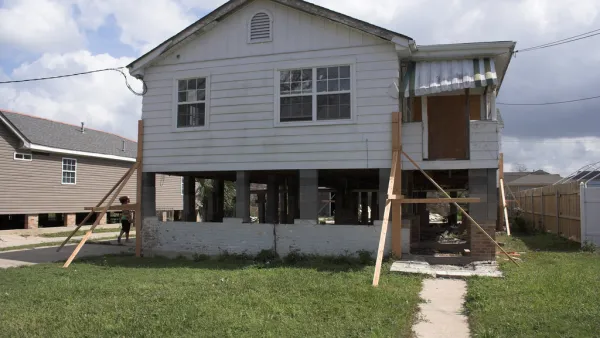
Adapting Building Codes to Natural Disasters Saves Billions
New research shows that modern building codes have prevented around $27 billion in damage from natural disasters between 2000 and 2016, yet many cities still operate under decades-old regulations.
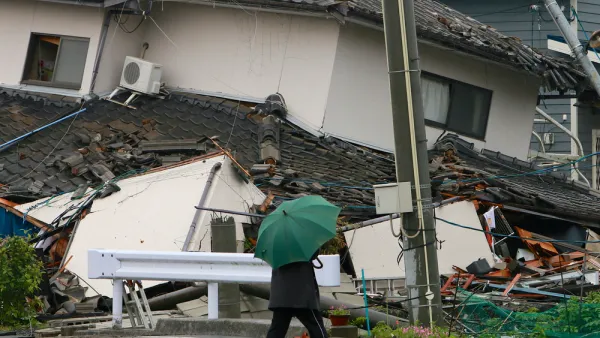
When the Earth Turns to Liquid
A 7.5 magnitude earthquake struck the Indonesian island of Sulawesi on Sept. 25, followed by a massive tsunami. Soil liquefaction caused by the tremor resulted in 1,700 homes being "swallowed" as the soil shifted. Deaths exceeded 1,400 on Oct. 3.
NYC Studies How to Build Resiliency
In the wake of Superstorm Sandy, a new task force convened by New York's Mayor Michael R. Bloomberg and City Council speaker Christine C. Quinn will look into potential changes to the city's building code, with recommendations due next summer.

Planetizen Federal Action Tracker
A weekly monitor of how Trump’s orders and actions are impacting planners and planning in America.

Amtrak, CN end decades-long dispute with eight-year agreement
The new operating agreement establishes an updated framework for the companies to work together, including processes to resolve disputes.

Colorado’s Largest Data Center Could Rise Next to Homes — Without a Public Hearing
The proposed campus would consume 11 times the power of Denver International Airport; as it has across the country, opposition mounts.

Road safety in Charlotte, NC, a 'public health crisis'
Twelve serious or fatal crashes happen in the region every week. Since 2021, over 900 people have been killed in accidents.

Federal judge strikes down DOE orders to keep Michigan power plant open past retirement date
The decision is one of the first successful legal challenges to President Trump’s “national energy emergency” ruling, which instructs federal agencies to use emergency powers to increase fossil fuel production.

'This is going to be painful:’ Virginia stares down $1.7 billion funding gap for highway maintenance
The state may address the deficit by shifting $290 million from its construction budget to maintenance projects.

FREE Course: Walkable City 1: Why Walkability?
After describing his path towards focusing on walkability as the essence of good planning, Jeff Speck marches through his five principal reasons for making more walkable places.
Reinventing Malls: Planning Alchemy—Turning Gray Fields Into Gold
The course focuses on the opportunities and imperatives that shape reinvention of mall sites.

KFH Group Inc.
Greater Baltimore Committee
Eagle County Government
The Architects Foundation
University of Cincinnati Online
The Pocatello Development Authority
The Urban Renewal Agency of the City of Pocatello