According to the Washington Post, 62% of Americans think Sonia Sotomayor should be confirmed for the U.S Supreme Court because she is “about right” ideologically. The question is, how good will she be for municipal attorneys?



According to the Washington Post, 62% of Americans think Sonia Sotomayor should be confirmed for the U.S Supreme Court because she is "about right" ideologically. The question is, how good will she be for municipal attorneys?
I was privileged to attend Yale Law School when she did. I'm almost eight years older and she graduated a class behind me, but I had been off in Vietnam and elsewhere with the Navy for 7 years. Yale Law School is a small place with only 170 or so in class. Regrettably, however, I didn't get to know her well. When she was nominated, I began to read everything I could about her and to consider the decisions she wrote or joined in to try to get a bead on her.
The short answer is that she can't be pigeon-holed.
Judge Sotomayor has participated in 3,600 (not a typo) decisions, I assume most of which are routine motions and the like. In the 10 years on the Second Circuit, she has authored over 150 decisions.
The case most talked about among property rights and government types alike is Didden v. Port Chester in which she voted with the majority 5-4 in 2006, after Kelo, in a short unsigned opinion to uphold Port Chester, New York's taking of private property to enable a 27-acre urban renewal project.
The pro-property rights advocates were quick to look for a wooden stake to drive through her heart because of this decision. "This is the worst federal court takings decision since Kelo," said Ilya Somin, who teaches property law at George Mason University and was quoted in a New York Times article. "It's very extreme, and it is significant as a window into Judge Sotomayor's attitudes toward private property."
On the other side of the ledger is Brody v. Village of Port Chester. There, she wrote an opinion a year earlier finding that publication in the newspaper of a proposed eminent domain taking failed to meet the requirements of due process.
In Riverkeeper Inc. v. USEPA, she authored an opinion in 2009 that held costs to industry need not be considered in determining how to protect fish from power plant discharges. The decision was described as "anti-business."
The U.S. Supreme Court granted certiorari and reversed in April holding that cost-benefit analysis is not categorically forbidden by the Clean Water Act. Entergy Corp. v. Riverkeeper Inc.
On the other hand, or was that the same hand? – I'm running out of hands here – in Natural Resources Defense Council v. Abraham (2003), her panel ended up on the side of a coalition of states and environmental groups that had sued the federal government for weakening the energy conservation standards for appliances.
In New York v. National Service Industries (2006), Judge Sotomayor wrote a decision for the court in a Superfund case in which the State of New York sued a company to recover the state's costs of cleaning up a hazardous waste site. The court held that the company was not liable for what a remotely-connected firm had done.
Not a property rights, environmental or land use case, but certainly one of municipal law that is getting much press is Ricci v. DeStefano. The case is about white firefighters in New Haven who were not promoted when no black firefighters qualified for advancement. Her three-judge panel of the Second Circuit in an unsigned opinion rejected the race discrimination claim of the white firefighters, including a Hispanic. The court in a per curium opinion declined to rehear the case. The Supreme Court took the case, arguments were held in April, and the decision is pending was released this morning. [UPDATE 06/29/2009: From the New York Times -- Justices Rule for White Firefighters in Bias Case -- The Supreme Court ruled on Monday that white firefighters in New Haven, Conn., were unfairly denied promotions because of their race, reversing a decision that Sonia Sotomayor, a Supreme Court nominee, endorsed as an appeals court judge.]
Here are a couple [1 and 2] of gossipy personal items which might help you fill out your own picture of Judge Sotomayor. She has been married and divorced, never had any children, is generous to her clerks and staff, has little accumulated wealth, and won $8,283 at a casino last year while visiting a casino with her mother.
To sum up Sonia Sotomayor
I believe it is fair to say, based on the totality of her record, that she is a liberal of the non-dogmatic variety, makes narrow decisions sharply focused on the cases before her, is not a judicial activist, will be an active questioner in oral arguments unlike Justice Thomas, respects private property rights, understands the needs of government especially to carry out the common good, and will prove to be more of a centrist.

New London, Four Years After Kelo
The 2005 Supreme Court decision on Kelo v. New London was a landmark in eminent domain law, paving the way for Pfizer to develop there. Four years later, Pfizer is pulling up stakes.
Why Kelo is not a blank check
Last week marked the third anniversary of the Supreme Court’s ruling in Kelo v. New London. The first time I read Kelo, I thought what many Americans probably thought: that any government could seize property for any reason, so long as it compensated prior owners. But after having taught Kelo to law students several times over the past few years, I now realize that Kelo is much more complex. Kelo was a 5-4 decision, and Justice Anthony Kennedy wrote a separate concurrence. Because Justice Kennedy was the “swing vote”, his decision predicts future Court decisionmaking more accurately than the Court’s primary opinion, because a taking which fails to satisfy Kennedy might not be able to get five votes in the Supreme Court.
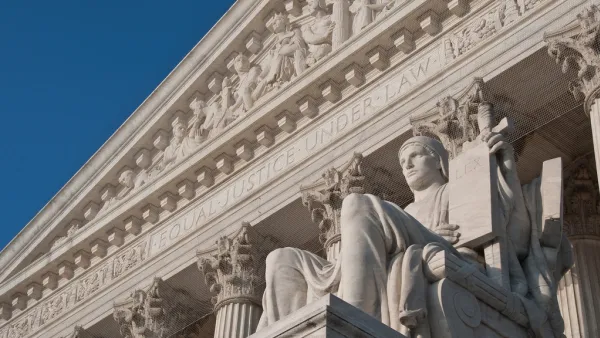
Supreme Court Landlord Appeal Case Could Overturn Tenant Protections
A legal case claiming that COVID-era eviction moratoriums were unconstitutional could spell trouble for tenant protections.

Planetizen Federal Action Tracker
A weekly monitor of how Trump’s orders and actions are impacting planners and planning in America.

Amtrak, CN end decades-long dispute with eight-year agreement
The new operating agreement establishes an updated framework for the companies to work together, including processes to resolve disputes.

Judges permit Denver to divert 77,000 acre feet from the Colorado River for reservoir expansion
Overuse and climate change have caused the Colorado River’s water levels to plummet.

Idaho may see an 18% drop in federal surface transit funding — the largest estimated cut in the US
Transit systems in rural communities are much more reliant on federal funding to provide their services.

How ‘post-disaster gentrification’ alters neighborhoods after natural calamities
After hurricanes, fires or other calamities, the original residents of a community are often replaced by younger, wealthier residents.

Maryland local governments examine if they should have more power to raise property taxes
Maryland’s housing market is out of reach for the majority of moderate-income residents.

FREE Course: Walkable City 1: Why Walkability?
After describing his path towards focusing on walkability as the essence of good planning, Jeff Speck marches through his five principal reasons for making more walkable places.
Reinventing Malls: Planning Alchemy—Turning Gray Fields Into Gold
The course focuses on the opportunities and imperatives that shape reinvention of mall sites.

Harvard University Graduate School of Design
KFH Group Inc.
Greater Baltimore Committee
The Architects Foundation
University of Cincinnati Online
The Pocatello Development Authority
The Urban Renewal Agency of the City of Pocatello

