The 1909 Plan of Chicago is widely credited to Daniel Burnham. But Burnham's right-hand-man, Edward Bennett not only played a big role in writing the plan, he also helped put it into action.


This piece from Chicago Tribune architecture critic Blair Kamin looks at the role of Bennett in drafting the plan, and his long career of project that shaped the city of Chicago. Also discussed are Bennett's frustrations with his lack of credit for some of the city's most notable designs and structures.
"As the architectural historian Joan Draper has documented, Bennett played an essential, albeit low-profile, role in bringing many recommendations of the plan to life. As consulting architect to the Chicago Plan Commission, the group of business and civic leaders charged with carrying out the plan, he and his staff quietly drew up designs that other agencies constructed. A trace of that influence survives on one of the many plaques on Michigan Avenue Bridge, where, if you look closely, you can find the letters, 'E.H. BENNETT, CONSULTING ARCHT.'"
Read the full story: The forgotten man of the Plan of Chicago: co-author Edward Bennett helped realize its recommendations and was a pioneer in the field of city planning

Make No Little Plans, 100 Years Later
As the 100-year anniversary of the writing of the Burnham Plan for Chicago approaches, the city and its suburbs are thinking big about how to improve the city.
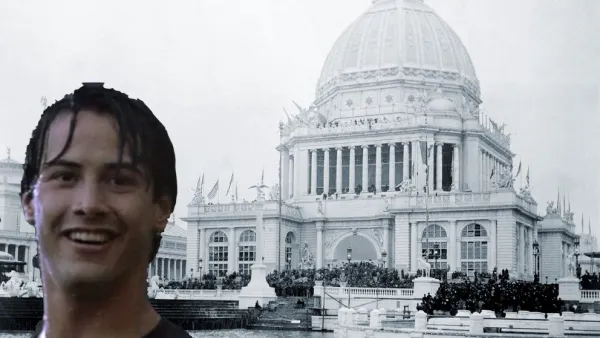
Keanu Reeves, Daniel Burnham Dream No Longer a Reality
Keanu Reeves will no longer portray Daniel Burnham in a film adaptation of The Devil in the White City.
Keanu Reeves Set to Play Daniel Burnham in ‘The Devil in the White City’
Planning is going to get a new level of star power as a limited series adaptation of The Devil in the White City gets ready for television screens in 2024.

Planetizen Federal Action Tracker
A weekly monitor of how Trump’s orders and actions are impacting planners and planning in America.

California plans to bury El Niño’s downpour
If the state plays its cards right, it may be able to store a billion acre-feet of El Niño’s water in aquifers.

Chicago breaks ground on $3 billion megadevelopment
The new neighborhood, titled Foundry Park, will one day host 3,700 residences.

City officials are dumping billions of gallons of sewage into the Chicago River
This year, the Racine Avenue sewage pumping station has poured over 10 billion gallons of sewage into the Chicago River.

Move over, LA: St. Louis gears up for Olympics, invests millions in downtown redevelopment
The Missouri city will host the 2028 Olympic soccer group stage and knockout matches.

Satanic place names
From streams and lakes to valleys and canyons, I mapped more than 1,000 places named after the Devil.

FREE Course: Walkable City 1: Why Walkability?
After describing his path towards focusing on walkability as the essence of good planning, Jeff Speck marches through his five principal reasons for making more walkable places.
Reinventing Malls: Planning Alchemy—Turning Gray Fields Into Gold
The course focuses on the opportunities and imperatives that shape reinvention of mall sites.

City of Rosemead
Rutgers University, Edward J. Bloustein School of Planning and Public Policy
One Hundred Miles
Hunter College, City University of New York (CUNY)
The Architects Foundation
University of Cincinnati Online
City of Cambridge
Montrose County
The Pocatello Development Authority