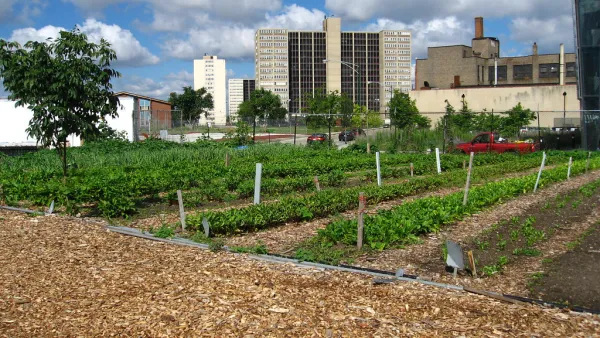
Organic farms are increasingly being included in site plans for new subdivisions. And homebuyers seem to like them.


Since the success of a few developments that integrated farm space back in the early part of the decade, developers are getting on the farm bandwagon. Hundreds of projects are either completed or in development.
"Increasingly, subdivisions, usually master-planned developments at which buyers buy home sites or raw land, have been treating farms as an amenity. 'There are currently at least 200 projects that include agriculture as a key community component,' said Ed McMahon, a senior fellow with the Urban Land Institute."
Read the full story: Organic Farms as Subdivision Amenities

Vertical Farms, Fad or Feast?
Hydroponic indoor farmers hope to charge a premium for plants grown out of season in indoor farms. The notion has generated attention from big investors, but whether or not consumers will follow is an open question.
Guidebook: Lowering Barriers to Urban Farming
Urban agriculture has long been a staple of sustainable urbanism—in theory. Can policy changes help it become much more than that? This guidebook offers tactics and policies that planners can use to promote urban farms.
Exploring Serenbe
Terrain.org's newest "UnSprawl" case study explores the new Serenbe development, a mixed-use community of three hamlets anchored by an organic farm and striving to be an Atlanta-region destination for its restaurants, inn, and more.

Planetizen Federal Action Tracker
A weekly monitor of how Trump’s orders and actions are impacting planners and planning in America.

Eastern Nebraska is running out of electricity
Data centers and electrification are straining eastern Nebraska’s grid, throttling economic development.

Washington state to charge fee to drivers with fuel-efficient cars
Revenue from the fee will go towards supporting the state’s highways.

Instead of building new housing, LA developers are turning mansions into mega-mansions
In the richest areas, the number of houses valued at $30 million with demolition permits has skyrocketed since 2018.

Illinois considers spending $1 billion in taxpayer money on data center
A quantum computing campus and data center are currently under construction in Chicago.

As development costs rise, Boston moves to lessen affordable housing requirements
The Boston Zoning Commission and the City Council still need to approve Boston Mayor Michelle Wu’s proposed changes

FREE Course: Walkable City 1: Why Walkability?
After describing his path towards focusing on walkability as the essence of good planning, Jeff Speck marches through his five principal reasons for making more walkable places.
Reinventing Malls: Planning Alchemy—Turning Gray Fields Into Gold
The course focuses on the opportunities and imperatives that shape reinvention of mall sites.

City of Charlotte
City of Rosemead
Rutgers University, Edward J. Bloustein School of Planning and Public Policy
University of Michigan School for Environment and Sustainability (SEAS)
Hunter College, City University of New York (CUNY)
The Architects Foundation
University District Partnership
City of Cambridge
The Pocatello Development Authority